Yuki Hayashi explains how You Say Run’s drums power My Hero Academia scenes
The drums in "You Say Run" turn a battle cue into a reusable surge of momentum, and Yuki Hayashi’s path explains why it lands so hard.
Why "You Say Run" keeps hitting
"You Say Run" works because it does not rush to its payoff. The quiet opening gives the ear a brief breath before the drums and riff lock in, and that delay is exactly what makes the cue so useful for anime edits, climaxes, and fan memory. Instead of feeling locked to one scene, the track behaves like a launch pad: it can sit under a stare-down, a charge forward, or a final push to victory and still feel earned.
That flexibility is why the theme has become one of the most recognizable battle cues in My Hero Academia. It sits inside the first-season soundtrack as a signature piece, but its life has spread far beyond that original placement. The drum writing, more than anything else, gives the track its repeat value: it creates tension, then releases it with enough forward motion to make almost any scene feel bigger.
The drummer's trick: momentum before payoff
From a drumming perspective, the magic is in how the song manages energy. The intro is restrained, which makes the first percussive lift feel like a door opening rather than a crash landing. Once the drums enter, they do not just keep time; they push the scene, building a sense that something decisive is about to happen.
That is the reason "You Say Run" translates so well across internet culture. Editors know it as a reliable emotional engine because the beat gives structure to a clip without overpowering the visuals. The result is a piece of music that can underline a punch, a resolve speech, or a comeback moment and still feel like it belongs there.
For drummers, that matters because it shows how percussion can carry narrative weight without needing constant complexity. The groove does the storytelling. It marks the threshold between hesitation and action, which is exactly the kind of musical shape that keeps a cue reusable over and over.
Yuki Hayashi's path into composition
Yuki Hayashi was born in Kyoto, Japan, in 1980, and he came to composing from a background that is unusually physical even by drummer standards. He is a former male rhythmic gymnast, and he has said that choosing music for performance helped lead him toward composition. That connection between movement and sound makes a lot of sense in a franchise built on motion, impact, and release.
After graduating, Hayashi learned track-making basics from Hideo Kobayashi. That detail matters because it helps explain why his writing feels built for momentum. He did not arrive at anime scoring as an outside specialist observing action from a distance; he came in with an understanding of timing, movement, and how music can support a body in motion.
How My Hero Academia made the theme part of its identity
Hayashi's involvement with My Hero Academia goes back to the anime's first season in 2016, and "You Say Run" quickly became one of the series' defining battle themes. The track is now closely tied to major climactic moments, especially Izuku Midoriya versus Katsuki Bakugo and All Might versus All For One. Those are not throwaway scenes, and the music had to rise to match their scale.
The My Hero Academia original soundtrack covers the first season with 35 songs, and Hayashi composed and arranged that music. Within that larger body of work, "You Say Run" stands out because it became more than a cue. It became shorthand for the show’s emotional highest points, the kind of theme fans hear and immediately connect to triumph, desperation, and the moment a hero refuses to stop moving.
That association is also why the track travels so well outside the show itself. The drum pattern and the gradual build give it enough shape to survive repeated use, but not so much specificity that it can only belong to one scene. That balance is rare, and it is a big part of why the song keeps resurfacing in clips, edits, and fan conversations.
A theme that still gets reworked
The franchise's 10th anniversary in 2026 showed just how central Hayashi’s score remains to the series identity. Toho marked the occasion with a free-streaming marathon and new anniversary content, which underlines how deeply the anime's music is woven into its legacy. When a series celebrates that way, it is not just honoring nostalgia. It is reaffirming which sounds helped build the brand in the first place.
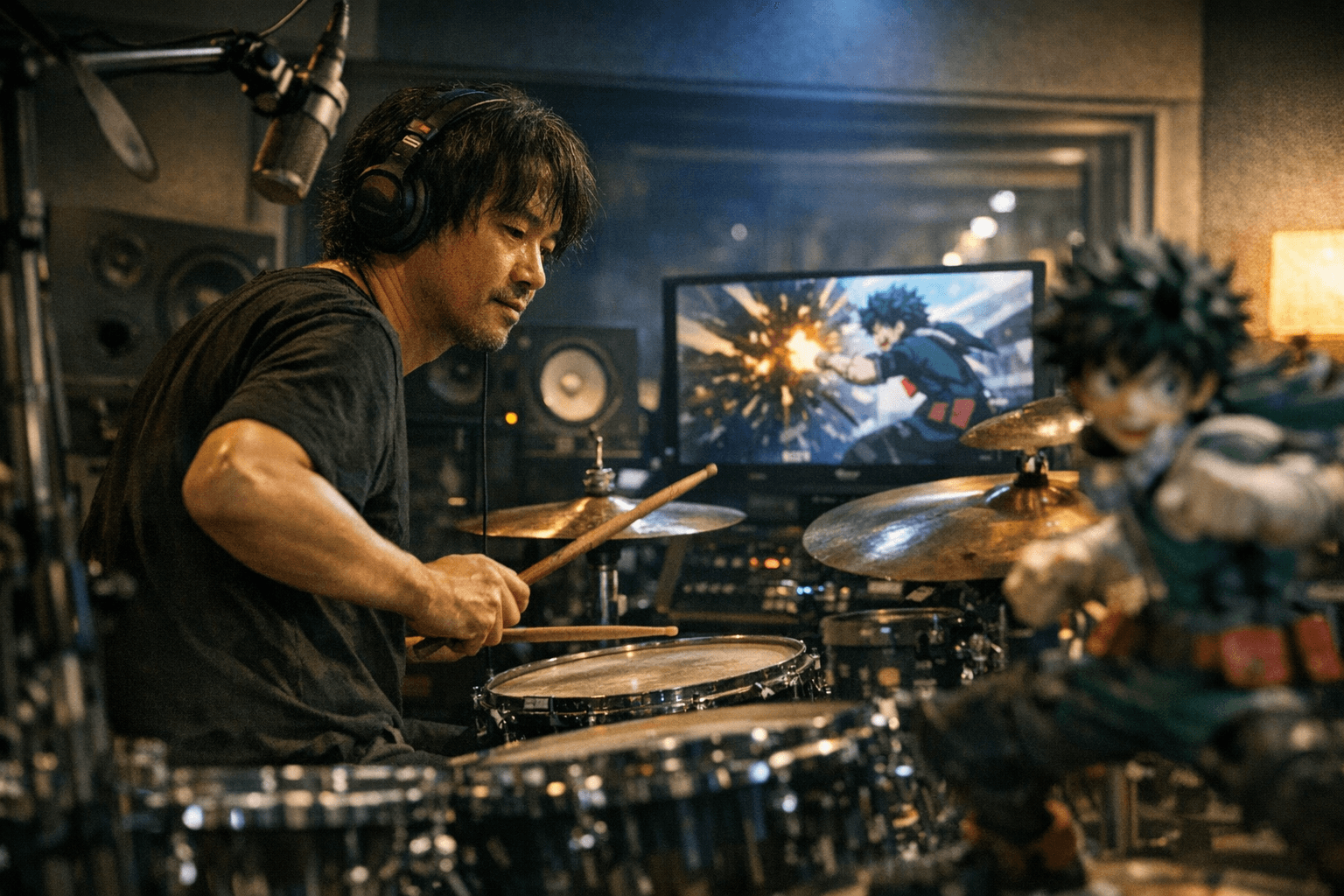
The reuse did not stop there. A 2024 behind-the-scenes video for My Hero Academia: You're Next showed Hayashi recording "Next it's our turn!," an arrangement of "You Say Run." That is the clearest proof that the theme is still alive inside the franchise, not sealed off as a one-time classic. It keeps getting reinterpreted because the musical idea behind it still works.
What drummers can take from it
The lesson in "You Say Run" is not about flash. It is about control. Hayashi uses percussion to create lift, keep the scene moving, and leave room for the melody to deliver the emotional hit, which is why the track can support so many different kinds of moments.
- Start with restraint so the entrance of the groove feels consequential.
- Use the drums to shape the scene’s arc, not just the tempo.
- Leave space for the riff and the visual payoff to land together.
- Think of the beat as narrative support, not background decoration.
That is what makes "You Say Run" such a durable piece of anime music. Its drums are not simply keeping time, they are building belief, and that is exactly why the theme still feels ready to run whenever the moment calls for it.
Know something we missed? Have a correction or additional information?
Submit a Tip