How to use a Dungeons & Dragons character sheet, step by step
A character sheet is the fastest bridge from a blank concept to a playable hero, and the 2024 rules make the first decisions clear before the dice hit the table.
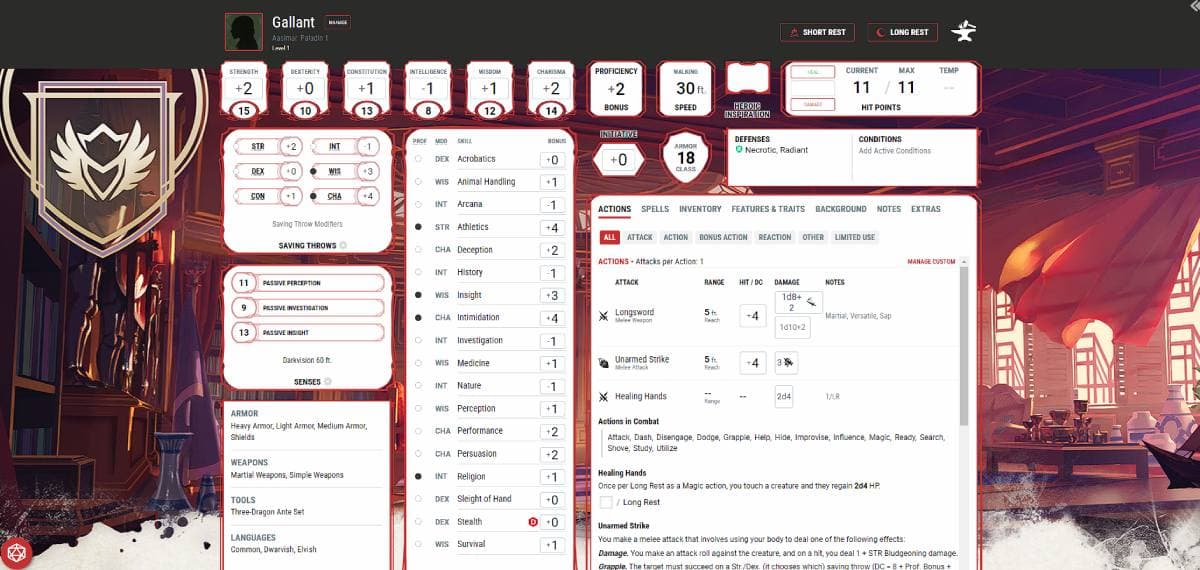
The 2024 Basic Rules treat a Dungeons & Dragons character sheet as whatever you use to track your character, whether that is printed, digital, or plain paper. D&D Beyond’s character builder pushes the process forward step by step, and its free tier lets you create up to six characters without paying a cent.
Start with the sheet you can actually use
The best first move is choosing the format that will not slow you down. If you like paper, print the sheet. If you want prompts and automatic math, use a digital version. If all you have is a notebook and a pencil, that still counts.
D&D Beyond’s digital sheet can track hit points, spells, class features, and inventory, and it can roll 3D dice that do the math for you. That is a real advantage for a first-time player who does not want to juggle a rulebook, a calculator, and a stack of bookmarks before the first initiative roll.
Use the builder to cut down the blank-page problem
The official character builder walks you from the opening choices to a finished sheet, which matters when you are staring at a full page of boxes and do not yet know where to begin. The builder includes the 12 core classes available in the 2024 Player’s Handbook, so you are not inventing a class from scratch before your first session.
That free limit of six characters is more useful than it sounds. You can make one serious build, one backup, and a few experiments while you figure out whether you want to be a fighter, wizard, rogue, cleric, or something else entirely.
Follow the 2024 creation order
The 2024 Player’s Handbook puts character creation in Chapter 2 and lays out a clean sequence: choose a class, determine origin, determine ability scores, choose an alignment, and then fill in the remaining details. That order is the core of the sheet, because each step tells you what belongs in the next set of boxes. Some steps have shifted compared with the 2014 rules, but the process is still familiar to anyone who has ever built a character.
Start with class because it answers the most important question at the table: what kind of adventurer are you? Class determines your role, your style, and much of what you will do in play. After that comes origin, which in the 2024 rules combines background and species into one early decision.
Ability scores come next because they shape how well the character handles the basic demands of the game. Alignment and the remaining details come after that.

Learn the numbers that show up everywhere
The six ability scores are Strength, Dexterity, Constitution, Intelligence, Wisdom, and Charisma. The rules describe them in plain terms: Strength is physical power, Dexterity is agility, Constitution is endurance, Intelligence is reasoning and memory, Wisdom is perception and insight, and Charisma is force of personality. Those six labels are the shorthand behind almost every action you take.
That shorthand matters because ability modifiers are added to D20 tests when the rules call for them. If you are trying to climb, hide, persuade, or keep standing in a fight, the game is usually asking how one of those abilities helps you.
Proficiency bonus is the other number that deserves attention immediately. For a 1st-level character, the proficiency bonus is +2, and you mark it on the sheet alongside the skills and saving throws your character is trained in. That bonus is how the sheet turns a broad ability score into a more focused advantage, whether you are making a save, making a skill check, or leaning on something your class does well.
Read the sheet like a table tool, not a form
The printable 2024 character sheet labels the fields you will use most often: armor class, hit points, hit dice, death saves, and proficiency bonus. Those are the numbers that matter when the room gets tense, because they tell you how hard you are to hit, how much damage you can take, what you can spend during a rest, and whether you are hanging on after a bad round.
The digital sheet handles much of that tracking for you, but the logic is the same. You still need to know where your hit points are, what your class features do, which spells you have prepared or ready, and what is in your inventory. The point of the sheet is to give you one place to check when the DM says, “It’s your turn.”
If you want to print after building online, D&D Beyond also lets you export the digital sheet to a form-fillable PDF.
The character sheet’s paper trail
Dungeons & Dragons was first published in 1974, and the character sheet came later as players looked for a cleaner way to keep track of their heroes. The first published character sheet is credited to Stephen Tihor’s Haven Herald fanzine in May 1975, and TSR sold official character record sheets for basic D&D in 1977. Wizards of the Coast released official fifth-edition character sheets in June 2017, then followed with a refreshed 2024 character-sheet package on September 17, 2024.
This article was produced by Prism’s automated news system from verified source data, official records, and press releases, then run through automated quality and moderation checks before publishing. The system is built and supervised by the people who set the standards it runs under. Read our full AI policy.
Did this article answer your question?

