Kevin Clay’s touring cast kept a three-night-a-week D&D campaign alive
Kevin Clay’s Broadway life and his cast’s three-night-a-week Kardelheim campaign show how touring groups can keep a D&D table alive with ruthless scheduling and strong table culture.

A Broadway lead, and a table that refused to die
Kevin Clay spends his nights as Elder Price in *The Book of Mormon*, but offstage he was helping run one of the more demanding D&D tables you are likely to hear about. The campaign lived in Kardelheim, a homebrew world that kept moving even while the cast was moving city to city. For a touring company, that is the whole trick: make the game feel as non-negotiable as the show call.
What makes this story hit is the scale of the commitment. At its peak, the group was meeting three times a week for about four hours at a stretch, which puts the table at roughly 12 hours of play every week. That kind of cadence does not just keep a campaign alive, it turns it into a parallel production, with character arcs, continuity, and table habits that have to survive buses, venues, and everything else a tour throws at them.
How a touring cast built a campaign around the calendar
The people around Clay were not casual drop-ins. Jacob Ben-Shmuel and Cody Jamison Strand were among the cast colleagues helping keep the game moving, and the result was less a loose pickup group than a revolving company table. That matters, because touring life punishes inconsistency, and this group answered it with structure instead of hoping the schedule would magically calm down.
For any group trying to copy that model, the first lesson is calendar discipline. The campaign did not survive because everyone had endless free time, it survived because the play rhythm was protected hard enough to create momentum, even when the cast was on the road. If your table is always waiting for the “perfect” week, you will never get the deep continuity that makes long-form D&D feel alive.
The second lesson is to make the session length count. Three four-hour sessions a week leave no room for half-hearted drift, so every meeting has to carry narrative weight. That is the kind of pressure that teaches a table to show up ready, keep turns brisk, and treat the game like part of the company’s culture instead of an optional add-on.
What Kardelheim got right: stakes that travel with the players
Kardelheim worked because the world could absorb travel chaos without losing its center. In a campaign built for a touring cast, the setting cannot rely on one static room or one perfect weekly night, so the story has to be strong enough to survive interruptions and pick back up with real force. A dense homebrew world gives you that flexibility, because the setting is already built to carry the table even when the schedule is not kind.
Clay’s cleric, Dama, is the clearest example of how the campaign tied character drama to mechanical consequence. Dama’s faith in Selûne, the moon goddess, wavered in step with the story, and that spiritual crisis showed up at the table in the character’s powers. When the narrative later brought a divine reckoning that restored and even strengthened those abilities, the game did something every great campaign wants to do: it made belief matter in play, not just in dialogue.
That is the kind of design move ordinary groups can steal immediately. If a character is wrestling with a vow, a god, a faction, or a personal oath, let the story push back in ways the rules can feel. The table remembers consequences when they are not just emotional, but mechanical.
The touring-table playbook every group can borrow
You do not need a Broadway contract to use the habits that kept this campaign together. You do need a clear sense that the table has to be built for real life, not for the life you wish you had. The touring cast succeeded because they treated continuity as something worth protecting, even when their days were stacked with performances and travel.
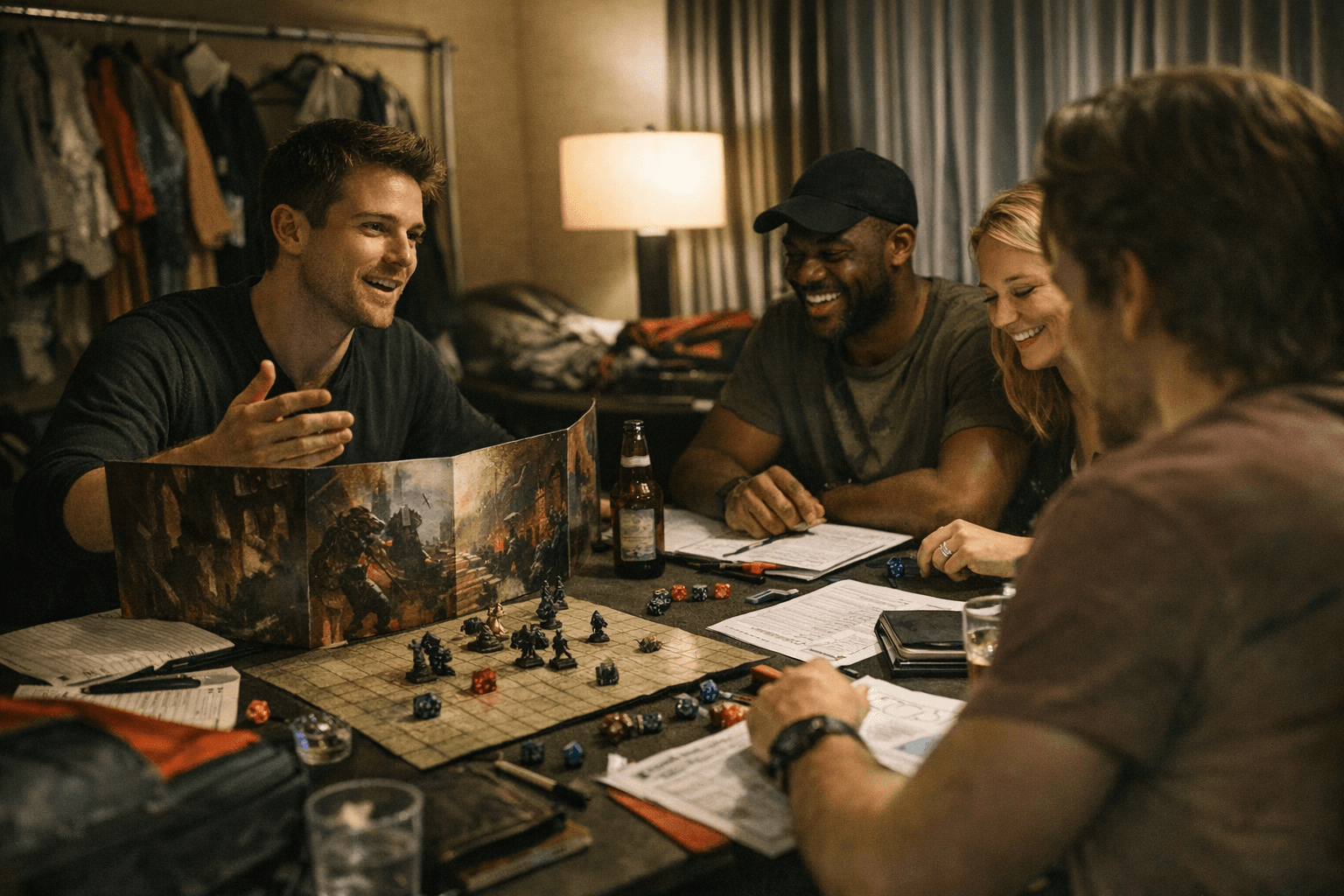
A few habits stand out from the way this campaign held together:
- Treat the schedule like part of session zero. If the campaign can only survive with recurring slots, make those slots sacred.
- Use shorter one-shots on travel-heavy stretches so the story keeps breathing when a full session is impossible.
- Build in strong in-world pressure, like faith, factions, or personal quests, so every return to the table feels urgent.
- Let guest players and rotating cast members refresh the energy without resetting the campaign.
- Keep character arcs visible enough that a missed week does not flatten the emotional thread.
That last point is the quiet one, but it is probably the most important. A touring group cannot rely on memory alone, because the table is constantly being interrupted by outside life. The campaign needs enough shared culture that everyone can step back in and immediately know what matters.
Why this story lands now
Clay’s table is not just a fun backstage anecdote, it sits inside a bigger moment for the hobby. D&D Beyond has pointed to 85 million fans worldwide and millions of characters created in 2024, while Wizards of the Coast and Hasbro’s 2024 business reporting underscored how central the game remains as a commercial engine. D&D is not a small, hidden hobby anymore, it is a major part of mainstream gaming culture.
The theater world has noticed that too. Productions like *Dungeons & Dragons: The Twenty-Sided Tavern* have already pushed the game onto bigger stages, and coverage of live D&D performances has tracked the hobby’s move from private tables into public-facing entertainment. Clay’s campaign belongs to that same current, where theatrical instincts and tabletop storytelling keep feeding each other.
What lingers is the image of a touring company that did not let the road break its campaign. Kardelheim kept going because the table was disciplined, the stakes were personal, and the people around it treated play as something worth protecting. That is the real takeaway for any group trying to keep a campaign alive when life keeps threatening to scatter it.
This article was produced by Prism’s automated news system from verified source data, official records, and press releases, then run through automated quality and moderation checks before publishing. The system is built and supervised by the people who set the standards it runs under. Read our full AI policy.
Did this article answer your question?