Wizards of the Coast artists push Black representation in D&D and Magic
Black creators at Wizards are changing what fantasy looks like, from D&D's species rewrite to art that puts Black heroes at the center of the table.
Black representation is moving from background detail to design choice
Black heroes are showing up with more agency, more style, and more ownership in the worlds Wizards of the Coast puts on the page. That shift matters because Dungeons & Dragons is built on imagination, and the images, names, and settings around the rules help decide who feels like they belong there.
The clearest window into that change comes from two people inside Wizards: Lauren Brown and LaTia Jacquise. Brown, the company’s marketing art director, is shaping the visual language of fantasy across both Dungeons & Dragons and Magic: The Gathering. Jacquise, Dungeons & Dragons’ community manager, is helping carry that vision into the spaces where players talk, build, and belong.
Lauren Brown is centering Black fantasy on purpose
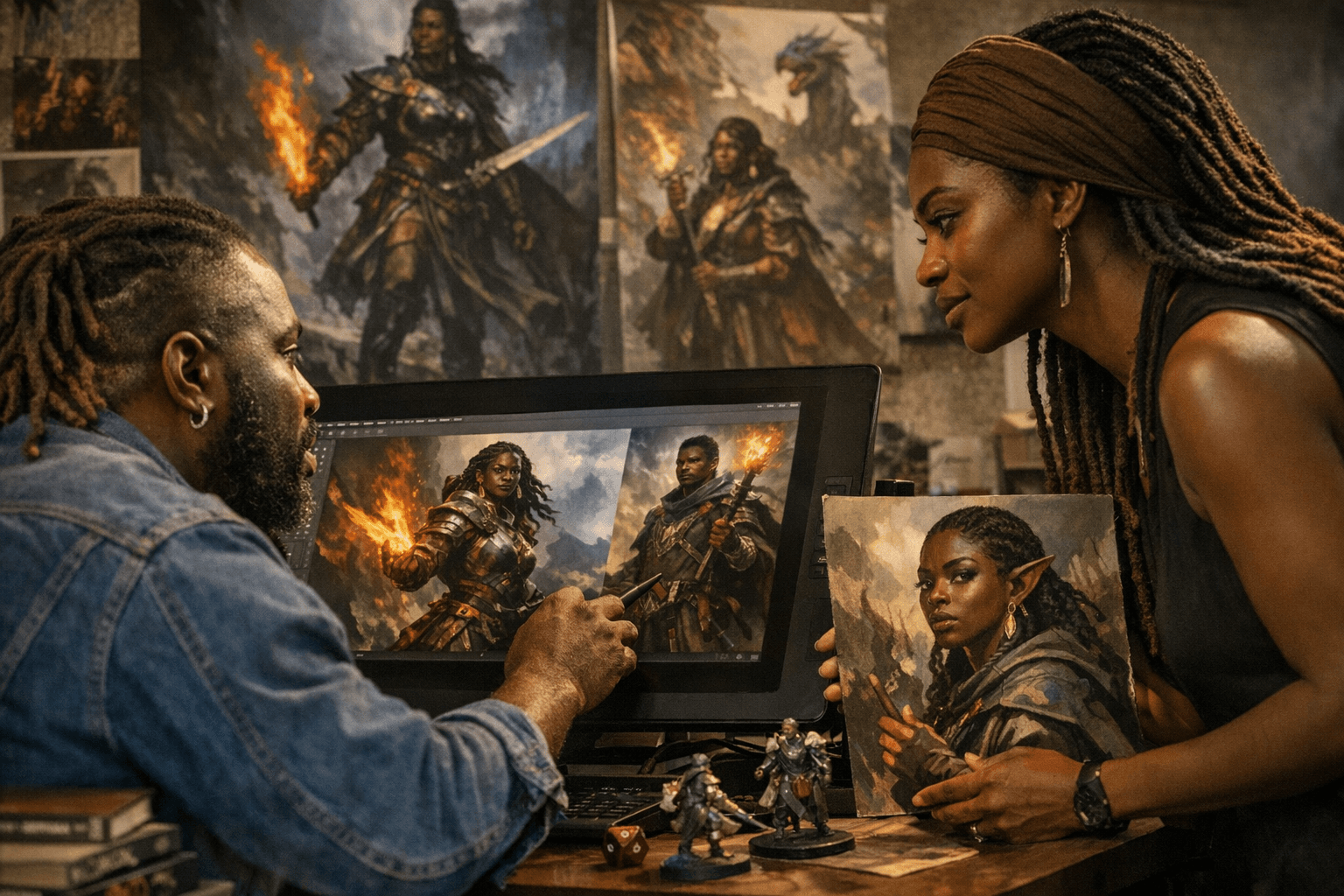
Brown’s approach is straightforward and deeply personal: she wants Black characters in fantasy to have agency, style, and ownership of their worlds. She has said she wants to show Black people in roles she did not often see growing up, and she treats that not as a side note, but as part of making fantasy broader and more welcoming.
That distinction matters at the table. In a hobby where cover art, card art, and sourcebook spreads can set the tone for an entire campaign, representation is not just about who appears in the picture. It shapes which kinds of heroes feel normal, which cultures feel honored, and which fantasies players think they are allowed to claim as their own.
Brown also sells her art at conventions such as Gen Con, which gives fans a direct look at how these images are meant to live in the tabletop space. That kind of face-to-face connection is important in a community that often discovers its favorite worlds through art first and rules second.
LaTia Jacquise brings the community side of representation into focus
Jacquise’s perspective starts from identity. She has said she always imagined her own characters as Black because that is how she understands herself. In a game that invites players to invent heroes, build parties, and create entire campaign worlds under a Dungeon Master’s guidance, that personal lens is not a small thing. It is part of how the game feels playable, visible, and real.
As Dungeons & Dragons’ community manager, Jacquise also represents something players do not always see reflected in tabletop culture: Black people working in the creative and community-facing side of the games they love. Her public bio also identifies her as a community review board member for TakeThis.org, a nonprofit focused on reducing stigma around mental health and wellness in gaming communities, along with work as a writer, game designer, and streamer.
That kind of visibility sends a practical message to the community. Representation is not only about the heroes in the books. It is also about who gets to help shape the conversation around the hobby, support the community, and decide what welcoming looks like in real life.
Why Dungeons & Dragons makes representation especially visible
D&D is not a fixed-story game. It depends on players creating their own heroes, settings, and campaign stories, with the Dungeon Master helping hold the world together. That freedom makes representation more powerful, because the art and setting material can either normalize a wide range of identities or quietly narrow what seems possible.
Wizards’ own tooling reinforces that point. D&D Beyond centers character building, encounter and campaign management, and Maps VTT, which means players interact with identity not just in lore books but in the tools they use to play week after week. When the official toolkit is built around creating your own character, the visual and textual cues around that toolkit matter even more.
The same logic carries across Magic: The Gathering. The art fans see on cards and in related fantasy worlds helps define the emotional and cultural boundaries of the game. If Black characters are present only in the margins, the message is one thing. If they are depicted with authority, complexity, and care, the whole fantasy space opens up.
Wizards says inclusion is part of the work, not an afterthought
Wizards of the Coast says it is committed to a diverse and inclusive culture that values, respects, and empowers employees to be their authentic selves. The company also describes its studios as building role-playing, trading card, and digital games for all genres of players. That language gives context to what Brown and Jacquise are doing inside the company: this is an internal priority, not just a personal preference.
The company’s inclusion work has also changed in response to criticism. In 2020, Wizards said making D&D “as welcoming and inclusive as possible” had moved to the forefront of its priorities over the prior six years. After backlash over Spelljammer, Wizards said it built and tested a new inclusion-review process for D&D products, with the goal of making games inclusive and welcoming for all players.
That history matters because it shows how the company got here. Wizards also acknowledged in its Hadozee statement that not all portions of the content had been properly vetted before publication. In that same statement, it said that throughout D&D’s 50-year history, some characters were described in ways reminiscent of how real-world groups have been denigrated. For fans, that is the clearest sign that representation and review are not abstract policy debates; they are corrections to the way fantasy worlds have been drawn for decades.
The 2024 core books show the shift on the page
One of the most visible changes is the move in the 2024 core rulebooks from “race” to “species.” Wizards said that revision required open conversation with the community, and D&D Beyond said the new books include fresh art to showcase species. D&D Beyond also described the 2024 Player’s Handbook as the result of a decade of lessons learned and adventures had.
That combination of language and visuals is exactly where representation becomes real. New terminology changes how players talk about their characters. New art changes who players picture when they open the book. Together, those shifts can make the game feel less locked to old assumptions and more open to the actual diversity of the people around the table.
What this means for the next campaign
The bigger story here is not just that Wizards is talking about representation. It is that Black representation is shaping the worlds players enter, the characters they build, and the community spaces around the game. Brown’s art choices and Jacquise’s visibility in the D&D community point to a version of the hobby where Black fantasy is not exceptional or symbolic. It is part of the default creative landscape.
That matters in a commercial way, too. Public reporting has put Dungeons & Dragons at roughly $100 million to $150 million in 2022 revenue, which means the images and messages attached to the brand reach far beyond one table or one convention hall. When a game that large changes how it depicts people, those changes ripple outward into stores, streams, home campaigns, and the next generation of players.
For D&D fans, the takeaway is simple: representation is no longer just about who gets mentioned in a statement. It is about who gets drawn, who gets centered, and who gets to see themselves as part of fantasy without having to ask permission.
This article was produced by Prism’s automated news system from verified source data, official records, and press releases, then run through automated quality and moderation checks before publishing. The system is built and supervised by the people who set the standards it runs under. Read our full AI policy.
Did this article answer your question?