Five pre-session checks and battery best practices for foil and eFoil riders
When battery drops below 20 percent the remote shows a red icon and beeps as the eFoil reduces motor output; lock the controller after a fall, wear a helmet and PFD, and note 50 feet versus 100 meters separation guidance.

When the battery power level is lower than 20 percent, the eFoil activates low power safety mode: the battery icon on the remote display turns red and the battery will start beeping while motor output and speed are reduced to preserve energy and allow a return to base safely, Mackiteboarding notes. That single metric is a decisive safety cue for riders, rental shops, and coaches to monitor before they drift offshore.
Before every session, verify you know how to connect and disconnect the battery and how to synchronize the remote with your board; Motosurfing emphasizes, "Before the first ride make sure that you know properly how to connect and disconnect the battery, how to connect or synchronize the remote with your board." Confirm controller pairing and that the hand controller will lock when entering the water, and always lock the controller after a fall, Pulseersport, Emeraldwake, and Mackiteboarding repeat this as an operational imperative to prevent runaway craft.
Protective gear remains nonnegotiable: "At the very least, this includes an impact vest or a personal flotation device and a helmet," Pulseersport states, while Efoiling Online adds, "Wear an approved and certified helmet and PFD (Personal Flotation Device) at all times." Motosurfing recommends a helmet and impact vest for the first lesson and a full wetsuit to protect knees and feet; Mackiteboarding advises a life jacket and wetsuit for added foil protection.
Separation and site selection vary by source and should shape your local operating practice. Pulseersport and Efoiling Online recommend staying about 50 feet from swimmers, surfers, and kiteboarders; Mackiteboarding sets a much more conservative buffer, "Stay at least 100 meters away from swimmers." Ride in water deeper than two meters and do not go farther offshore than you can swim in the current conditions, Mackiteboarding warns.

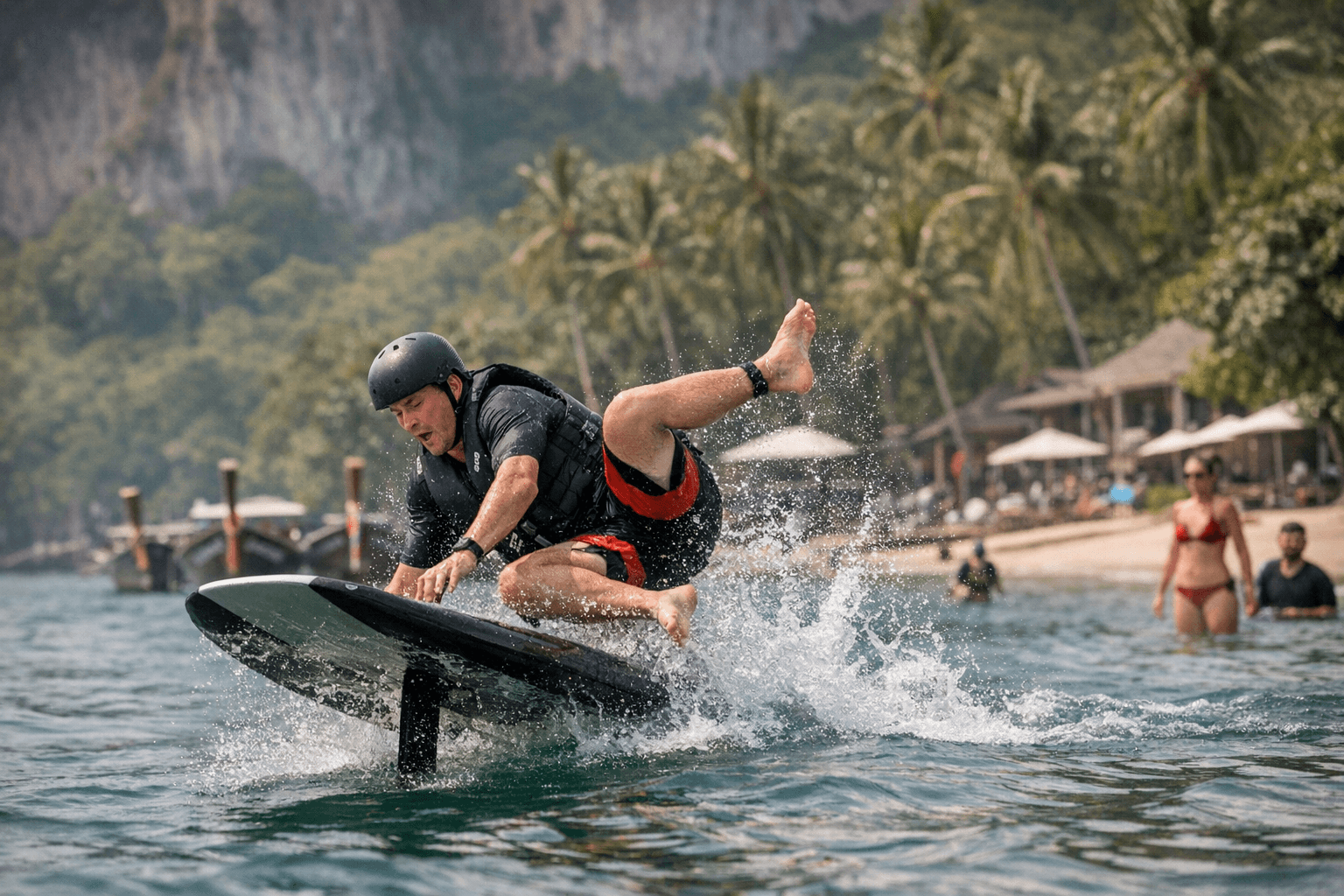
Falling and throttle technique are decisive safety moves. "Release the trigger immediately on committing yourself to a fall," Efoiling Online directs; practice stopping the propeller before you hit the water. Both Pulseersport and Efoiling Online advise to fall in the direction of your momentum so you end up opposite the hydrofoil assembly and keep limbs away from the board to avoid lacerations. When reboarding, Emeraldwake cautions to "Watch your feet, as it's possible to kick the foil or the prop when climbing back on."
Handle batteries and equipment with protocol: Motosurfing recommends, "Make sure that you discharge your battery as much as you can for safety reasons (fireproof case for your battery is only added safety)," and also to keep remote displays and batteries away from direct sun. Many boards include automatic shut-off features, Efoiling Online notes "Most eFoil boards are set up to automatically shut off when the controller trigger is released, or the controller comes in contact with the water," and Emeraldwake cites the Flitescooter as an example that disengages the motor on a fall. Verify model-specific fail-safes in your manufacturer manual.
For instructors and rental operators require demonstration of battery coupling, remote sync, controller lock policies, mandatory helmet plus PFD, and supervise the first 40 minutes of a rider's session, Motosurfing cautions, "Your most challenging and dangerous time on e-foil will be your first 40 minutes." Combine those checks with the battery <20 percent alarm, the controller-lock rule, and conservative separation distances to reduce the most common risks in foil and eFoil operations.
Know something we missed? Have a correction or additional information?
Submit a Tip