Craft Beer Closures Outpace Openings, Yet Entrepreneurs Bet on Local Demand
For the second straight year, craft beer saw 434 closures against 268 openings in 2025, yet taproom-focused entrepreneurs keep signing leases on local demand.
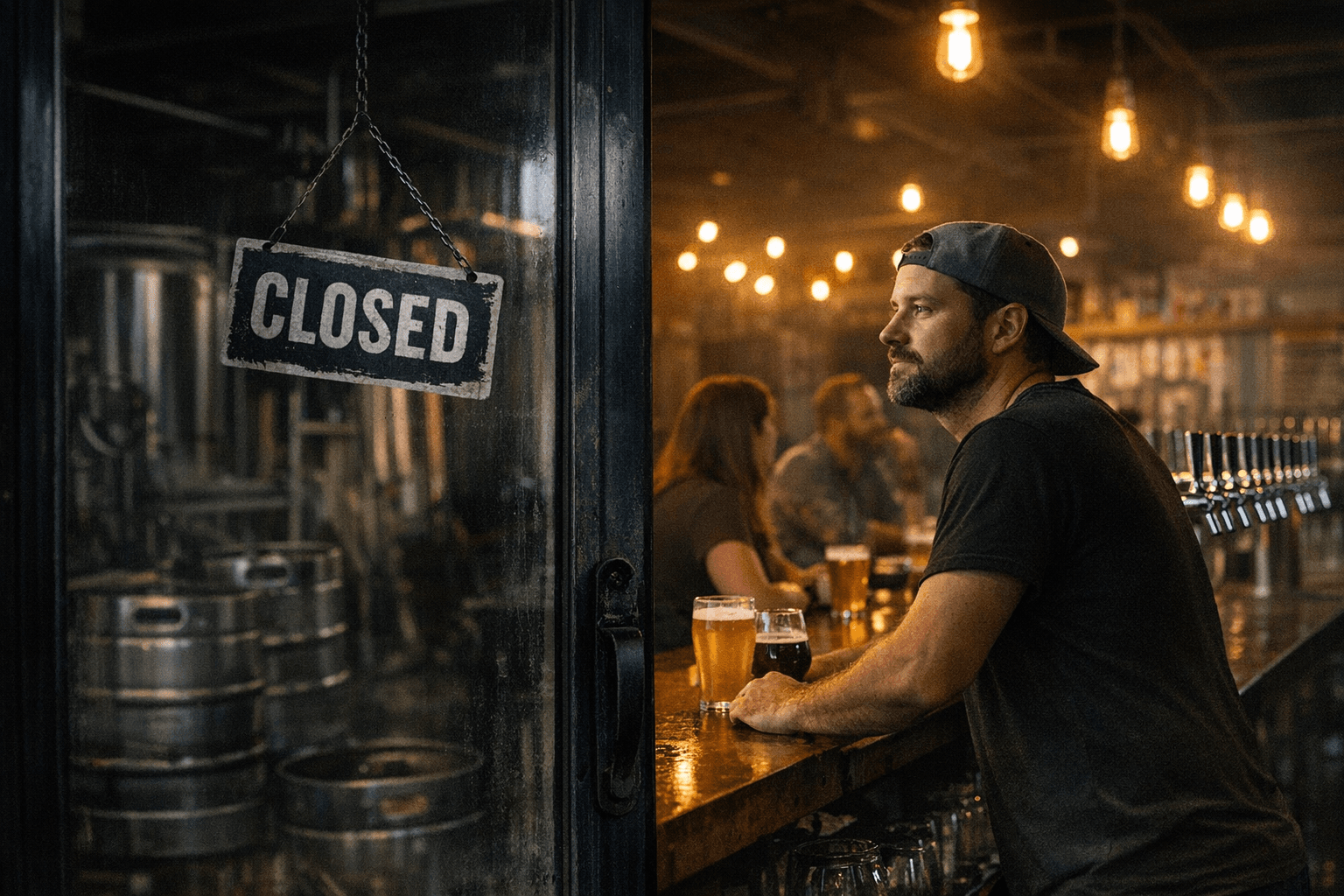
The numbers tell a bracing story: 434 craft breweries closed in 2025, against just 268 that opened, the second consecutive year the industry ran that math in reverse. Between 2006 and 2023, openings beat closures without exception. That streak is now two years gone.
The Brewers Association counted 9,778 active small and independent breweries by year's end, a figure representing continued, if gradual, contraction. Closures accounted for roughly 4.4 percent of operating breweries, not a collapse but not comfortable either. Volume fell an estimated five percent for the year, steeper than the four percent decline recorded in 2024.
The casualties spanned the full spectrum. Rogue Ales, one of Oregon's oldest and most widely distributed craft labels, shuttered abruptly in November after decades of national reach. In North Carolina, Duck Rabbit Craft Brewery, a name long respected among dark beer devotees, quietly closed in April after two decades. Boundary Bay Brewery in Bellingham, Washington, which had operated for 30 years, pulled its taps in September. Even Thimble Island Brewing in Connecticut, a regional staple with a flagship American Ale that found steady success across New England, couldn't hold on.
Brewers Association CEO Bart Watson described the broader pattern plainly: "Craft has been going through a painful period of rationalization." Inflation and tariffs drove up input costs. Retailer shelf rationalization squeezed distribution-focused operations hardest, with the Beer Purchasers' Index for craft beer scoring just 20 in March 2025, well below the 50-point benchmark that signals growth. Consumer attention scattered toward hard seltzers, spirits, and an expanding low- and no-alcohol category.
That last shift, rather than being fought, is one the survivors embraced. Non-alcoholic beer continued growing through 2025, and sub-4.0% ABV offerings gained meaningful tap presence as brewers chased occasions that used to belong to soft drinks or sparkling water.
The clearest dividing line in the data ran between business models. Distribution-centric microbreweries took the worst of it. Taproom-focused operations and brewpubs fared measurably better, posting modest growth of one to two percentage points above their distribution-heavy counterparts. Breweries that functioned as neighborhood gathering spots, layering in food programs, live events, and diverse beverage options, proved more durable than those relying on retail placement.
That's precisely the bet new entrants made. In Milwaukee, Tree Line Brewing Company opened with a rotating menu of experimental brews, an outdoor patio, and a small stage for local performers. In Appleton, Wisconsin, Vault 202 Brewery and Taproom converted a historic bank building at 202 W. College Ave. into a community taproom. Others capitalized on cheap used equipment and vacant brewing spaces left behind by closures, lowering the barrier to entry even as the macro numbers warned against it.
The raw totals still show an industry shedding more than it builds. But the operators signing leases into 2026 have studied every closure and arrived at the same conclusion: a well-run taproom that belongs to its neighborhood is a harder thing to kill than a SKU fighting for shelf space.
This article was produced by Prism’s automated news system from verified source data, official records, and press releases, then run through automated quality and moderation checks before publishing. The system is built and supervised by the people who set the standards it runs under. Read our full AI policy.
Did this article answer your question?