Nordic Grog Archaeology Reveals Ancient Secrets of Fermented Beverage History
Wheat, honey, cranberries, and bog myrtle in a single Bronze Age vessel: ancient Nordic brewers were making fermented hybrids that defy every modern style category.
Somewhere between a braggot, a fruit wine, and a farmhouse ale sits a Bronze Age vessel that refuses to be categorized. That tension is exactly what Lars Marius Garshol explores in his feature "The Mixed Mysteries of Nordic Grog," published in Craft Beer & Brewing on March 9, 2026. The subject: a class of ancient Scandinavian fermented beverages so compositionally complex they collapsed the boundaries we assume have always existed between beer, mead, and wine.
What "Nordic Grog" Actually Means
The term itself is relatively new. In 2013, Dr. Patrick McGovern and colleagues at the University of Pennsylvania published a new analysis of four archaeological drink finds from Denmark and Sweden. Their results, combined with the chemical profile of a previously analyzed drink, led them to coin the name "Nordic grog" to describe these ancient mixed beverages. The label stuck because it captures something genuinely unusual: these weren't beers that happened to contain a little honey, or meads with a few botanicals. They were hybrid fermentations drawing on grain, fruit, honey, and wild plants simultaneously.
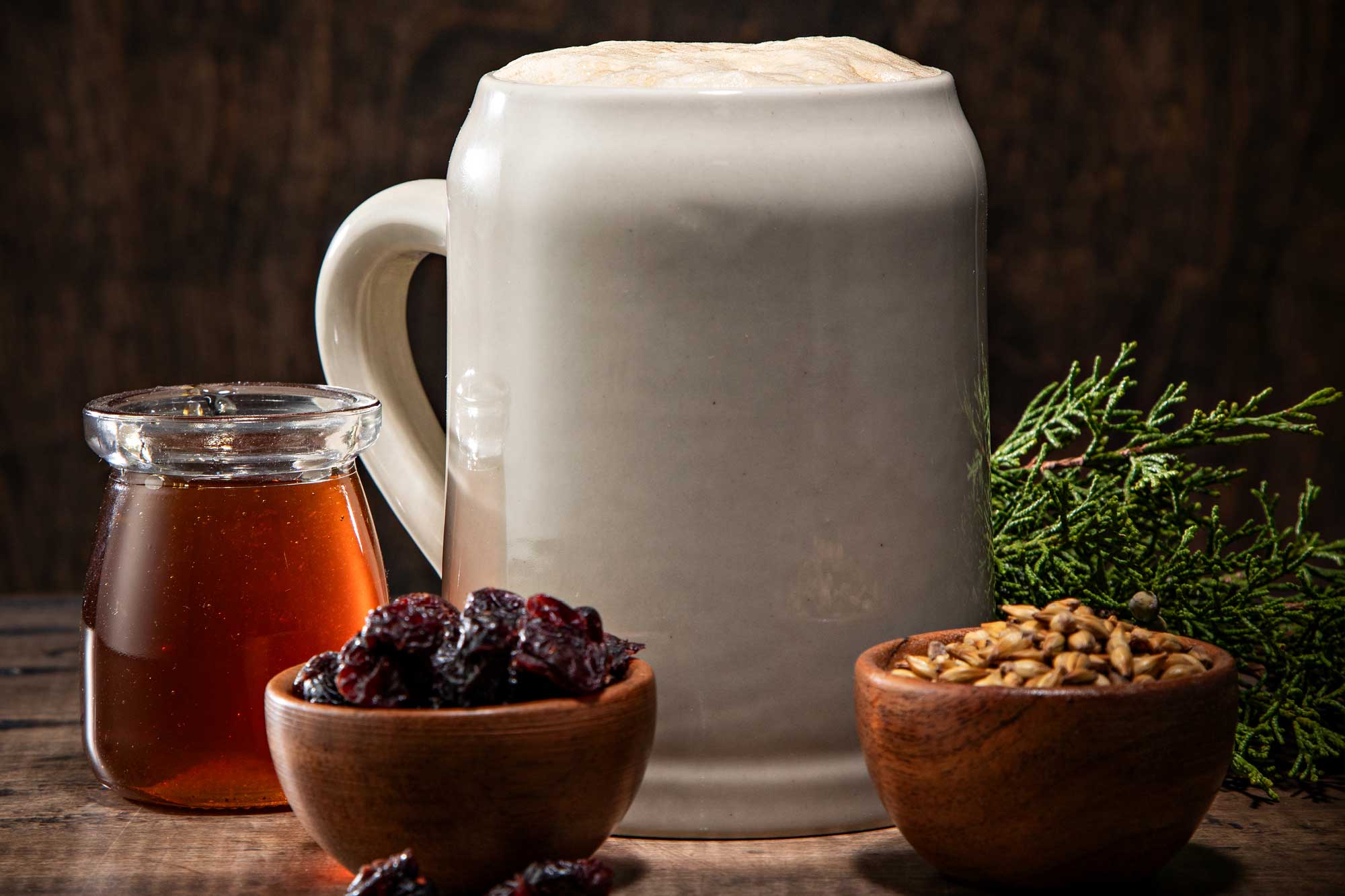
One find in particular anchors the conversation. "The drink proved to be made of wheat, honey, cranberries, and lingonberries, and it had been flavored with bog myrtle, or Myrica gale," the analysis notes, concluding that it "was a sort of mixed wheat-and-berry beer with honey." Bog myrtle, the same herb that predates hops as a bittering and preserving agent in northern European brewing traditions, turns up repeatedly across these finds. So does a consistent cast of botanicals. As the research summarizes: "Malt, honey, cranberries, lingonberries, gale, and juniper seem the most common ingredients, though not necessarily all in the same beer."
What the Archaeological Record Can and Cannot Tell Us
Here is where the story gets genuinely complicated, in ways that matter if you want to think clearly about what these finds mean. The chemical residue analyses that identify ingredients like honey, fruit acids, and bog myrtle are impressive, but they have hard limits. Malt is particularly difficult. "We know almost nothing about malting in this era," the research states plainly, though two exceptions exist: finds from Sweden and Germany both contained smoked malt, giving archaeologists at least two concrete data points. What almost certainly goes undetected is sun-dried malt, which "would not leave archaeological traces, and it would give the other ingredients more room to shine." That absence of evidence shapes any reconstruction significantly.
Proportions are an even larger unknown. "As for the proportions, nobody has any idea about those," the sources note, though the context carries an intriguing hypothesis: "if Nordic grog really was a status drink, you'd expect it to be strong. (Whatever 'strong' meant in 1370 BCE.)" The status-drink framing is speculative, but it reflects a reasonable inference given the richness and diversity of ingredients that appear in elite burial contexts across the Norse world.
And as the research itself cautions, single finds are dangerous ground for sweeping conclusions. "There was a lot of speculation about this 'beer' in the decades to follow, but it was difficult to conclude anything from just a single find." McGovern's 2013 multi-find analysis addressed that limitation directly, giving researchers a comparative dataset instead of a curiosity.
Setting the Record Straight on Beverage Evolution
The "Nordic grog" concept has generated one persistent misreading worth addressing head-on. Some have interpreted the existence of these mixed beverages as evidence that beer, wine, and mead only became distinct categories later in history, as if the grog represents an undifferentiated proto-fermentation that preceded specialization. The archaeological record does not support that reading. "There are two mead finds from 1400 BCE, a pure wine from 50 CE, and a pure beer from 50 CE (Skudstrup). So, clearly, 'pure' drinks also existed. In fact, there are more pure finds than grogs."
Mixed and unmixed fermentations co-existed across a long chronological span. The grogs don't represent a primitive antecedent to proper beverage categories; they represent a parallel tradition of intentional complexity, brewed alongside straightforward meads and beers by the same cultures.
Dogfish Head and the Kvasir Project
All of this archaeology eventually found its way into a fermenter. Sam Calagione, Owner and Brewmaster of Dogfish Head Craft Brewery, has spent decades turning residue analysis into drinkable beer. "I'm lucky I get to do this," he said about Kvasir, his latest archaeobeer project, a reconstruction of a 3,500-year-old Nordic grog and the seventh beer in an ongoing collaboration with Dr. Patrick McGovern of the University of Pennsylvania Museum of Archaeology and Anthropology. The partnership goes back to the late 1990s: "In the late '90s we started doing some historic beers on our own, which led to our collaboration with Dr. Pat."
Kvasir presented specific challenges. "With this one we had some challenges," Calagione acknowledged, with the core difficulty being how to balance an ingredient list that included cranberries, lingonberries, yarrow, bog myrtle, honey, and meadowsweet. Rather than work through those ratios in isolation, Calagione reached out to Swedish brewery Nynäshamns Ångbryggeri, reasoning that brewers closer to this botanical tradition might handle the ingredients differently. "We thought it would be fun to reach out to a local Swedish craft brewery and see how they would brew with these ingredients. They handled the European test brew." It's a smart instinct: consulting brewers who still live in the landscapes where these plants grow brings an experiential dimension that no residue analysis can replicate.
What the project confirmed for Calagione aligned precisely with what McGovern's analysis had shown: "What we learned is that almost all these were fermentable hybrid beverages. That is, something between mead, wine, and beer. Grain and honey and fruit."
How to Approach This at the Homebrew Level
The most practically useful insight from the Kvasir project for homebrewers is that Nordic-grog-style fermentations are surprisingly accessible. Because they rely on multiple fermentable sugar sources rather than a purely grain-driven mash, they don't demand the infrastructure or technical precision of an all-grain batch. Calagione put it directly: "These are pretty easy to attack at the homebrew level. You don't have to be a world-class, all-grain brewer to replicate ancient ale because they have so many more accessible sugars than a simple all-grain version."
The technique is about as approachable as homebrewing gets:
1. Steep grain in a bowl of water as a partial grain batch to extract fermentable sugars and a baseline of malt character.
2. Add honey or an alternative sweetener such as birch syrup to boost fermentables and introduce additional flavor complexity.
3. Build the botanical layer from the most archaeologically consistent herbs: bog myrtle (Myrica gale), juniper, yarrow, and meadowsweet are all documented in finds and reconstructions.
4. Incorporate fruit additions, with cranberries and lingonberries being the most historically grounded choices, though local alternatives that approximate their tartness are reasonable substitutes.
"These ales are a lot of fun to brew at home because you have all these partial mash syrups," Calagione noted. "There are a lot to play with."
Why This History Matters to Modern Brewers
The gruits, the mixed-fermentation traditions, the farmhouse ales with their wild botanical additions: contemporary craft beer has spent decades rediscovering complexity that turns out to have Bronze Age precedent. The Nordic grog evidence doesn't just complicate beverage history; it validates an instinct that drives a lot of experimental brewing today, namely that the lines between beer, mead, and wine are conventions, not laws of nature. Ancient Nordic brewers apparently knew that. The Egtved Girl's wheat-and-berry honey drink, the smoked malt finds from Sweden and Germany, the consistent reappearance of bog myrtle across millennia: the record suggests a brewing culture that was sophisticated precisely because it refused to stay in a single category. That's not a primitive feature of ancient fermentation. It's an advanced one.
This article was produced by Prism’s automated news system from verified source data, official records, and press releases, then run through automated quality and moderation checks before publishing. The system is built and supervised by the people who set the standards it runs under. Read our full AI policy.
Did this article answer your question?