Thiol-Enhancing Yeast Strains Unlock Tropical Aromas in Hoppy IPAs
A single yeast swap can add passionfruit and guava at concentrations unachievable through hopping alone; here's what thiol yeast actually does, which strains to buy, and how not to waste a batch.
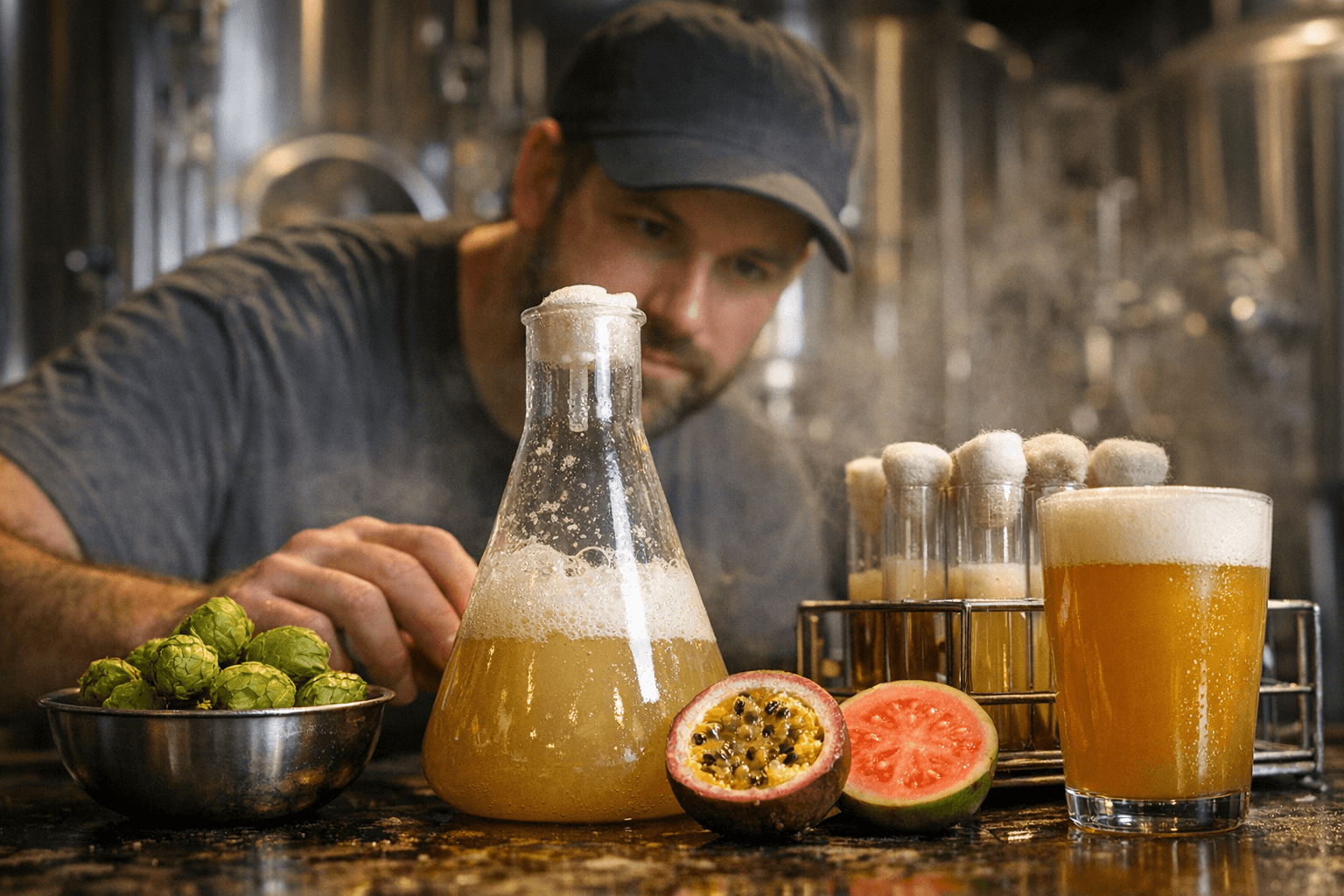
Thiols are detectable by the human nose at a few nanograms per liter. That isn't a typo. These sulfur-containing aroma compounds are among the most potent aromatics in brewing, responsible for the intense passionfruit, guava, grapefruit, and black currant character that define modern tropical IPAs. And yet, for most of brewing history, the overwhelming majority of thiols in both hops and malt have remained locked in an odorless, bound form, completely inaccessible to standard ale yeast. Thiol-enhancing strains change that equation entirely, and with IPAs now accounting for over half of US craft beer production, the timing for homebrewers to understand and adopt this technology has never been better.
What Thiols Actually Contribute in the Glass
Chemically, a thiol is a sulfur-based analog of an alcohol. There are many thiol compounds in hops, but four polyfunctional thiols drive the flavors worth chasing: 3-sulfanylhexan-1-ol (3SH/3MH), which produces passionfruit and guava; 4-methyl-4-mercaptopentan-2-one (4MMP/4MSP), which registers as black currant; 3-sulfanyl-4-methylpentan-1-ol (3S4MP), associated with the sauvignon blanc character of Nelson Sauvin; and 3-mercaptohexyl acetate (3MHA), a softer, tropical-citrus companion to 3MH. These compounds can be detected in the parts-per-trillion range, meaning even a modest increase in free thiol concentration translates to a dramatic sensory shift in your finished beer.
The catch is that thiols exist in two states. Free thiols are the aromatic, volatile compounds responsible for all the flavors above. Bound thiols are non-aromatic precursors, locked to amino acids such as cysteine or glutathione, and they make up the overwhelming majority of thiols in both hops and malt. Research from Omega Yeast has quantified this imbalance: in wort, the ratio of precursor-form to free-form thiols can exceed 1,000-to-1. All of that latent aroma potential requires an enzyme called beta-lyase, encoded by the IRC7 gene in yeast, to cleave the sulfur bond and release it.
The problem is that most common brewing strains either have a mutated IRC7 gene that disables the enzyme entirely, or they have a functional copy that wort chemistry suppresses. High nitrogen levels in wort, which are standard in healthy fermentations, switch off IRC7 expression before it can do meaningful work.
The Commercial Strains Worth Knowing
Yeast labs have taken two distinct approaches to solving this. White Labs developed WLP077 Tropicale through natural selection, screening non-GMO strains for high enzymatic beta-lyase activity. The result is a blend specifically tuned to unlock bound thiols without genetic modification.
Omega Yeast took a more aggressive route, using CRISPR/Cas9 to engineer strains with a permanently active IRC7 promoter. Their Thiolized series now includes four commercially available strains, each optimized for a different IPA profile:
- Cosmic Punch is the accessible entry point, a Thiolized version of the British Ale V strain introduced in 2021. It produces grapefruit, passionfruit, and guava character at levels that complement rather than overwhelm the hop bill, making it an ideal house strain for hazy brewers.
- Helio Gazer is a more aggressive performer, producing thiol biotransformation at levels 20 times higher than Cosmic Punch and 200 times above the sensory perception threshold. Expect dominant guava and New Zealand sauvignon blanc character.
- Star Party is Omega's most thiol-forward hazy strain, built on the Chico ale backbone for clean, reliable fermentation with maximum tropical output. It's the right tool if you're specifically targeting a thiol-dominated aroma profile.
- Lunar Crush brings thiol activity to hop-forward lagers, producing crisp grapefruit character alongside traditional lager drinkability.
Escarpment Labs also offers Thiol Libre, a bred (non-CRISPR) strain designed for tropical fruit enhancement across hoppy styles.
Which Beer Styles Actually Benefit
Hazy and New England IPAs are the obvious home for thiol-enhancing yeast, but the picture is more nuanced than it first appears. Omega Yeast's own sensory work found that thiols are more perceptible in simpler grain bills, like blonde ales and lagers, than in dense IPA recipes. When a beer already carries intense layered hop aroma, thiol character can be partially masked. For homebrewers, this means a thiolized lager or pale ale can be a surprisingly effective way to calibrate what your chosen strain actually produces before committing it to a complex IPA recipe.
West Coast IPAs, fruited IPAs, and even smoothie sours are all viable targets. Southern Hemisphere hop varieties including Nelson Sauvin, Motueka, and Waimea pair particularly well with Thiolized strains because their flavor profiles align with the sauvignon blanc and tropical-fruit register that liberated thiols produce.
A Step-by-Step IPA Workflow
Getting the most from a thiol-enhancing strain requires coordinating hop selection, addition timing, fermentation temperature, and oxygen control across the entire brew day.
1. Precursor loading at the mash. Start building thiol potential before the boil by mash hopping with varieties high in bound thiols: Cascade, Centennial, Calypso, and Perle are all strong candidates.
Unkilned adjuncts such as flaked barley also contribute bound precursors. This stage is also where Phantasm powder, a commercial thiol-precursor product derived from Sauvignon Blanc grape skins, can be added for additional loading.
2. Whirlpool additions at controlled temperature. At whirlpool, use hops with both free and bound thiol content: Citra, Mosaic, Simcoe, Galaxy, Strata, and Nelson Sauvin all carry significant 4MMP and 3MH.
A whirlpool temperature around 180°F (82°C) retains survivable hop compounds including thiols while managing IBUs.
3. Early dry hop during active fermentation. This is the single most important timing decision for thiol expression.
Adding dry hops two to three days after pitching, while the yeast is still actively metabolizing, creates the conditions for biotransformation. The beta-lyase enzyme is active at this stage and hop-bound precursors introduced into an actively fermenting vessel have the highest conversion rate. Note that heavy dry hop additions can paradoxically pull back thiol character, as physical hop matter can rebind or scrub free thiols; keep dry hop rates moderate and pair them with higher-concentration whirlpool additions of products like Cryo Hops or Incognito to maximize efficiency while minimizing thiol loss.
4. Fermentation temperature management. Research published in the Journal of the American Society of Brewing Chemists examined fermentation temperatures from 15°C to 30°C and found temperature-dependent increases in 3SH of 33 to 72 percent depending on strain.
A warmer fermentation in the 68 to 72°F (20 to 22°C) range will generally favor thiol expression, though sensory results vary by strain. Dial in your specific strain with a small pilot batch before committing to a full volume.
5. Oxygen control from transfer onward. Thiols are highly sensitive to oxidation.
Once fermentation is complete, every transfer, packaging step, and dry hop addition should be executed with meticulous oxygen exclusion: purge vessels with CO2, use closed transfers, and monitor dissolved oxygen if your setup allows. Oxidation doesn't just flatten the beer; it directly destroys the thiol compounds you worked the entire process to build.
The Three Mistakes That Produce Catty or Off-Flavor Results
Thiol-enhancing yeast is not a set-it-and-forget-it upgrade. These are the three failure modes most likely to ruin a batch.
Mistake 1: Poor fermentation health driving sulfur faults. The same IRC7 pathway that produces desirable passionfruit and guava aromas can amplify minor off-notes if fermentation is stressed. Underpitching, insufficient nutrients, or fermentation temperatures outside the strain's recommended range can tip thiol production toward the undesirable end of the spectrum, producing the infamous cat-pee character associated with overproduced 4MMP or worse, genuine hydrogen sulfide from stressed yeast. Fermentation health is the non-negotiable foundation; a thiol-enhancing strain is not more forgiving than a standard ale strain. It is less forgiving.
Mistake 2: Blowing off volatiles with excessive CO2. Homebrewers using high-kraeusen or high-temperature fermentation techniques risk purging thiol aromatics through vigorous CO2 evolution. Using an open blowoff rather than an airlock at peak fermentation can literally exhaust the tropical notes you're trying to capture. The fix is a spunding valve or closed pressure fermentation once the thiol conversion window has opened, typically after the most vigorous phase of fermentation subsides.
Mistake 3: Over-relying on yeast alone without precursor loading. A thiolized strain cannot generate thiols from nothing. If the wort contains insufficient bound precursors, the beta-lyase enzyme has nothing to work with. Brewers who simply swap in a Thiolized strain on an otherwise standard IPA recipe and expect a dramatic transformation often report underwhelming results. The process chain matters: mash hops for precursor loading, hop varieties selected for bound thiol content, and a fermentation nutrient regime that supports enzymatic activity without over-suppressing IRC7 expression through excessive nitrogen.
The broader lesson, and the reason thiol science represents a genuine inflection point for advanced homebrewing, is that the most concentrated tropical aromas in modern IPAs are not coming exclusively from more expensive or more exotic hops. They're coming from yeast metabolism unlocking what was already in the grain and the cone. Getting that right requires process discipline, not just a larger hop bill.
This article was produced by Prism’s automated news system from verified source data, official records, and press releases, then run through automated quality and moderation checks before publishing. The system is built and supervised by the people who set the standards it runs under. Read our full AI policy.
Did this article answer your question?