U.S. Breweries Slow Expansion, Optimize Events and Sourcing to Weather Economic Uncertainty
Craft beer volume dropped 5% in 2025 and closings outpaced openings for the second straight year — the breweries still standing are rethinking expansion, hops contracts, and taproom revenue.
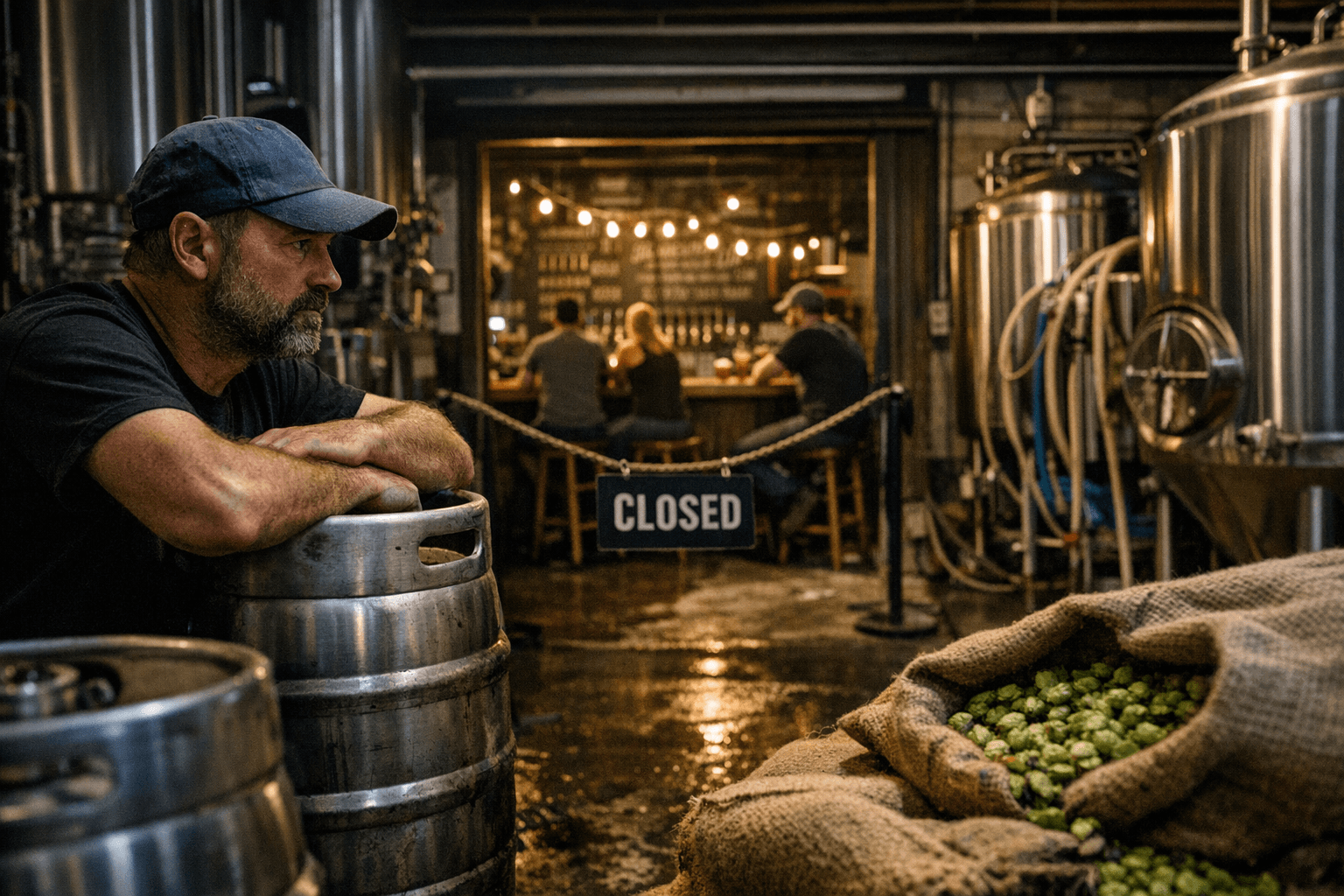
The number that defines the current era of American craft brewing is 434. That's how many breweries closed in 2025, against just 268 openings, making it the second consecutive year that closings outpaced new entrants, according to the Brewers Association. Craft beer volume was estimated down 5% as of the BA's midyear survey, a steeper decline than 2024's full-year drop of 4%, and retail scan data from Q3 2025 showed further weakening in the back half of the year. By June 2025, the number of operating craft breweries stood at 9,269, down 1% from 9,352 a year earlier.
The picture in retail is equally sobering. For the 52 weeks ending December 28, 2025, craft beer sales totaled $4.4 billion, a decrease of 4.3% across total U.S. multi-outlets. Kaleigh Theriault, beverage alcohol thought leader at NielsenIQ, points to ready-to-drink competition and retailer rationalization as compounding factors: "Craft is facing a lot of struggles... especially with the introduction of ready-to-drink products. There's fewer products on the shelf because retailers are swapping them out for faster-moving products."
Once the engine of craft growth, microbreweries saw a 3% decline while taprooms dipped 1%. For the first time, the industry is confronting what analysts are calling structural equilibrium: a market that can no longer absorb new entrants or sustain expansion without corresponding demand.
The breweries navigating this reset most effectively aren't waiting for the market to recover. They're rebuilding around three pillars: operational efficiency in their taproom event programs, smarter hop sourcing, and renegotiated supplier relationships.
Taprooms as Event Venues, Not Just Tasting Rooms
The goal in forward-thinking taprooms is no longer just selling more pints; it's about ensuring the space generates income from two distinct sources simultaneously: high-margin private bookings and consistent walk-in traffic. This dual-revenue stream model has become one of the clearest differentiators between breweries that are merely surviving and those that are actually posting margin gains.
Charlotte Herndon, who has managed events for Mighty Squirrel and Exhibit A Brewing, has been one of the clearest voices on building this kind of intentional structure. "Private events are great, they should make you a lot of money," Herndon said at the 2025 Craft Brewers Conference. "But there are good things and bad things about them, like always." At Mighty Squirrel's Boston-area locations, Herndon oversees a mix of private and semi-private spaces that can accommodate groups from 25 to 200 people. Rather than charging a rental fee, the brewery requires a minimum spend based on the size and timing of each event, a model that protects revenue while keeping the booking process flexible for clients.
The upside extends well beyond the immediate check. "They're a fantastic source of word-of-mouth marketing," Herndon noted. "Every single time someone remembers that amazing wedding reception they went to, they're also going to remember that brewery." Herndon's framework is direct: private events should fill in around the public programming calendar, not replace it. "Definitely encourage rentals on low-volume dates and times," she explained, so private bookings act as a revenue floor rather than a disruption to regular traffic.
Allagash Brewing in Portland, Maine, has taken a similar approach, building a dedicated private event program in its Tasting Room and The Cellars spaces. Events Manager Maya Atlas describes the appeal: the same community-forward atmosphere that draws walk-in guests makes private groups feel genuinely welcomed rather than processed.
Technology is increasingly central to making this model work at scale. Venue management tools now allow operators to customize menus by space, monitor sales per event, and track ROI in real time, giving breweries the data to fine-tune their programming rather than relying on gut instinct alone.
Hop Sourcing as a Financial Instrument
For breweries still building their ingredient strategy around informal spot-market purchases, the current landscape is punishing. The 2026 hop market is shaped by climate volatility in the Pacific Northwest and surging demand for high-oil aroma varieties like Citra and Mosaic. For the modern microbrewery, hops represent one of the most significant variable costs, often second only to labor and packaging, and unlike malt, hop prices fluctuate sharply based on harvest yields and global demand.
Forward contracting is no longer just a variety-assurance play; it has become a vital financial instrument. For a brewery contracting 75% of its annual hop supply, locking in at $14.30 per pound (including storage fees) versus a spot price of $17.00 represents $21,600 in savings that can be redirected toward equipment upgrades or operational reserves. Industry guidance now points toward contracting 70% to 80% of annual hop volume, leaving a portion for spot flexibility without overexposing the balance sheet to price spikes.
Tariffs on imported malt, barley, hops, and aluminum cans are making already-expensive raw materials significantly more costly, and many of these inputs cannot be readily substituted with domestic alternatives at comparable scale. Bart Watson, president and CEO of the Brewers Association, along with Scott Metzger, president and COO of Craft 'Ohana, and Steven Rannekleiv of RaboResearch Food and Agribusiness, addressed these pressures directly in a Brewers Association webinar, describing how "Liberation Day" tariffs and the volatility of the 90-day pause have turned cost planning into an ongoing exercise in scenario management rather than annual budgeting.
Supplier Relationships Are Being Rebuilt From Scratch
Aluminum prices have risen nearly 15% year-over-year, cutting directly into packaging margins. The rising cost of imported brewing equipment, hops, and malt has already forced many breweries to delay capital projects or scale down batch sizes.
Suppliers that help reduce exposure through smarter sourcing, bulk purchasing programs, or local partnerships are becoming invaluable allies. Inflation doesn't just raise costs; it reshapes trust. Beer makers are prioritizing packaging suppliers who communicate early and proactively address price changes.
The keg situation is an acute example of how global trade uncertainty feeds directly into taproom operations. Many kegs are sourced from Germany, and with U.S.-EU negotiations extended through July 9, tariffs on EU goods could spike to 50% without a deal, putting further upward pressure on imported stainless steel products. Small brewers reliant on European-made keg systems have no economies of scale to cushion that kind of increase.
Export markets are also narrowing: GlobalData's Q1 2025 survey found that 85% of Canadian Boomers and 71% of Gen X consumers were reconsidering U.S.-made products, with some Canadian retailers already pulling American alcoholic beverages from shelves. For independent breweries that had started growing cross-border, this represents a meaningful blow to revenue projections.
The Case for Measured Expansion
The Brewers Association sees potential upside in 2026, pointing to declining interest rates, possible tariff clarity, and consumer intent to socialize more as factors that could help at the margins, though these tailwinds will not reverse structural change overnight.
Breweries integrating food effectively into their taproom experience can see up to 40% increases in pint sales, while 90% of consumers report being satisfied with overall on-premise experiences, suggesting that quality execution still carries significant weight with guests who do show up. Matt Gacioch, the Brewers Association's staff economist, has noted there were "no significant year-over-year variations in sales volume share by channel," a finding that underscores the taproom model's resilience even amid the broader contraction.
The throughline across every strategy gaining traction right now is discipline. Breweries that expanded aggressively in the post-pandemic window are now carrying costs that the current market won't support. Those that treated hop contracts, event programming, and supplier agreements as afterthoughts during boom years are scrambling to retrofit those systems under pressure. The breweries posting gains are the ones that built operational clarity before they needed it, and that clarity is proving to be the single most durable competitive advantage in a market that has very little room left for inefficiency.
This article was produced by Prism’s automated news system from verified source data, official records, and press releases, then run through automated quality and moderation checks before publishing. The system is built and supervised by the people who set the standards it runs under. Read our full AI policy.
Know something we missed? Have a correction or additional information?
Submit a Tip
