Bennie Smith’s Tom, Bert, and William deck turns death into value
Tom, Bert, and William is already a real brewing puzzle, with sacrifice, recursion, and combo lines waiting to be tuned before The Hobbit arrives.
A Troll commander that rewards you for letting things die
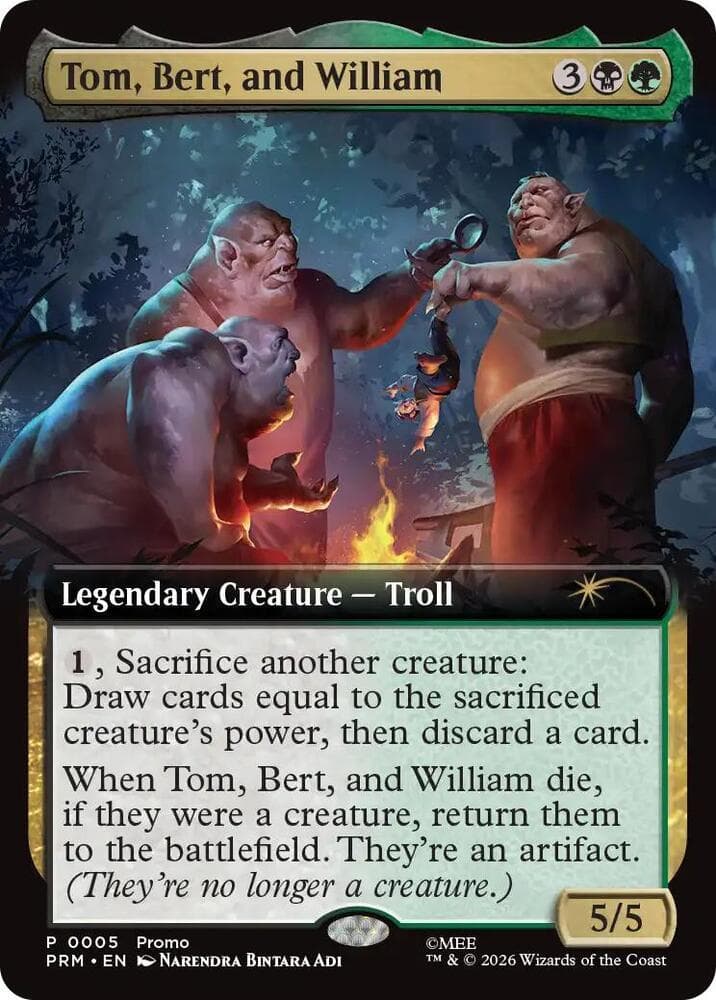
Tom, Bert, and William already looks like the kind of Commander legend that makes brewers stop and start sketching piles. Bennie Smith’s deck tech treats the card as more than a novelty from a Tolkien set, and that matters because the commander’s text points straight at value, recursion, and sacrifice loops instead of straightforward combat.
The card is a 5/5 Legendary Creature - Troll for {3}{B}{G}. Its activated ability, {1}, sacrifice another creature, draws cards equal to that creature’s power, then makes you discard a card. Its death trigger brings it back to the battlefield if it dies while it was a creature, and it returns as an artifact. That combination is the entire story: every body you cash in can become cards, and every time Tom, Bert, and William itself dies, it threatens to come right back and keep the engine going.
Why the early numbers matter
Tom, Bert, and William is not sitting in the Commander database as a solved puzzle. EDHREC shows only 111 decks on the commander page and 104 on the decks page, which is still very early adoption for a build-around legend. That tiny footprint is exactly what makes the card interesting right now: the community is still deciding whether the best shell is aristocrats, combo, reanimator, or something more counter-centric.
The tag spread is telling. EDHREC already surfaces Aristocrats, Combo, Reanimator, and +1/+1 Counters as the dominant macro-archetypes around the card, which means players are not seeing a one-note sacrifice commander. They are seeing a flexible engine that can point in several directions, depending on whether you want to grind, loop, or go over the top with death triggers.
What Bennie Smith is really spotlighting
Bennie Smith’s May 12, 2026 deck tech frames the commander as a “Greater Good-ish shenanigans” card, and that is the right instinct. The draw ability rewards you for feeding it creatures with real power, not just disposable chaff, so the deck wants bodies that either replace themselves or are worth turning into a fresh grip.
That pushes the build away from pure combat and toward resource conversion. Instead of asking whether your Troll can attack profitably, the real question is how often you can turn a creature into cards, turn those cards into more creatures, and keep Tom, Bert, and William alive long enough to repeat the process. That is the kind of play pattern Commander players love because it creates choices on every turn cycle.

The packages that make the commander hum
The early deck tags point to the core packages you want to prioritize. Aristocrats gives you the usual death payoff structure, Combo points toward repeatable loops, Reanimator keeps the graveyard relevant, and +1/+1 Counters suggests there is also room to grow sacrifice fodder into meaningful draw spells.
- Recursive threats matter because the commander wants a steady stream of bodies that can come back and do it again.
- Sacrifice-friendly creatures are better than random filler because Tom, Bert, and William cares about power, not just quantity.
- Graveyard support keeps the discard clause from becoming a tax, since the card naturally pushes things into the yard.
- Counter synergies help turn small creatures into bigger draw bursts, which makes each activation more than a cantrip.
That is the appeal of the card as a Commander project: you are not locked into one lane. You can lean into an aristocrats shell if you want reliable drain and sacrifice value, pivot into a combo build if your table expects loops, or slow the deck down into a grindy reanimator plan that keeps recycling the same threats.
Why the death trigger is the real glue
The death trigger is what separates this legend from a generic sacrifice outlet. If Tom, Bert, and William dies while it is a creature, it comes back as an artifact, which means the commander itself is built to resist the natural weakness of sacrifice strategies: losing your centerpiece. That matters in Commander, where one removal spell often decides whether a deck can keep functioning.
It also explains why early coverage is already talking about infinite combo potential and death-loop abuse. A commander that can sacrifice other creatures for cards and then return after death invites players to ask a very specific question: how many times can this be repeated before the table runs out of answers? That is a powerful brewing prompt, especially when the card already wants you in black and green, the two colors that best support recursion, tutoring, and creature-based engines.
The release window gives brewers an edge
The timing is part of the story too. Magic: The Gathering | The Hobbit is scheduled for worldwide release on August 14, 2026, with prerelease events running August 7 through August 13, 2026. The set is already available for preorder and sits inside the Universes Beyond line, so this is not a distant speculative card pool. It is a real upcoming product wave, and Commander demand will likely sharpen quickly once the set lands.
That is why an early deck tech like Bennie Smith’s matters. It gives players a chance to decide whether Tom, Bert, and William is worth hunting as an aristocrats shell, testing as a combo engine, or filing away as a graveyard deck before the broader market and the broader table meta settle on a consensus. In Commander, that window is often where the best buys and the most interesting builds happen.
A Tolkien crossover with a proven Commander footprint
There is also a useful historical parallel here. The Lord of the Rings: Tales of Middle-earth launched with four Commander decks on June 23, 2023, and it established that Tolkien-branded Magic releases can drive serious Commander attention. The Hobbit arrives into a format that already understands how much appetite there is for Middle-earth cards, especially when they offer strong mechanical hooks and not just flavor.
Tom, Bert, and William fits that pattern perfectly. It has the kind of text that asks to be broken, the kind of death trigger that invites recursion, and the kind of early deck data that says the community is still experimenting. Bennie Smith’s deck tech captures the moment well: this is not just a Troll legend to admire, it is a live brewing challenge for players who like turning sacrifice into advantage and death into another turn’s worth of cards.
This article was produced by Prism’s automated news system from verified source data, official records, and press releases, then run through automated quality and moderation checks before publishing. The system is built and supervised by the people who set the standards it runs under. Read our full AI policy.
Did this article answer your question?