Budget blink-Equipment build turns The Mighty Thor into a Voltron threat
Jane Foster turns a budget Azorius shell into a real Voltron plan, where blink keeps the cards flowing and every Equipment drop pushes the commander closer to lethal.
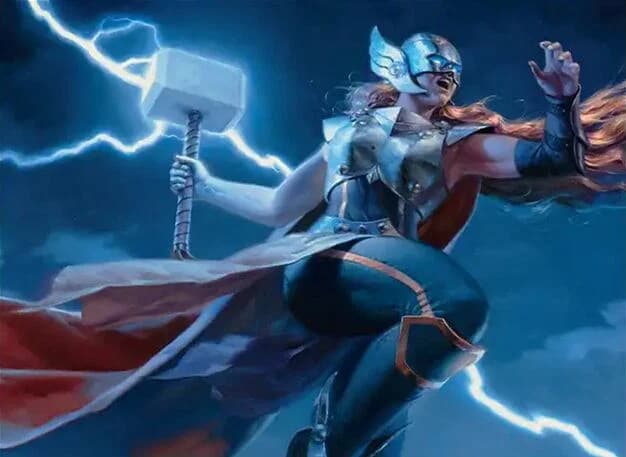
The Mighty Thor, Jane Foster is the kind of Commander that rewards clean deckbuilding instead of forcing a theme into every slot. In Ciel Collins’ Love & Thunder list, she sits at the center of a budget-friendly Equipment shell that uses blink to generate value, keep the board moving, and still present a credible Voltron clock.
A Marvel commander that already knows her lane
Jane Foster’s color identity is Azorius, and that alone tells you a lot about how she wants to play. EDHREC currently shows 563 Commander decks built around her, while the card page tracks 2,084 decks overall, a sign that players are already treating her as more than a novelty crossover legend. The tag spread is just as telling: Equipment, Blink, Voltron, and Artifacts all sit near the center of her profile, which points to a hybrid value-combat deck rather than a pure gimmick build.
That matters because the best Marvel legends in Commander are not the ones that demand you rebuild your whole list around a single joke. Jane Foster plugs into a plan many players already know how to pilot: deploy value artifacts, suit up a threat, and press advantage through combat. The difference is that she gives that familiar shell a new engine, and the result is a commander that feels thematic without losing structure.
Why blinking an Equipment deck actually makes sense
Jane’s text is what makes the package work. She is a 3/3 legendary Human God Hero with flying, and when she attacks, she exiles up to one target nontoken artifact or creature and returns it to the battlefield tapped under its owner’s control. She also draws a card whenever an Equipment you control enters the battlefield. Those two abilities pull in the same direction: play permanents that matter when they enter, then keep reusing them.
Blink is not just protection here. In a deck full of artifacts and creatures with enter-the-battlefield value, blinking turns one card into repeated utility, and Jane’s attack trigger gives you another way to reset your own pieces while temporarily removing a blocker or a problematic artifact. Because the returned permanent comes back tapped, the ability can also buy a tempo window, which is exactly what a Voltron deck wants when it is trying to force through combat damage.
The cleanest part of the design is that the Equipment package does double duty. It fuels the commander’s draw trigger, and it gives you the stats and keywords needed to turn a flying 3/3 into a real threat. Instead of choosing between value and pressure, the deck uses the same cards to do both.
The budget build keeps the engine intact
Ciel Collins’ companion list, Love & Thunder, puts a concrete number on the approach: Archidekt estimates the deck at about $114.10. That keeps the build in the range where it can lean on synergy instead of pricey staples, which is exactly what makes the list interesting for everyday Commander play. The Archidekt tags, Equipment, Tap/Untap, and Blink, reinforce that the deck is built around repeated actions rather than one explosive combo turn.

That tap-untap tag is a clue that the deck is not just trying to pile on swords and call it a day. It suggests a structure that wants to keep Jane attacking, keep her triggers online, and keep permanent-based value cycling through the battlefield. In practical terms, that means the deck is happiest when it can turn each combat step into a small sequence of gain, reset, and re-deploy.
The budget angle also makes the deckbuilding lesson sharper. If you want to use a Universes Beyond legend well, you do not need to turn the list into a tribute act. You need to ask what the commander already does, then build around that text with the same shell you would have used for a non-crossovers commander in the same colors.
How the deck closes games
Jane Foster wins by making ordinary turns snowball. Equipment entering the battlefield draws cards, which keeps the hand stocked; blink effects recycle useful artifacts and creatures, which keeps the board from running out of gas; and the commander’s own body, a flying 3/3, gives you a reliable evasive attacker once the Equipment starts stacking up. EDHREC’s commander tags line up with that plan, because the deck is not trying to be a toolbox or an all-in aura list. It is a Voltron deck that keeps drawing cards while it does the usual Voltron thing.
The best pilots will treat her attack trigger as both removal and setup. A tapped permanent is a temporary opening, and in Commander that window is often enough to push damage, protect a key line, or reset a value piece for another round. When the blink package is doing its job, every combat step becomes another chance to re-use the battlefield instead of merely advancing on it.
What Jane Foster teaches about Marvel commanders
Jane Foster is proof that a crossover commander can strengthen an established archetype instead of replacing it. The deck does not need to announce itself as Marvel first and Commander second. It functions because the commander cleanly supports an Azorius Equipment shell, and because blink adds a layer of play that makes the list feel fresh without abandoning its core plan.
That is the real draw of the card’s first wave of brewing around Magic: The Gathering | Marvel Super Heroes, which released on June 26, 2026. Jane Foster does not ask you to choose between flavor and function. She lets you play a familiar Equipment deck, then rewards you every time you blink, re-equip, and swing with a commander that can actually finish the job.
This article was produced by Prism’s automated news system from verified source data, official records, and press releases, then run through automated quality and moderation checks before publishing. The system is built and supervised by the people who set the standards it runs under. Read our full AI policy.
Did this article answer your question?