Crab Twin turns Red Death, Shipwrecker into a combo machine
Red Death, Shipwrecker stops being a combat nuisance and becomes a compact combo shell, with Kiki lines and Marvin plus Pili-Pala doing the real work.
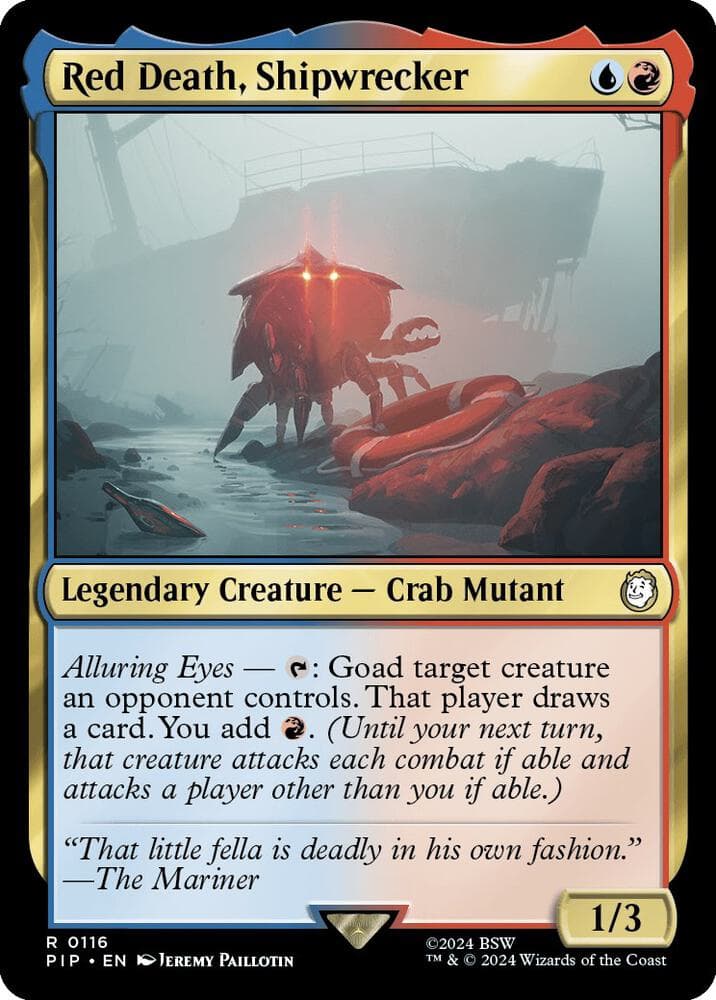
Crabs can be more than a joke, and Crab Twin makes that plain. Benjamin Levin’s July 7 deck tech turns Red Death, Shipwrecker into a modular combo commander, built to win like a Splinter Twin shell instead of trying to end the game with one giant combat step. The real story here is not the name on the card. It is how the list assembles two-card finishes, what pieces never change, and how much of Red Death’s identity you can flex before the deck stops feeling like Red Death at all.
How Crab Twin actually wins
The heart of the list is redundancy. Crab Twin leans on a stack of two-card combo lines, including classic Kiki lines and a Marvin plus Pili-Pala engine, so the deck is never forced to hinge on one narrow sequence. That matters in Commander, where one broken-up line often means the difference between looking clever and actually closing the game.
That structure gives the deck a very specific rhythm. You are not building a battlefield and hoping your commander survives long enough to turn sideways. You are assembling overlapping pieces, forcing the table to answer one threat after another, and then converting the right pair of cards into a finish. The Splinter Twin comparison is useful because it captures the play pattern exactly: one card provides the shell, another card turns that shell into a loop, and the rest of the deck exists to help you find, protect, and reuse those lines.
What stays fixed, and what can flex
The essential part of Crab Twin is not a particular combat plan. It is the combo map. Kiki lines and the Marvin plus Pili-Pala engine are the core win paths named in the deck tech, and everything else should be judged by how well it supports those lines. If a slot does not help you assemble, protect, or recur one of those finishes, it is probably a flex slot rather than a foundation piece.
That flexibility is the reason Red Death is such a natural commander for this kind of build. EDHREC’s commander page places Red Death, Shipwrecker at rank #867, with 2,742 decks using it as commander, and the archetype labels around it are all over the map. Forced Combat is the dominant tag, sitting at 305 decks on the archetype page, while Wheels, Group Hug, Control, and Combo show up at 73, 72, 41, and 40 decks respectively. In other words, the card already lives in multiple deckbuilding conversations, which makes it a better shell for a re-read than a commander with only one obvious job.
Why the community already had room for this build
Red Death’s identity has never been locked to one lane. EDHREC’s archive shows the commander collecting labels over time, including forced combat, group hug, wheels, control, and combo, and that breadth explains why a tech like Crab Twin can feel both surprising and completely plausible. The broader Commander community has already treated the card as a piece that can pressure the table, steer politics, and contribute to a combo finish. Levin’s deck simply chooses one of those identities and pushes it hard.
Wizards of the Coast’s Gatherer page adds another layer to that identity. Red Death, Shipwrecker is an official Magic: The Gathering card from the Fallout crossover set, and its type line reads Legendary Creature - Crab Mutant, card PIP 116. That detail matters less as a punchline than as context: the commander already arrives with a strange, memorable frame, and the build uses that frame for a list that is far more precise than the name suggests.
What to know before you put it in your meta
If your table expects Red Death to be a forced-combat nuisance, Crab Twin changes the conversation fast. The deck still sits on a commander that the community has historically associated with pressure and politics, but the win plan now asks the table to respect combo assembly first. That means the list will feel strongest in metas where players can interact early and where having more than one line to victory is a real advantage.
It also means the deck rewards pilots who like choosing their route on the fly. A pod full of creature decks may leave more room for setup, while a table that holds up removal will punish a list that cannot switch from one combo lane to another. Crab Twin’s appeal is that it does not ask Red Death to become a different commander. It asks the table to notice that the crab can force combat, wheel, bargain, and then still assemble a clean finish when the right two cards line up.
That is the move Crab Twin makes so well. It takes a commander many players already filed under pressure and politics, then shows that the same shell can assemble like a combo deck, pivot like a toolbox, and still feel unmistakably like Red Death when the last piece falls into place.
This article was produced by Prism’s automated news system from verified source data, official records, and press releases, then run through automated quality and moderation checks before publishing. The system is built and supervised by the people who set the standards it runs under. Read our full AI policy.
Did this article answer your question?