Crumbling Sanctuary Recasts Damage as Mill, Unleashing Artifact-Control Chaos
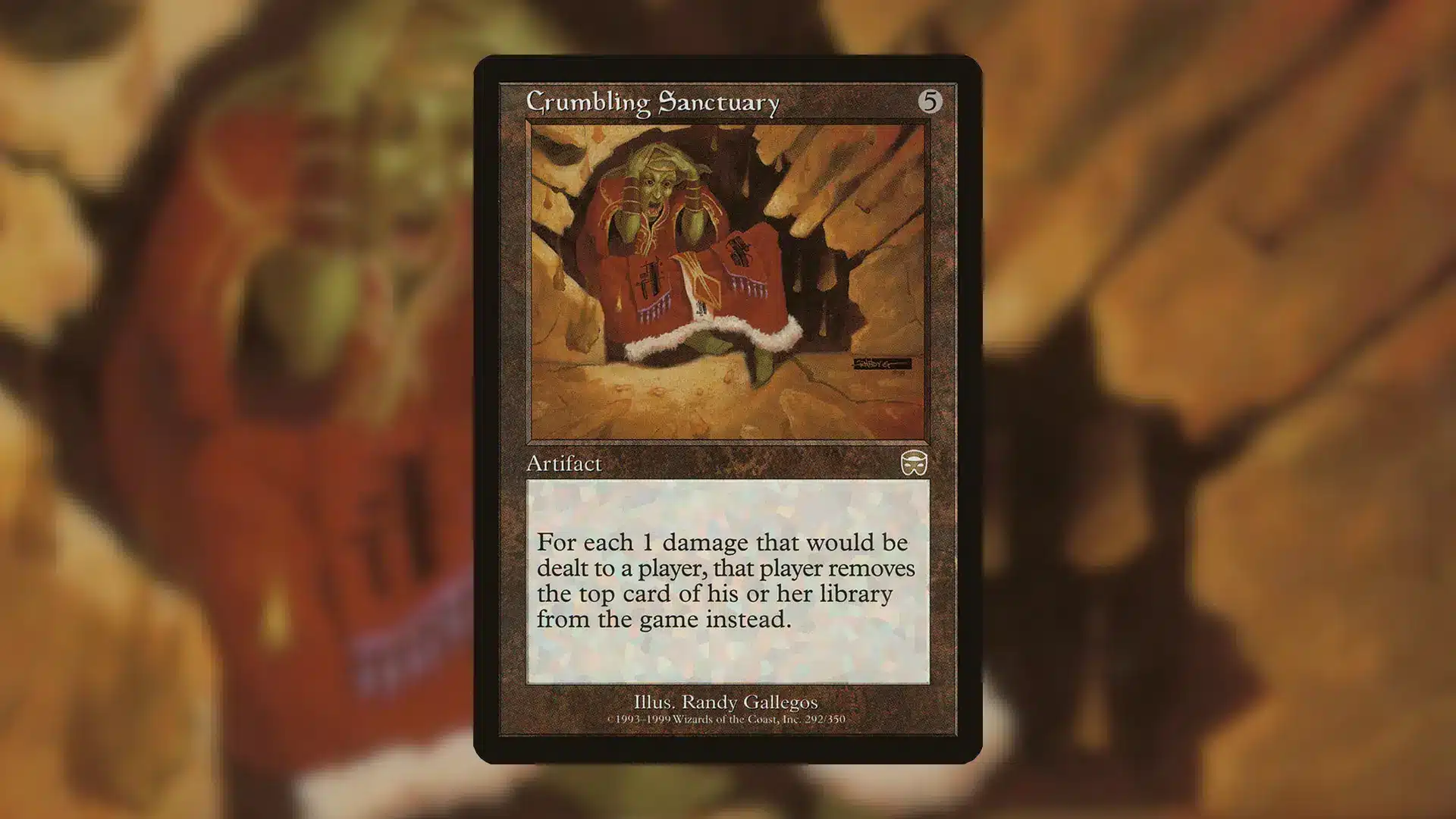
Crumbling Sanctuary turns every damage step into library pressure, making turbo fog, exile payoffs, and mill shells suddenly much nastier.
Why Crumbling Sanctuary matters now
Crumbling Sanctuary does something brutally simple and deeply strange: “If damage would be dealt to a player, that player exiles that many cards from the top of their library instead.” In Commander, that does not just blunt combat, it changes the win condition in the middle of the game, because every attack step becomes a race against a 100-card deck instead of a 40-life total.

That is exactly why the card has real table power again. Commander starts everyone at 40 life and uses 100-card singleton decks, so Sanctuary converts a huge resource pool into the actual clock. The longer it sits on the battlefield, the more it behaves like a prison piece, except the prison bars are made of your library disappearing one card at a time.
What the card actually does at the table
Crumbling Sanctuary is a rare artifact from Mercadian Masques, and its Oracle text is the whole story. It does not prevent damage in the normal sense, it replaces damage with exile milling, which means any point of damage that would have landed instead strips cards off the top of a library.
Two rules details make the card even more warped. First, the replacement effect applies to all players, not just the controller. Second, if a player has no cards left in library, damage to that player does nothing because the replacement action cannot happen. That means Sanctuary can create weird endgames where life totals stop mattering and deck size becomes the only resource that still counts.
For Commander, that creates a very specific problem and opportunity. Straight combat decks get taxed hard, but decks built to ignore damage, recover from exile, or profit from cards leaving libraries can turn the same effect into a lock or a clock.
The shells that break parity
Turbo Fog is the cleanest way to make Sanctuary hurt everyone else first. If you can stop the damage with cards like Inkshield, Solitary Confinement, and Energy Field, then Sanctuary becomes one-sided pressure, because opponents still bleed library cards while you stay intact. That is the kind of setup that turns the artifact from a curiosity into a real plan.
Exile-friendly creatures and payoff cards take the plan even further. Misthollow Griffin and Eternal Scourge are the kind of cards that keep you playing Magic while your own deck is being chipped away, because they do not mind exile the way normal threats do. Laelia, Blade Reforged and Crackling Drake push the opposite angle, turning exiled cards into direct value and damage so that Sanctuary is not just defensive, it is feeding your board.
That mix is what makes the card feel mean in the best Commander way. It does not need a combo finish to be dangerous. It just needs a shell that can survive long enough for the table to realize the damage step has become a self-inflicted library purge.
The commanders that can actually use it
Mill-heavy commanders are the most natural home, because they already care about reducing decks to nothing and already know how to win a resource war. MTG Rocks points to Oona, Queen of the Fae, Phenax, God of Deception, and Umbris, Fear Manifest as clean fits, and that makes sense immediately. Each of them wants the game to revolve around library pressure, not life totals, so Crumbling Sanctuary slots in as a global engine that accelerates the whole plan.
There is also a more political and flexible side to the card. Zedruu, Sky Rampart, Kenrith, the Returned King, and Pramikon, Sky Rampart all point toward shells where color access, table manipulation, and unusual board states matter as much as raw inevitability. In those lists, Sanctuary can be a strange bargaining chip, a soft lock, or a way to make combat math look ridiculous.
That spread of commanders is the real signal. Crumbling Sanctuary is not confined to one narrow archetype, but it does reward decks that are comfortable playing a long, annoying game where life totals are basically a distraction.
Why exile support matters so much
The card sounds symmetrical until you build for the exile side of the equation. If Sanctuary is turning damage into exile, then your deck should treat exile as a resource, not a punishment. That is where the current Commander environment gives the card extra texture, because official Wizards of the Coast Commander 2021 decklists include Laelia, the Blade Reforged, a clean example of a recent card that actively rewards exile-heavy play patterns.
That matters because it shows the plan is not just theoretical. If your list can convert the cards Sanctuary exiles into pressure, card flow, or combat damage, then every point of damage being redirected becomes a form of progress. Instead of asking, “How do I survive this weird artifact?”, the better question becomes, “How do I turn every combat step into fuel?”
How the card actually plays from the first turn it matters
The best Crumbling Sanctuary games are not explosive, they are oppressive. Once it resolves, every attack, ping, or incidental damage source starts trimming libraries, and that changes how the whole table behaves. Suddenly, small chips of damage matter more than big life swings, because each one is a miniature mill spell attached to combat.
That is also why the card becomes stronger the longer it survives. Early on, players may shrug because 40 life still feels like a lot. But with Sanctuary on the battlefield, every combat step is secretly shortening the game, and the table eventually has to decide whether to answer the artifact or race a shrinking deck.
EDHREC shows 883 decks using Crumbling Sanctuary, which is enough to prove this is not just a forgotten relic sitting in bulk bins. It is a niche build-around with real Commander gravity, the kind of old card that keeps resurfacing because the format’s size and life total make it weirdly better than it first appears.
The practical takeaway
Crumbling Sanctuary is strongest when you stop treating it like a damage-hate oddity and start treating it like an engine. Pair it with fogs if you want to break parity, with exile payoffs if you want to turn the milling into advantage, and with mill commanders if you want the whole deck to lean into the same pressure point.
That is the reason the card deserves a fresh look. In Commander, where everyone begins at 40 life and library size is the real hidden resource, Crumbling Sanctuary does not just survive the modern table. In the right shell, it hijacks it.
This article was produced by Prism’s automated news system from verified source data, official records, and press releases, then run through automated quality and moderation checks before publishing. The system is built and supervised by the people who set the standards it runs under. Read our full AI policy.
Did this article answer your question?