Gorma, the Gullet’s infinite persist loops face cEDH viability test
Gorma’s persist loop is real, but cEDH only rewards it if the list is fast enough to survive interaction. The first 427 brews suggest combo teeth, not just casual value.
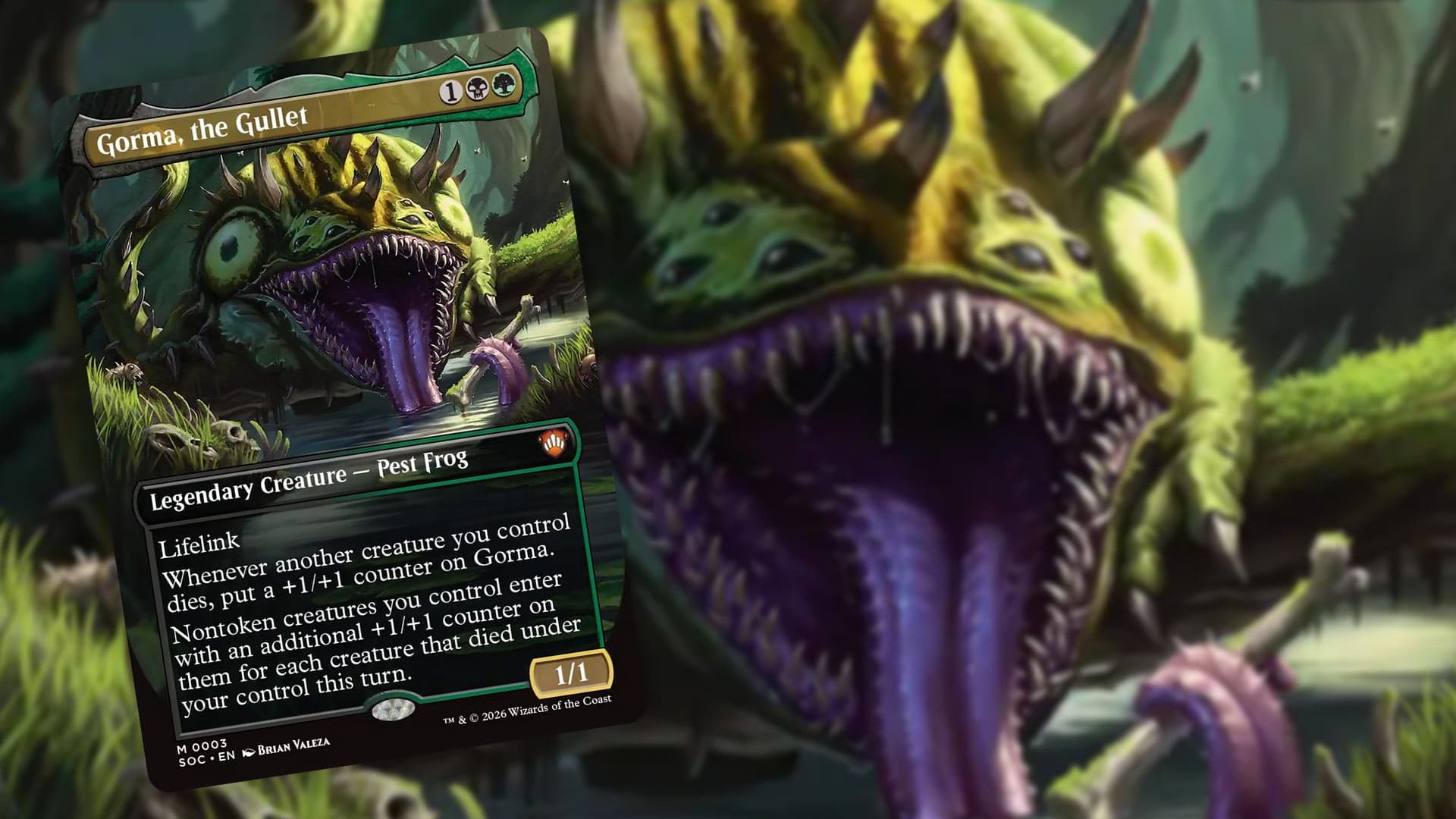
Can Gorma, the Gullet actually earn a seat at real cEDH tables this season?
The short answer is yes, but only on a narrow path. Gorma is not just a cute +1/+1 counters commander with aristocrats upside. It is a {1}{B}{G} legendary Pest Frog with lifelink that turns every creature death into permanent growth and makes nontoken creatures enter bigger based on the deaths that already happened this turn. That is the kind of text box that forces cEDH players to stop and check the math.

Why Gorma gets immediate attention
Harvey McGuinness’s April 15 article, *Building Gorma, the Gullet for cEDH*, zeroes in on the exact question competitive players care about: does this commander do anything broken enough to matter at the highest level? The answer starts with the commander’s rules text. Whenever another creature you control dies, Gorma gets a +1/+1 counter, and every nontoken creature you control enters with an additional +1/+1 counter for each creature that died under your control this turn.
That second clause is the real pressure point. It means Gorma does not merely reward sacrifice, it compresses the turn into a resource engine. Once you start looping deaths, every follow-up creature becomes part of the combo rather than just another body. In cEDH terms, that makes Gorma more than a value commander. It is a potential combo core.
The persist loop is the real test
The most important line around Gorma is the persist line. MTG Rocks described the deck’s core trick on April 3, saying Gorma can exploit persist by pairing the commander with a persist creature and a free sacrifice outlet. The loop works because the persist creature returns with both a +1/+1 counter and a -1/-1 counter, and those counters cancel out. That interaction is what turns the commander from a board-growth engine into a repeatable engine of death triggers.
Once the loop is online, Blood Artist becomes the cleanest example of why the deck matters. If each creature death is also draining the table, the loop stops being cute and starts becoming lethal. That is the exact kind of compact win condition cEDH decks want: a small number of cards, minimal board presence, and a line that converts setup into a kill without needing combat.
What makes Gorma interesting is that the commander itself helps the loop function. It is not just sitting there asking you to assemble a two-card combo somewhere else. It actively improves the state of the board every time your creatures die, which can matter when your combo piece needs to return with the right counter state.
What the current brewing data says
This is not a theory-only commander anymore. EDHREC showed 427 decklists built around Gorma by April 16 to 17, 2026, which is a meaningful early signal for a commander that has not even been released yet. The platform’s tags point in the same direction: +1/+1 counters, aristocrats, combo, and tokens.
That spread tells you something important about the deck’s identity. Gorma is already being explored from multiple angles, but the overlap between aristocrats and combo is where the real cEDH conversation lives. Tokens and counters give the deck board texture, but the competitive question is whether those pieces are just the scaffolding for a deterministic kill.
Scryfall lists Gorma as unreleased with an April 24, 2026 release date, so this is still a pre-release brewing story, not a settled metagame report. That timing matters. Before a commander has actual tournament data, the best indicator is whether it presents a clean, low-card-count combo that can be protected and repeated. Gorma passes that first screen.
Where Gorma looks better than ordinary Golgari value shells
Golgari has always been happy to sacrifice things, recur things, and grind with death triggers. Gorma stands out because it ties those habits to a specific combo incentive. The commander does not ask you to build a slow midrange pile and hope the table runs out of answers. It rewards you for making your board state recursive.
That makes Gorma especially attractive in tables where creature-based combo is safer than spell-heavy combo. If the room is full of decks that lean on removal, combat pressure, or softer stax pieces that do not completely shut off sacrifice, Gorma can pivot between board development and combo assembly in a way that feels leaner than many black-green commanders. The lifelink is not the headline, but it does help in races and gives the deck some incidental stability when games get messy.
At the same time, Gorma’s best lines are still creature-dependent. That is a strength when your table is light on exile-based interaction and artifact hate, and a weakness when the room is packed with instant-speed disruption or hard hate for graveyard and creature loops. In other words, Gorma is explosive, but it is not invisible.
When to register it, and when to leave it in the binder
If your local cEDH table rewards compact creature combos, Gorma deserves a serious look. The commander’s best case is a fast, resilient sacrifice shell with a persist creature, a free sacrifice outlet, and a drain finisher like Blood Artist. In that configuration, Gorma can threaten kills early enough to matter and generate enough value through the loop to force opponents to answer it immediately.
If the table is dense with exile removal, fast combo that ignores the combat axis, or stax pieces that break sacrifice lines, Gorma becomes much harder to justify. It is powerful, but not automatically faster than the format’s best decks. It still needs setup, and setup in cEDH is always a tax.
So does Gorma earn a seat at real cEDH tables this season? Yes, but as a tuned combo deck, not as a generic value commander. The early 427 decklists, the persist-loop technology, and the commander’s own death-trigger scaling all point to a legitimate competitive shell. The question is no longer whether Gorma can do something broken. It can. The real test is whether your table gives it enough breathing room to do it before the rest of cEDH slams the door shut.
This article was produced by Prism’s automated news system from verified source data, official records, and press releases, then run through automated quality and moderation checks before publishing. The system is built and supervised by the people who set the standards it runs under. Read our full AI policy.
Did this article answer your question?