Hofri Ghostforge still turns sacrifice into value in Commander
Hofri Ghostforge has aged into a real Boros engine, turning every sacrifice into a token, a trigger, or a combo line that can still close games.
Hofri Ghostforge rewards you for doing what Boros already wants to do
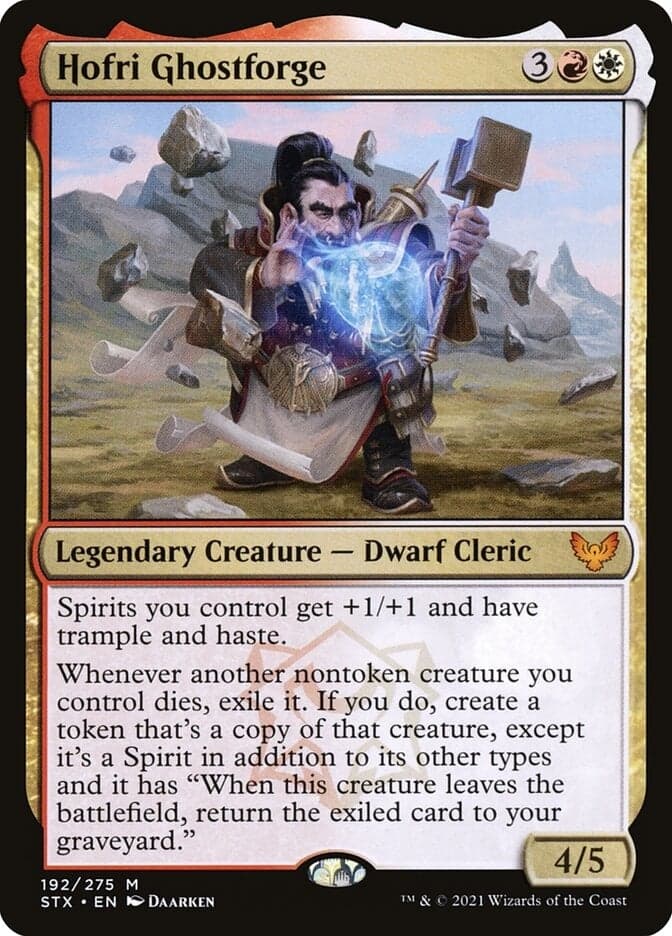
Hofri Ghostforge never stopped being interesting, but the card looks a lot sharper now than it did when Strixhaven first put it on the table. The Boros legend from Lorehold Legacies turns every nontoken creature death into a new Spirit token, and that token is more than a copy. Official rules text makes clear that the token is also a Spirit, the copied creature’s enters-the-battlefield abilities will trigger, and when that token leaves the battlefield, the exiled card returns to its owner’s graveyard. Add Hofri’s anthem, which gives Spirits you control +1/+1, trample, and haste, and you get a commander that is built to make sacrifice feel like gain, not loss.
Why the card reads better now than it did in 2021
Hofri first arrived in Strixhaven: School of Mages and Commander 2021, which released on April 23, 2021. The original Boros precon, Lorehold Legacies, was already pointed toward graveyard recursion and artifacts rather than generic combat spam, and that context matters. Hofri slots cleanly into that shell because he turns the zone Boros usually struggles with, the graveyard, into a resource engine that keeps replacing the things you cash in.
That is the real reason the legend has aged well. Every new sacrifice outlet, token doubler, death trigger, or recursion piece that has entered the pool since then gives Hofri more ways to convert a board into value. The deck does not need to reinvent itself, it just needs better tools, and Commander has printed plenty of those.
The easiest sacrifice lines are the ones that already make sense in Boros
The cleanest Hofri turns start with simple, reliable sacrifice pieces. Ashnod’s Altar and Martyr’s Cause are both perfect examples because they let you turn creatures into mana or protection while Hofri ensures you still get a payoff on the back end. Sacrifice a creature to either outlet, exile it with Hofri’s trigger, and you are not just cashing in material, you are setting up a copied Spirit that can re-enter with its own enters-the-battlefield abilities.
That interaction matters because Hofri does not ask you to build around awkward hoops. If the creature you sacrificed already had an ETB effect, the token brings that trigger back with it. The result is a play pattern that feels more like looping a resource than spending one, especially once you start aiming the engine at creatures that were already meant to die.
Token multipliers push the whole shell over the top
Once the sacrifice engine starts moving, token doublers make it snowball fast. Anointed Procession is the cleanest example, and Ocelot Pride adds another way to multiply the amount of cardboard Hofri creates from a single death. When your commander is already turning one creature into a Spirit with haste and trample, every extra token means more pressure, more triggers, and more board presence from the same sacrifice.
That is where Hofri starts to feel less like a value commander and more like a board-state tax. Your opponent cannot just measure one creature against one creature anymore, because every death is carrying replacement power with it. With a doubler out, the deck can go from “steady grind” to “suddenly overwhelming” in a single rotation.
Hofri works on stolen creatures, too
One of Hofri’s most appealing tricks is that the ability does not care whose creature you started with, only that you control it when it dies. That opens the door to threat-heavy lines with Act of Treason and Zealous Conscripts. Steal the best creature on the table, attack if the window is there, sacrifice it before it goes back, and Hofri will turn that borrowed body into a Spirit version you get to keep.
Helm of Possession is especially nasty here because it serves as both a sacrifice outlet and a theft tool. It gives the deck a way to take a creature, feed it to Hofri, and keep the value chain running without needing a separate piece for each job. In practice, that means Hofri can play both fair and unfair, often in the same game.
The Spirit half is not just flavor text
It is easy to focus on the sacrifice clause and miss how much the Spirit wording matters. Hofri’s anthem gives all Spirits you control +1/+1, trample, and haste, which means the token copies are immediately relevant even when they are not part of a combo. That matters for cards like Skyclave Apparition and Atsushi, the Blazing Sky, which help the deck pivot into a more straightforward combat plan when the table gets grindy.
This is where Hofri stops being a narrow recursion commander and becomes a flexible Boros build-around. You can lean into ETB value, you can lean into Spirit pressure, or you can mix the two and force opponents to answer threats that keep coming back with haste. Few Boros legends offer that kind of range without asking you to move off the colors’ natural strengths.
The combo finish gives the deck a real ceiling
Hofri is not just about incremental value. The commander can assemble an infinite sacrifice loop with Mistmoon Griffin plus a sacrifice outlet, and that is the part that should make players sit up. Third-party combo databases now document a Hofri Ghostforge plus Mistmoon Griffin plus Phyrexian Altar line that generates infinite colored mana, infinite death triggers, infinite enters-the-battlefield and leaves-the-battlefield triggers, and infinite sacrifice triggers. Commander Spellbook also lists Hofri Ghostforge plus Mistmoon Griffin plus Ashnod’s Altar as producing infinite colorless mana and the same broad trigger loops.
That matters because it changes how the deck closes. You are not relying only on combat math or a slow value pile to finish the game. Hofri can turn a routine board of sacrifice pieces into a loop that ends things outright, which gives the commander a ceiling far above what many players expect from an older Boros legend.
Why Boros players should care now
Hofri Ghostforge is a reminder that older precon commanders often get better as the card pool grows around them. New sacrifice payoffs, better token enhancers, and more efficient creature-recursion pieces all make the commander more dangerous than it looked in the Strixhaven era. What was once an interesting Lorehold build-around is now a commander that can value-grind, steal, pressure, and combo from the same core.
That is the real reason Hofri deserves another look. The legend did not get replaced by time, it got sharpened by it, and the old sacrifice shell now has enough support to feel less like a cute Boros experiment and more like a legitimate plan.
Know something we missed? Have a correction or additional information?
Submit a Tip