K'rrik, Son of Yawgmoth Lists Shift as cEDH Staples Rise, Fall
K'rrik is still converting life into wins, and the lists that matter now are tightening around combo, reanimation, and storm while fluff drops away.

K'rrik still rewards ruthless tuning
Julia Maddalena’s Fire and Ice column puts K'rrik, Son of Yawgmoth under the lens the deck always demands: not whether it is powerful, but which parts of the shell are actually pulling their weight. That matters because K'rrik is one of mono-black’s clearest engines, turning life into mana and compressing black costs into explosive turns that can end a game before the table fully stabilizes.
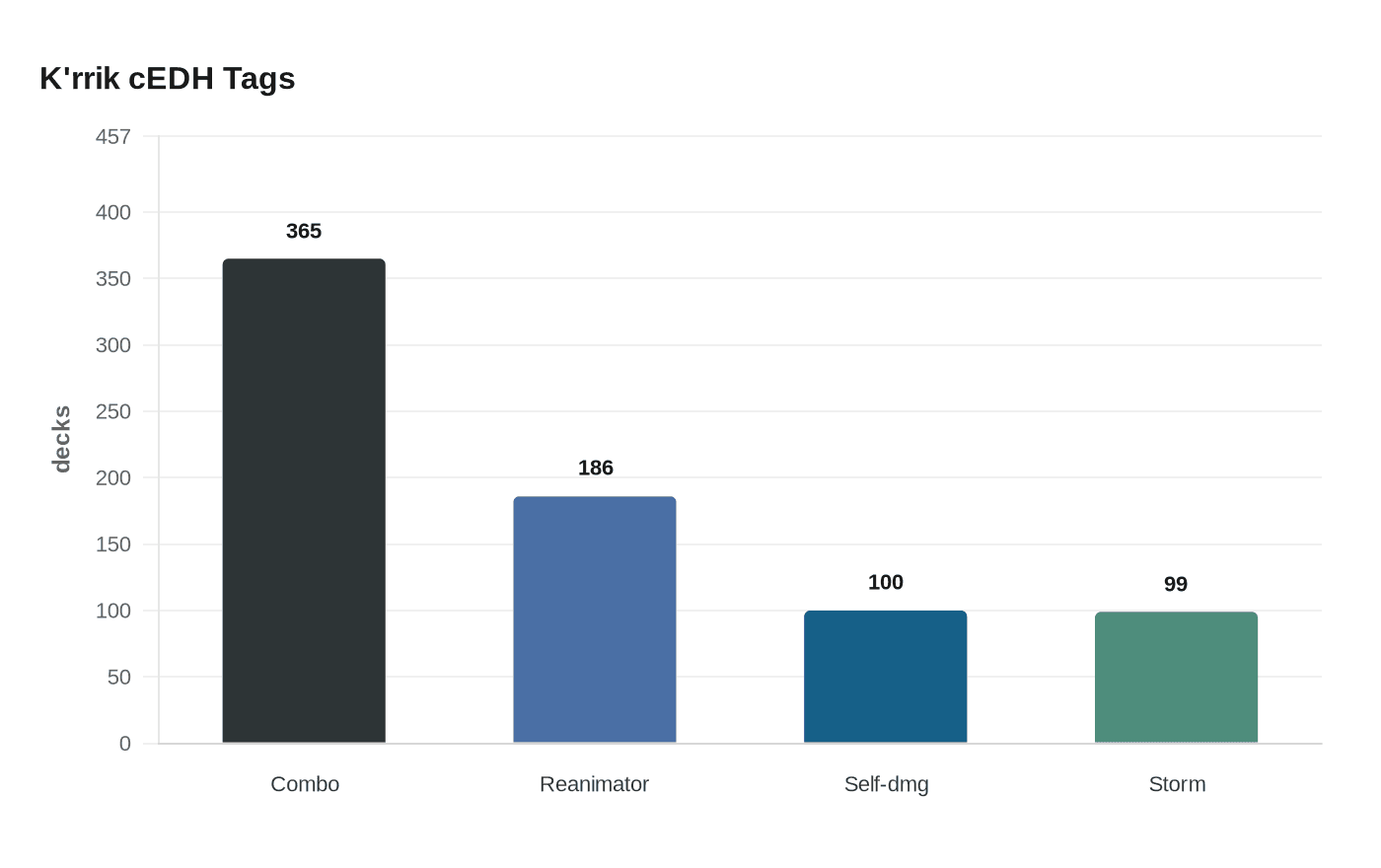
The numbers back up that reputation. EDHREC lists K'rrik in 19,220 Commander decks, while the cEDH page shows 1,413 decks. On the competitive side, the most relevant tags are combo, reanimator, self-damage, and storm, which tells you exactly where the deck is concentrating its slots when it is built to win fast rather than simply grind value.
What the deck is really optimizing for
For K'rrik, the cards that matter are the ones that improve one of three things: speed, resiliency, or combo consistency. Speed means getting from a full grip to a threatening line with minimal mana spent. Resiliency means recovering after a piece is answered or a burst turn is interrupted. Combo consistency means the deck sees enough of the right effects, in the right order, to turn K'rrik’s life-payment engine into a deterministic finish.
That is why the deck’s main tags are so revealing. Combo is the biggest category in cEDH at 365 decks, followed by reanimator at 186, then self-damage at 100 and storm at 99. In practice, that means the lists that are moving in the right direction are the ones that treat life total as a resource, the graveyard as a second hand, and spell chains as a real win condition rather than a stylistic flourish.
The cards rising in value are the ones that change the math
A K'rrik upgrade only matters if it changes how the deck plays on the critical turn. The best additions are the pieces that let you pay life for mana more efficiently, convert that mana into a clean win, or keep the engine going after the first attempt is checked. Anything that merely looks efficient on paper but does not shorten the line, protect the line, or recur the line is usually not doing enough for a high-power or cEDH build.
That is the practical filter for this deck right now. Cards that support one-shot bursts, recursive play, or compact combo construction belong near the top of the list. Cards that ask K'rrik to play a slower midrange game, build a board, or wait for value over multiple turns tend to drag the deck away from what makes it dangerous in the first place.
What is falling into noise
The easiest trap with K'rrik is mistaking style for substance. A new black card can look attractive because it fits the color identity, gains life, or creates incidental value, but those traits are not enough unless they move the deck closer to a fast win. If an inclusion does not improve speed, increase redundancy, or help the deck recover from interaction, it is probably noise.
That is especially true for lists that already lean on combo and storm. The deck does not need more cards that simply say “black” and “powerful.” It needs cards that pay for themselves immediately in tempo, compress multiple functions into one slot, or make K'rrik’s life-payment ability more oppressive. In other words, the trending pieces that matter are the ones that actually change sequencing, not the ones that just look popular in decklists.
Why K'rrik still holds up in cEDH
K'rrik’s official rules text is the core of the story: for each black mana symbol in a cost, you may pay 2 life rather than that mana. That is not a cost reduction, it is a payment change, and the distinction matters when you are trying to squeeze every point of tempo out of a turn. Scryfall also notes that K'rrik’s mana value is always 7 because of the Phyrexian mana symbols in its cost, which is a neat reminder that the card is built to cheat on the way you pay, not on what the spell actually is.
That design has aged well since Commander 2019, which released on August 23, 2019. K'rrik entered the format as part of that release, and the commander has stayed relevant because the engine is simple, brutal, and hard to fully ignore. Even now, the deck’s presence across 19,220 Commander lists and 1,413 cEDH lists shows that the archetype is still broad enough for casual power tables and sharp enough for competitive pods.
Tournament numbers show a live competitive deck
The tournament record sharpens the picture further. edhtop16 lists K'rrik with 191 entries, a 0.68% metagame share, and a 10.99% conversion rate, along with strong recent finishes across 2025 and 2026. That is not the profile of a dead strategy or a nostalgic pet deck. It is the profile of a commander that still punishes tables that are too slow, too soft to disruption, or too willing to let life total function as a free resource.
That is also why Julia Maddalena’s data-driven approach fits K'rrik so well. A statistics-minded column is the right place to ask which cards are actually rising, because K'rrik lists are always one tuning pass away from changing shape. The most successful builds will keep trimming away anything that does not accelerate the engine, preserve the combo, or close the game, and that discipline is exactly what keeps K'rrik relevant at the highest levels of Commander.
This article was produced by Prism’s automated news system from verified source data, official records, and press releases, then run through automated quality and moderation checks before publishing. The system is built and supervised by the people who set the standards it runs under. Read our full AI policy.
Did this article answer your question?