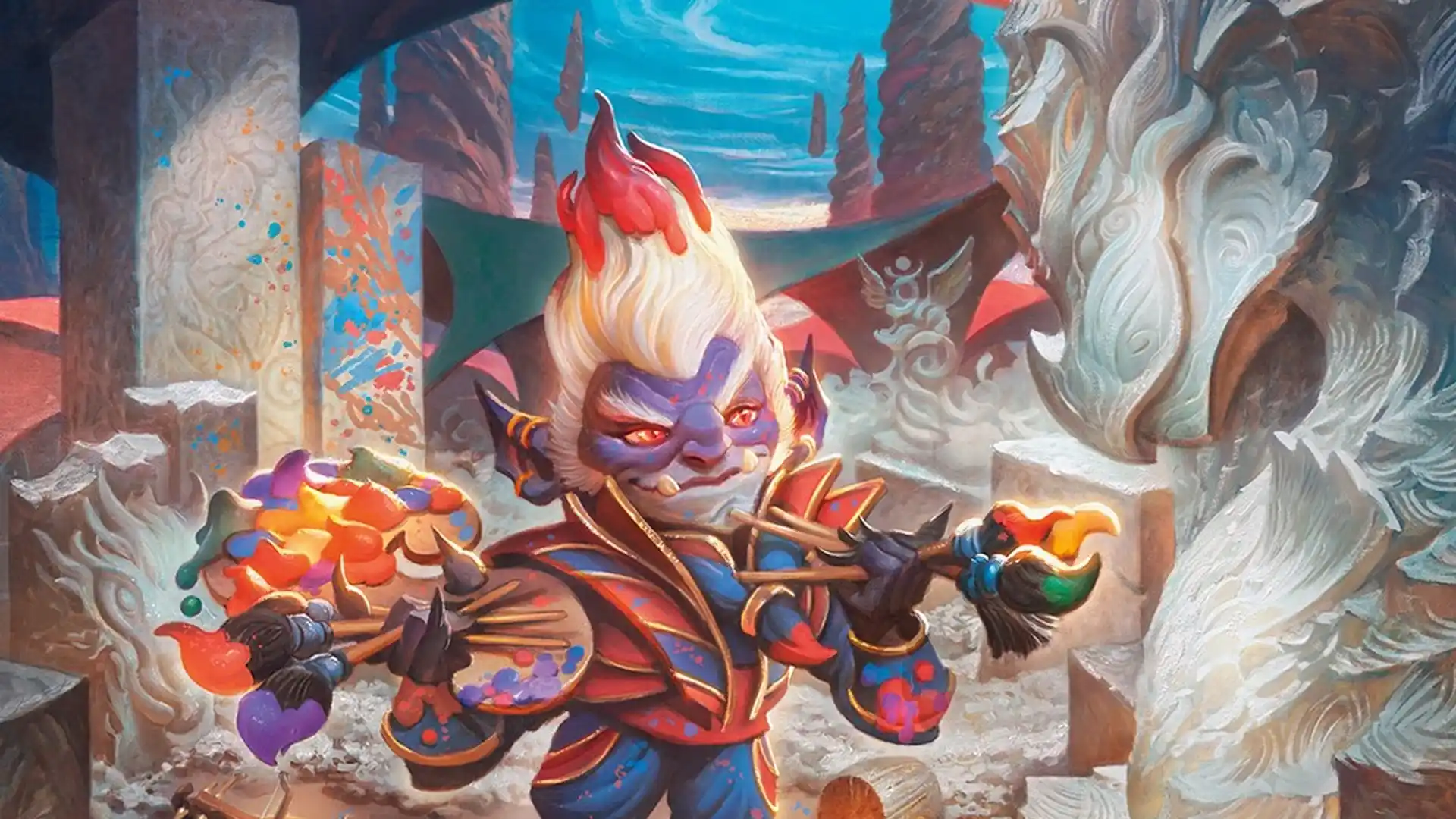
Sanar, Unfinished Genius Emerges as a Two-Mana Combo Commander Powerhouse
A two-mana tutor commander that also fuels mana is a fast track to broken turns. Sanar already has infinite mana, damage, and turn lines mapped out.
Why Sanar is dangerous on sight
A commander that costs two mana, generates mana, and tutors for the right payoff is already asking for trouble. Sanar, Unfinished Genius compresses ramp, selection, and win-condition access into a single card, which is exactly why it stands out as one of the sharpest combo commanders in the current Commander conversation.
That efficiency matters in a format built around 99-card decks, 40 starting life, and the ever-present 21 commander damage rule. Sanar does not just help you cast spells faster. It helps you find the exact spell that ends the game, which is why the card reads less like a value engine and more like a compact combo shell waiting for the right support.
What Sanar is actually doing
Sanar’s real strength is that it plays multiple roles at once. In a deck that wants to storm off, the commander can help produce mana, smooth draws through tutoring, and point you toward the finish line once the critical turn arrives. That combination makes it far more threatening than a simple two-mana ramp piece, because every activation or line effectively narrows the gap between setup and victory.
The surrounding card pool reinforces that this is not a casual synergy commander. EDHREC currently lists Sanar in 119 decks as a commander and tags it for Spellslinger, Combo, and Storm. Its combo hub already tracks 164 combos, which is a strong signal that players are building toward density and redundancy rather than cute one-off interactions.
The cleanest combo shells
Sanar’s most practical lines are the ones that ask for the fewest moving parts. The classic Dramatic Reversal plus Isochron Scepter package is the sort of compact engine that rewards a commander able to help assemble and support it. Once the Scepter is online with enough mana rocks, it can generate the mana needed to keep the loop going while Sanar keeps your hand pointed at the right next step.
Jeska’s Will plus Reiterate is another efficient route, especially in shells that are already set up to capitalize on burst mana and repeated spells. The same goes for Underworld Breach lines, where Lotus Petal, Brain Freeze, and Lion’s Eye Diamond can turn the graveyard into a resource loop instead of a liability. These are not slow, incremental value chains. They are the kind of lines that reward precise sequencing and punish tapped-out tables.
A useful way to think about Sanar’s combo map is by setup cost and card count:
- Two-card engines: Dramatic Reversal plus Isochron Scepter, Jeska’s Will plus Reiterate. These are the cleanest paths when your deck is built to produce and reuse mana quickly.
- Graveyard-fueled storm lines: Underworld Breach with Lotus Petal, Brain Freeze, and Lion’s Eye Diamond. These usually need more graveyard access and resource management, but they scale hard once started.
- Turn-lock finishers: Sanar plus Skycoach Waypoint can produce infinite turns by repeatedly casting Nexus of Fate. That pushes the commander beyond damage races and into the kind of inevitability that can end a table outright.
How fast the deck can come online
The dangerous part of Sanar is not just the existence of these lines. It is how little board presence they require once the deck is tuned. A two-mana commander can arrive early, and when that commander also searches for the payoff piece, the window to stop it gets very small very fast.
That is why Sanar fits so naturally into spellslinger, combo, and storm shells. Those archetypes already want cheap interaction, ritual-style mana bursts, and compact win conditions. Sanar simply raises the ceiling by making the commander itself part of the engine, not just a name in the command zone.
Infinite mana, damage, and turns all in one package
What makes Sanar especially alarming is the range of ways it can actually win. Some commanders threaten one axis, like infinite mana or commander damage, but Sanar’s current combo profile points to all three major pressure points: mana loops, damage finishes, and extra turns. That flexibility is what gives the card real competitive weight.
The Skycoach Waypoint line is the clearest proof. Infinite turns through repeated Nexus of Fate casts are not just flashy, they are practical. Once that loop starts, the table usually has one turn cycle left to find an answer, and often less if the Sanar pilot already has protection or interaction ready.
Serious engine or fragile glass cannon?
Sanar is absolutely a serious engine, but it is still a commander that demands discipline. The card rewards players who know exactly which line they are assembling, how much mana they need, and what the backup route looks like if the first attempt gets interrupted. In that sense, it is powerful in the most Commander-specific way possible: explosive when piloted well, but vulnerable if the table has the right hate at the right time.
That fragility does not make Sanar bad. It makes Sanar honest. If you are trying to build it as a fair value commander, you are probably missing the point. If you build it with density, redundancy, and a clear plan to convert one burst of mana into a win, it starts to look like one of the cleanest combo commanders to emerge from the recent wave of coverage.
Why the broader Commander context matters
The broader format has also moved in a direction that makes commanders like Sanar more relevant. Wizards’ Commander format rules still define the baseline: 99 cards plus one commander, 40 life, and 21 commander damage as a clean kill condition. But the conversation around the format has become more structured, with Wizards noting in February 2026 that Commander is now the largest format in Magic and that the goal is to better support everything from casual tables to cEDH.
That push also shows up in the Commander Brackets conversation. Wizards’ April 2025 bracket update reported that 87% of MagicCon: Chicago survey respondents who tried the bracket system found it helpful in their games. That is a meaningful number because it reflects how much the community wants clearer power-level signals, especially when commanders like Sanar can move from normal-looking two-drop to game-ending engine in a single turn cycle.
Sanar fits that moment perfectly. It is the kind of commander that forces a table to ask the right question immediately: do we have an answer now, or does the game end before the next rotation?
This article was produced by Prism’s automated news system from verified source data, official records, and press releases, then run through automated quality and moderation checks before publishing. The system is built and supervised by the people who set the standards it runs under. Read our full AI policy.
Did this article answer your question?