Was partner a mistake? Commander 2016’s four-color legacy revisited
Partner opened Commander 2016 to explosive deckbuilding, but the mechanic’s best and worst traits still define how two-commander designs get judged.
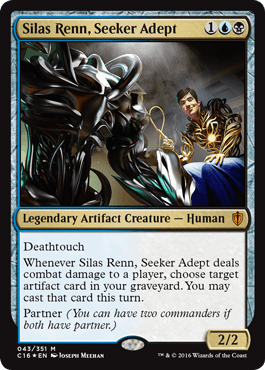
Partner is easiest to understand when you look at what Commander 2016 was trying to solve. Wizards of the Coast treated that product as the year it finally figured out how to make four-color work, and the set arrived on November 11, 2016 with 20 new legendary characters spread across five decks. Fifteen of those legends had partner, which meant Commander players got a second command-zone option attached to the release’s four-color centerpiece.
What Commander 2016 changed
That structure mattered because it did more than add new toys. The design team chose four-color as the direction for Commander 2016 after discussing it as the right year to do so, and the mechanics article for the product framed four-color as the release’s big draw. Mark Rosewater later explained that partner was added so each deck would have two different commander options alongside a four-color legend, which made the product feel flexible from the first shuffle.
The result was a package that reached both new and established players. Wizards described Commander 2016 as a good way into Commander, and that is exactly why the product still looms so large in deckbuilding conversations. Atraxa, Praetors’ Voice, Breya, Etherium Shaper, Saskia the Unyielding, Yidris, Maelstrom Wielder, and Kynaios and Tiro of Meletis did not just headline a cycle of legends, they helped define an era where the command zone itself became a major engine of power.
Why partner still draws heat
The criticism of partner is not that it is merely strong. It is that it changes how much of the game happens before a deck has even drawn its first card. When the command zone hands out color access, redundancy, and a built-in backup plan, deckbuilding can become less about choosing a lane and more about stuffing the best cards into an already-efficient shell.
That is why partner often gets blamed for compressing variety. A mechanic that gives players two commanders can make some colors more efficient than intended, and it can create combinations that are difficult to keep in check once they start interacting with the rest of the card pool. Wizards acknowledged that problem in 2020, saying partner has a built-in limitation because every new partner card powers up every existing partner card, which means the mechanic gets more dangerous every time the pool expands.
Sorting partner into three practical buckets
The cleanest way to judge partner today is to separate the mechanic into three buckets, not as a ranking, but as a way to see where the danger and the value actually live.
Still warping
The original four-color legends belong here, because they show partner’s surrounding design environment at its most extreme. Atraxa, Breya, Saskia, Yidris, and Kynaios and Tiro proved that the command zone could carry a huge portion of a deck’s identity before the game even began. These commanders changed expectations for what a Commander deck could do, and they are the clearest reminder that partner is most dangerous when it sits next to broad color access and high raw efficiency.
Now fair
This is where partner starts to look more like a tool than a problem. When the mechanic gives you two options but does not automatically hand you every color or every answer, the deck has to earn its wins through construction and sequencing rather than through raw command-zone volume. That makes the pairing feel strong without turning every game into a race against the same overbuilt opener.
For readers judging new two-commander designs, this is the key question: does the pairing expand choices, or does it remove constraints? If the answer is only choice, partner can be healthy. If the answer is choice plus free consistency plus easy access to the best colors, the design starts drifting back toward the warping bucket.
Healthiest executions
The healthiest version of partner is the one Commander 2016 itself was reaching for, even while it created all this controversy. Rosewater’s explanation makes the intent plain: a four-color legend at the center, plus a second commander option to give the deck texture and flexibility. That model works best when one commander establishes identity and the other sharpens the plan, instead of both commanders acting as interchangeable engines.
That lesson matters far beyond partner itself. Any future two-commander design needs a clear ceiling, a real tradeoff, and a reason to exist that is not just more command-zone power. If the pairing can be splashed into every best-card pile, it will become a balance problem; if it asks for a specific strategy, it can become one of Commander’s most satisfying deckbuilding spaces.
What the current Commander debate should take from partner
The broader conversation around Commander makes this question more urgent now than it was in 2016. The Commander Rules Committee says the format’s rules are updated roughly every three months when needed, and in October 2024 Wizards announced that Commander management would move from the Commander Rules Committee to Wizards’ game design team. That keeps power, accessibility, and design philosophy in the spotlight, which is exactly where partner belongs in the discussion.
The practical takeaway is simple: partner was not a clean mistake, and it was not a clean success. It opened the door to more expressive deckbuilding, but it also taught the format how quickly command-zone flexibility can snowball when the incentives are high enough. Commander 2016 used partner to solve four-color, and in doing so it gave the format one of its most useful warnings: the same flexibility that makes a commander exciting can also make it impossible to contain.
This article was produced by Prism’s automated news system from verified source data, official records, and press releases, then run through automated quality and moderation checks before publishing. The system is built and supervised by the people who set the standards it runs under. Read our full AI policy.
Know something we missed? Have a correction or additional information?
Submit a Tip