1984 Nintendo Famicom Keyboard Reborn as a Modern USB Input Device
Lucas Leadbetter stuffed an Adafruit KB2040 inside a 1984 Famicom keyboard and got QMK running on it, no special drivers needed.
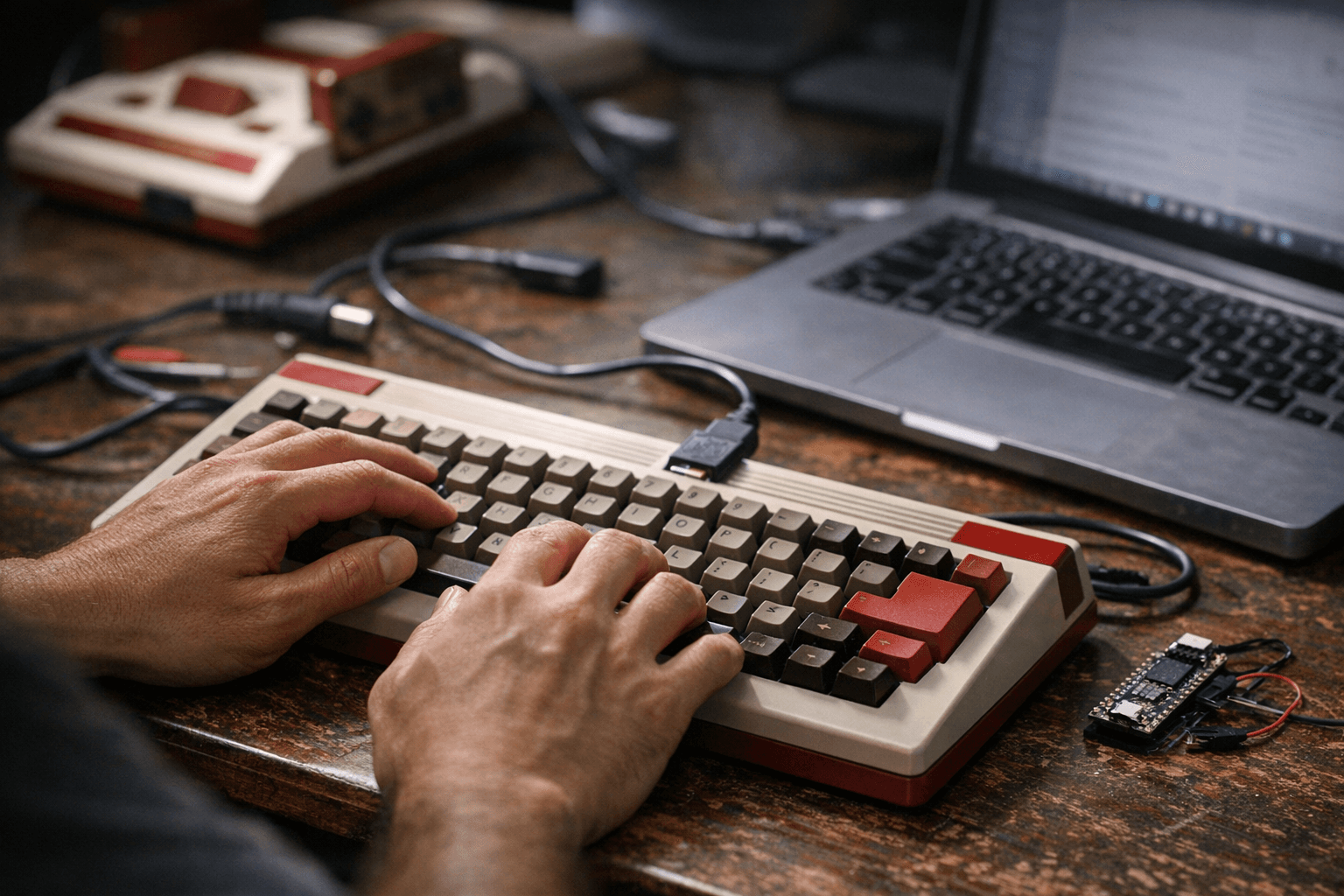
A 40-year-old Nintendo peripheral that once let Japanese Famicom owners turn their game console into a home computer now works as a standard USB HID keyboard on any modern PC, thanks to a conversion project by maker Lucas Leadbetter using an Adafruit KB2040 and QMK firmware.
The Family BASIC keyboard, released in 1984, was sold in Japan alongside a cartridge containing a word processor and programming environment that transformed the Famicom into a functional home computer. The keyboard used a DA-15 connector and a proprietary key matrix to map presses to characters, a combination that left surviving units, many of which still exist as collector's items, completely incompatible with modern hardware.
Leadbetter's path to a working USB conversion started with the NESdev wiki, which provided schematics and matrix details, and a video by Circuit Rewind that had previously demonstrated interfacing the keyboard with a Raspberry Pi Pico by reverse-engineering the onboard chip's scanning logic. Those resources, as Hackaday noted in its coverage, told Leadbetter enough "to get going, and that it should be as simple as wiring some custom hardware up to the internal keyboard matrix connector to get it speaking to USB." He reimplemented Circuit Rewind's scanning logic on an Adafruit KB2040, described by Hackaday as "an RP2040 microcontroller slapped onto a tiny PCB in a form factor that's ideal for making custom keyboards," and layered QMK on top for full modern firmware support. The build also includes VIA support, which Leadbetter explicitly encouraged others to configure: "having modern features on a 40+ year old keyboard is a treat."
A key discovery that shaped the build's philosophy came from Circuit Rewind's teardown: the DA-15 cable is not soldered to the PCB but plugs into it, making a fully reversible mod possible. Leadbetter, writing under the project name "Famikey or: How I Learned to Stop Worrying and Love the Membrane" in a February 15, 2026 post, made non-destructive conversion his primary goal. "There is an element here that preserving tech history is very important, and destroying even a piece of a relatively obscure product (obscure in the states, that is) is not good," he wrote. Final assembly involves wrapping the KB2040 in Kapton tape to prevent shorts against the metal chassis, routing a USB cable, and closing the case. Leadbetter noted the Kapton approach is practical for a mod even without a 3D-printed bracket, since it leaves no residue.
Leadbetter's project is not the only implementation circulating. A separate open-source repository titled "Famicom Keyboard Adapter" targets the Pro Micro ATmega32u4 microcontroller instead, with firmware written in C using the AVR-GCC toolchain. That project's author noted they were still waiting on parts at the time of writing and had used an LED blink test to verify the toolchain and OS permissions before committing to the full build. The repository includes build commands referencing a 16 MHz F_CPU clock, a make flash step over a /dev/ttyACM0 serial interface, and notes on a planned 3D-printed case.
Files for Leadbetter's KB2040 and QMK implementation are available on GitHub for anyone who wants to replicate the work on their own Famicom keyboard.
This article was produced by Prism’s automated news system from verified source data, official records, and press releases, then run through automated quality and moderation checks before publishing. The system is built and supervised by the people who set the standards it runs under. Read our full AI policy.
Did this article answer your question?