Alatus brings integrated trackpoint control to a compact travel split keyboard
Alatus folds a TrackPoint into a 38-key travel split, aiming to replace both mouse and larger board without giving up portability.
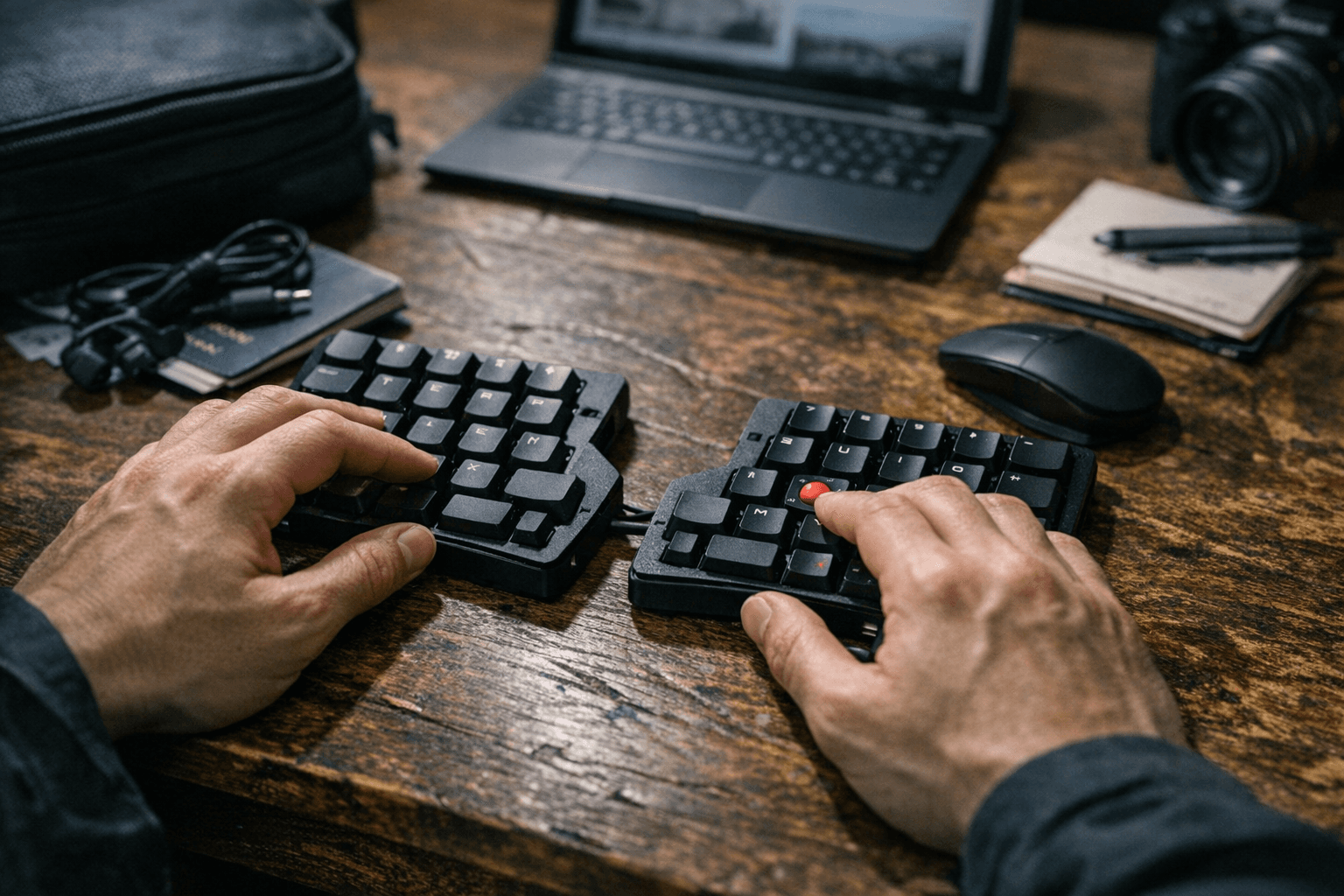
Alatus takes one of the small-split keyboard scene’s hardest questions head-on: can a 38-key travel board really stand in for both a mouse and a bigger layout if the pointing device is built in? Designed by DoomishGuy and published by kbd.news on April 20, the compact split uses a 5x3+3-ish layout with Choc v1 spacing, hotswap support, and a Pro Micro or nice!nano footprint, but the integrated TrackPoint is the feature that changes the conversation.
That matters because the 36 to 40-key split range already asks a lot from users. These boards win on bag-friendliness and desk footprint, but they often force a choice between extreme minimalism and usable pointer control. Alatus pushes back on that trade-off by keeping the pointing stick inside the board itself, along with an optional rotary encoder in the thumb cluster and support for per-key, underglow, and status RGB LEDs. The result is not just a small split, but a self-contained mobile workstation board aimed at coding on a plane, commuting, and couch use.
DoomishGuy’s design intent gives the project its shape. The board grew out of experience with older split designs such as the Fifi and the Kyria, including the very specific pain point of trying to code in cramped travel conditions. That lineage is easy to trace. The Fifi keyboard’s README describes it as a split board with 3x5 column-staggered keys and 3 thumb keys, based on foostan’s mini-crkbd schematic and Thomas Baart’s Kyria layout. splitkb.com describes the Kyria as a 40% split keyboard first designed in 2019, before being iterated several times ahead of release. Alatus reads like a next step in that line, not a novelty break from it.
The build approach also keeps it rooted in the DIY ecosystem. Alatus uses Ergogen-generated parametric layout work, and Ergogen describes its role as generating plates, cases, and un-routed PCBs from ergonomic layout descriptions. That makes the board easy to understand inside the hobby’s current language of reusable geometry, open hardware, and firmware flexibility.
The TrackPoint itself is part of a longer community experiment rather than a one-off stunt. A kbd.news guide on integrating a TrackPoint notes that builders have been working through these ideas for years, including ZMK support. Other projects, including TPS42 and the crkbd hotswap trackpoint module, show the same goal from different angles. A GitHub guide on custom TrackPoint builds even notes that some layouts may need at least 6 mm of clearance between the switch and base plates depending on module height. Alatus lands in that same lineage, but its compact 38-key form makes the idea feel more practical than flashy: a travel split that tries to keep the mouse in the board, right where small-board users have wanted it.
This article was produced by Prism’s automated news system from verified source data, official records, and press releases, then run through automated quality and moderation checks before publishing. The system is built and supervised by the people who set the standards it runs under. Read our full AI policy.
Did this article answer your question?