Hands-On Intro: Assemble, Solder, and Program a Custom Macropad
Attendees built and programmed custom macropads at a hands-on Fremont workshop, learning soldering or hot-swap assembly and QMK/VIA mapping for practical shortcuts.
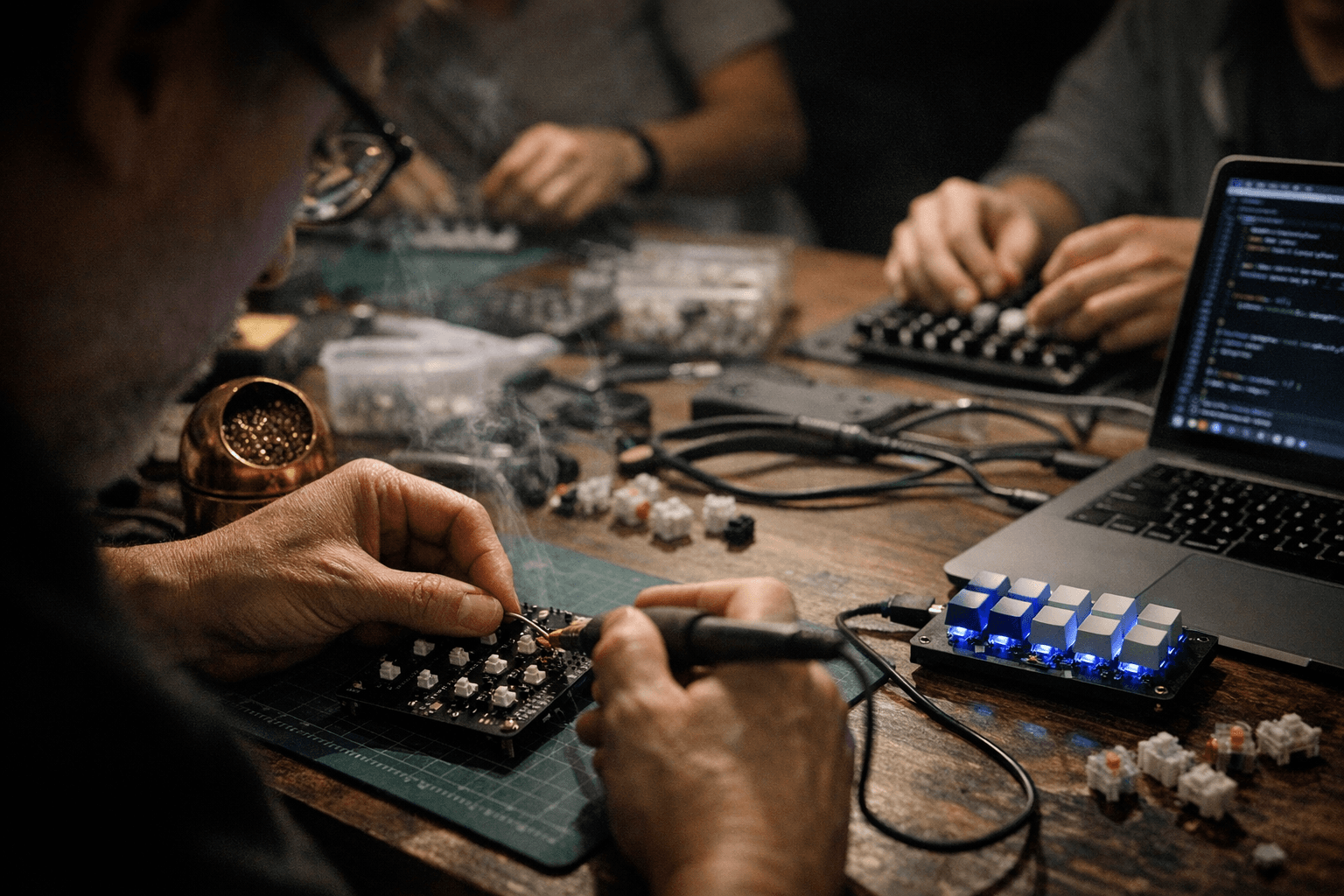
Attendees at Make Your Own Macropad | Intro to Keyboards left with working, programmable macropads after a two-hour hands-on session that taught practical hardware and firmware skills. Cassa Jam at the Art of the Bay Collective in Fremont hosted the in-person event on Saturday, January 24, 2026, and participants of varied experience levels learned how to turn parts into a useful macro controller for daily workflows.
The session focused on core shop skills: switch orientation, keycap profile choices, PCB wiring, and the soldering steps needed to secure switches to a non-hot-swap board. Where the session supported hot-swap PCBs, builders practiced switch testing and rapid swaps without solder. The class also covered QMK and VIA basics for mapping macros and layers, enabling attendees to program shortcuts for editors, streaming tools, or production software before leaving with a functional device.
Practical value was front and center. Learners who had never soldered before completed basic joints and confirmed signal continuity, while those who used hot-swap boards tested multiple switch types by feel and sound. The workshop demonstrated how operator choices - linear, tactile, or clicky switches, plus different keycap profiles - change ergonomics and typing feedback on a compact macropad. Mapping macros in QMK or VIA showed immediate payoff: a few keystrokes saved on repetitive tasks and multimedia control, making the macropad a tangible productivity upgrade.

Community relevance extended beyond the build itself. Local attendees exchanged tips on sourcing parts, stabilizing larger buttons, and optimizing layer design for single-handed use. The in-person format at Cassa Jam supported bench-level troubleshooting and peer learning, which many participants cited as the reason they finished with a working board. Ticketed attendance kept group size manageable and ensured hands-on time; the event listing had made the session beginner-friendly and age-appropriate.
For those ready to follow up, the next practical steps are clear: practice flashing QMK or adjust VIA mappings, experiment with alternate switches and keycap profiles, and document your layouts for reuse. Make Your Own Macropad showed that a modest investment in parts and two focused hours can turn curiosity into a customized tool. Expect more local build nights and workshops as builders seek small, programmable boards that solve real workflow problems and feed keyboard GAS with purpose.
This article was produced by Prism’s automated news system from verified source data, official records, and press releases, then run through automated quality and moderation checks before publishing. The system is built and supervised by the people who set the standards it runs under. Read our full AI policy.
Did this article answer your question?