Keyboard Builders’ Digest #209 spotlights splits, switches, and DIY tinkering
Split boards, switch rankings, and small DIY fixes drive Issue #209, where KBD.news shows the hobby testing ideas in public, not just admiring finished boards.
The hobby’s current obsession is hands-on proof
Keyboard Builders’ Digest #209 reads like a weekly lab notebook for the mechanical keyboard scene. KBD.news packs 11 editorial pieces and 28 additional entries into one issue, and the pattern is unmistakable: builders want things they can test, compare, and tweak themselves. Switch rankings, magnetic board reviews, split layouts, and little quality-of-life fixes all sit in the same feed, which tells you exactly where the hobby’s energy is right now.
That mix matters because it shows the community’s center of gravity is still the experimental side of the hobby. The issue is not just pointing at shiny releases; it is collecting the stuff that teaches you something about feel, geometry, or buildability. If you are tracking what people are actually talking about at the bench, this digest is the kind of guidepost that makes the scene feel legible.
Split boards are still where the most interesting ideas land
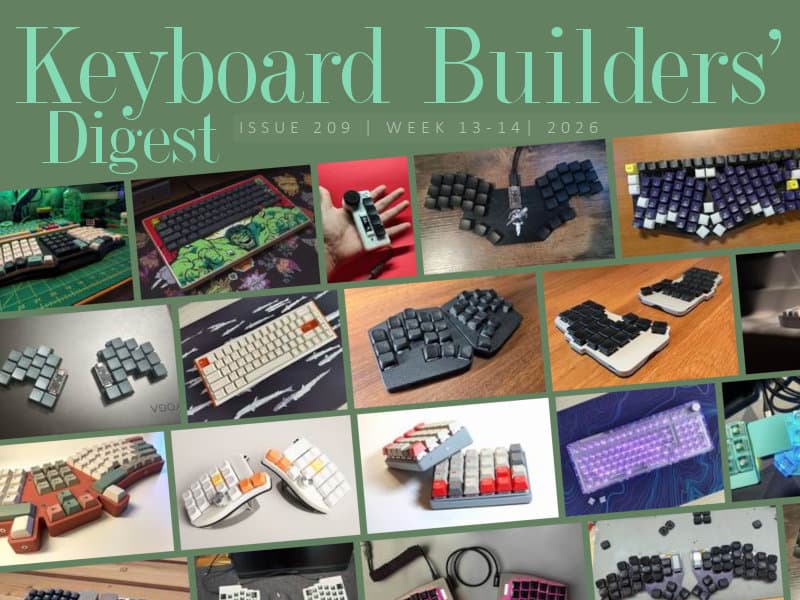
The strongest signal in Issue #209 is how many split and ergonomic projects are in motion at once. Cirrus40, Vostok Labs’ 20/20, flixo’s unnamed handwired unibody split, Pando58, Hollow Wood, Hector36, and Tom Strowger’s 3x6 board all show up as part of the same conversation. That is not a random list of curiosities. It is a snapshot of builders still pushing on geometry, thumb reach, and how far a layout can be bent before it stops feeling familiar.
The handwired unibody split is especially telling because it sits right at the intersection of DIY discipline and ergonomic ambition. A project like that usually means a builder is willing to trade convenience for control, and that instinct runs through the whole issue. Whether the form factor is more compact like the 3x6 board or more experimental like the 20/20, the common thread is the same: people are still willing to build outside the standard rectangle if the typing experience feels better.
For anyone watching the ergonomics side of the hobby, this is the important part to notice. These boards are not being treated as fringe one-offs. They are part of the main hobby conversation, which suggests split layouts and unusual geometry are no longer side quests. They are one of the places where the scene is actively defining its next round of preferences.
Switches and commercial boards keep feeding the same test bench
The opening roundup in Issue #209 does a nice job of showing how commercial releases and hobby experimentation keep cross-pollinating. The March switch rankings sit beside reviews of the KiiBOOM Phantom 98 with the Pixelpop Arcade keycap set and the Dareu Cool68 magnetic board, which gives the issue a very specific flavor: this is a space where people still care about how things feel on the desk, not just how they look in a product shot.
That matters because switch discourse is still one of the hobby’s quickest ways to measure change. A ranking only becomes interesting when it helps you compare feel in the real world, and the digest leans into that practical side rather than treating switches as abstract hype. Pairing those rankings with board reviews makes the issue feel useful to anyone who is trying to decide what to build, mod, or buy next.
The Dareu Cool68 magnetic board is a good example of the way the hobby keeps absorbing new ideas while staying rooted in hands-on evaluation. Magnetic boards bring their own set of questions about feel, tuning, and day-to-day use, and placing that review in the same issue as traditional DIY projects makes the editorial stance clear. KBD.news is not separating the commercial scene from the builder scene. It is showing how they influence each other.
The DIY tools are the real copy-and-paste value
The most builder-friendly part of the issue may be the practical tools and fixes tucked in among the project spotlights. A 3dkeycap custom keycap builder, a guide to fixing low-profile plate rattle, and a parametric MX keycap model are exactly the kind of small utilities that spread fast through the community because they solve real annoyances. They are not glamorous, but they shorten the distance between an idea and a finished board.
That low-profile plate rattle guide is a perfect example of the hobby’s current mindset. People are not just hunting for new parts, they are chasing cleaner builds and better acoustics from the parts they already own. The same goes for the parametric MX keycap model, which turns keycap design into something you can adapt rather than simply purchase. It points to a scene that is increasingly comfortable designing around its own needs.
The custom keycap builder fits that same pattern. If you build often enough, you eventually want more control over the details, and tools like this make the hobby feel less locked to off-the-shelf options. In a digest full of splits, handwiring, and layout experiments, these utilities are what make the whole ecosystem feel connected. They are the glue between inspiration and execution.
Why this issue feels like a status report on the hobby
Issue #209 works because it does not pretend the mechanical keyboard world is just one thing. It shows a hobby where review culture, open-source tinkering, and commercial experimentation are all feeding the same conversation. A builder can look at this issue and see the same priorities repeated in different forms: better feel, better geometry, better acoustics, and better ways to make custom work less painful.
That is why the issue lands like a real community report rather than a simple roundup. The projects are small enough to feel personal, but varied enough to show the scene’s momentum. Splits are still evolving, switch rankings still matter, and the little tools that remove friction from building are becoming part of the main story. If you want to know where mechanical keyboards are being invented right now, this digest points straight to the bench.
This article was produced by Prism’s automated news system from verified source data, official records, and press releases, then run through automated quality and moderation checks before publishing. The system is built and supervised by the people who set the standards it runs under. Read our full AI policy.
Did this article answer your question?