Can mindfulness improve romantic relationships, Oxford researcher asks
Mindfulness may soften conflict and reactivity with a partner, but the research still stops short of proving it makes relationships better overall.

Mindfulness probably will not rescue a shaky relationship by itself, but it may change what happens in the space between a trigger and your response. That is the useful tension in Andreas Voldstad’s Oxford Mindfulness post: the practice looks most promising not as a magic fix, but as a way to handle thoughts, emotions, impulses, and attachment reactions more skillfully when another person is in the room.
What the Oxford question is really about
Voldstad, a DPhil candidate in Psychiatry at the University of Oxford, frames romantic life as one of the clearest places to test mindfulness. His point is simple and easy to miss: a lot of the stress, joy, shame, anger, closeness, and avoidance that show up in meditation are not abstract inner events, they are bound up with other people. That makes couples a natural laboratory for present-moment awareness, because relationship life repeatedly puts attention, reactivity, and care under pressure.
Oxford Mindfulness says Voldstad’s work focuses on interpersonal mechanisms and outcomes in mindfulness interventions and psychotherapy, which is exactly the right frame for this topic. The real question is not whether mindfulness makes someone calmer in isolation. It is whether that calmer attention changes how conflict gets handled, how much a partner’s words stick, and whether people recover faster after a flare-up.
What the evidence supports, and what it does not
The strongest claim the research can support right now is narrower than the self-help version of the story. Mindfulness may influence how people relate to their own thoughts and feelings, and that shift can spill into relationship behavior. It may also help people notice attachment triggers sooner, which gives them a chance to pause before they snap, shut down, or spiral.
But the literature is still relatively limited, and that limitation matters. A 2025 scoping review found that most studies on relationship-specific mindfulness were cross-sectional and concentrated in the Global North, and that the concept itself is defined in different ways across studies. In plain English, the field still has a lot of measuring and mapping to do before anyone should promise that mindfulness broadly improves relationships across the board.
That caution fits the older evidence too. A 2016 meta-analysis found mindfulness was statistically significantly associated with relationship satisfaction, with an overall effect size of .27 across 12 effect sizes from 10 studies. That is a real signal, but it is not the kind of dramatic effect that justifies hype. It suggests mindfulness and satisfaction move together, not that every couple who starts meditating together suddenly becomes healthier and happier.
Why relationship mindfulness is not the same as general mindfulness
One of the most useful findings in this area comes from the 2017 validation study of the Relationship Mindfulness Measure. Using data from 185 young adults, the study suggested that mindfulness in romantic relationships may not be identical to general trait mindfulness. That distinction matters because someone can be attentive on the cushion and still go blank, defensive, or reactive in a fight with a partner.
That is where the relational version of mindfulness becomes interesting. In a couple, awareness is not just about watching thoughts pass by. It is about noticing the exact moment when a partner’s tone, silence, or criticism starts pulling you into old patterns, then staying present long enough to choose a cleaner response.
A 2024 study pushed that idea further by looking at 116 middle-aged different-sex couples and finding associations between relationship mindfulness, negative relationship quality, and physical health. That does not prove cause and effect, but it does suggest the stakes go beyond feelings about the relationship itself. How you show up with a partner may ripple into broader well-being.
What Voldstad’s newer review adds
Voldstad and colleagues also conducted a systematic review and meta-analysis of mindfulness interventions and romantic relationship satisfaction in randomized controlled studies, and Oxford Psychiatry lists it as an analysis of the effect of mindfulness interventions on couple relationship satisfaction. That matters because randomized studies are the best way to get past the usual self-selection problem, where calmer, more motivated people are also the people most likely to sign up for mindfulness in the first place.
Taken together, the newer review and the older meta-analyses point in the same cautious direction. Mindfulness has a plausible route into relationships through attention, emotion regulation, and reduced reactivity. What it has not yet earned is a blanket promise that couples who practice will automatically communicate better, argue less, or stay together longer.
Two practices worth trying in a real relationship
Oxford Mindfulness points to exercises that already lean relational, and those are the ones worth paying attention to.
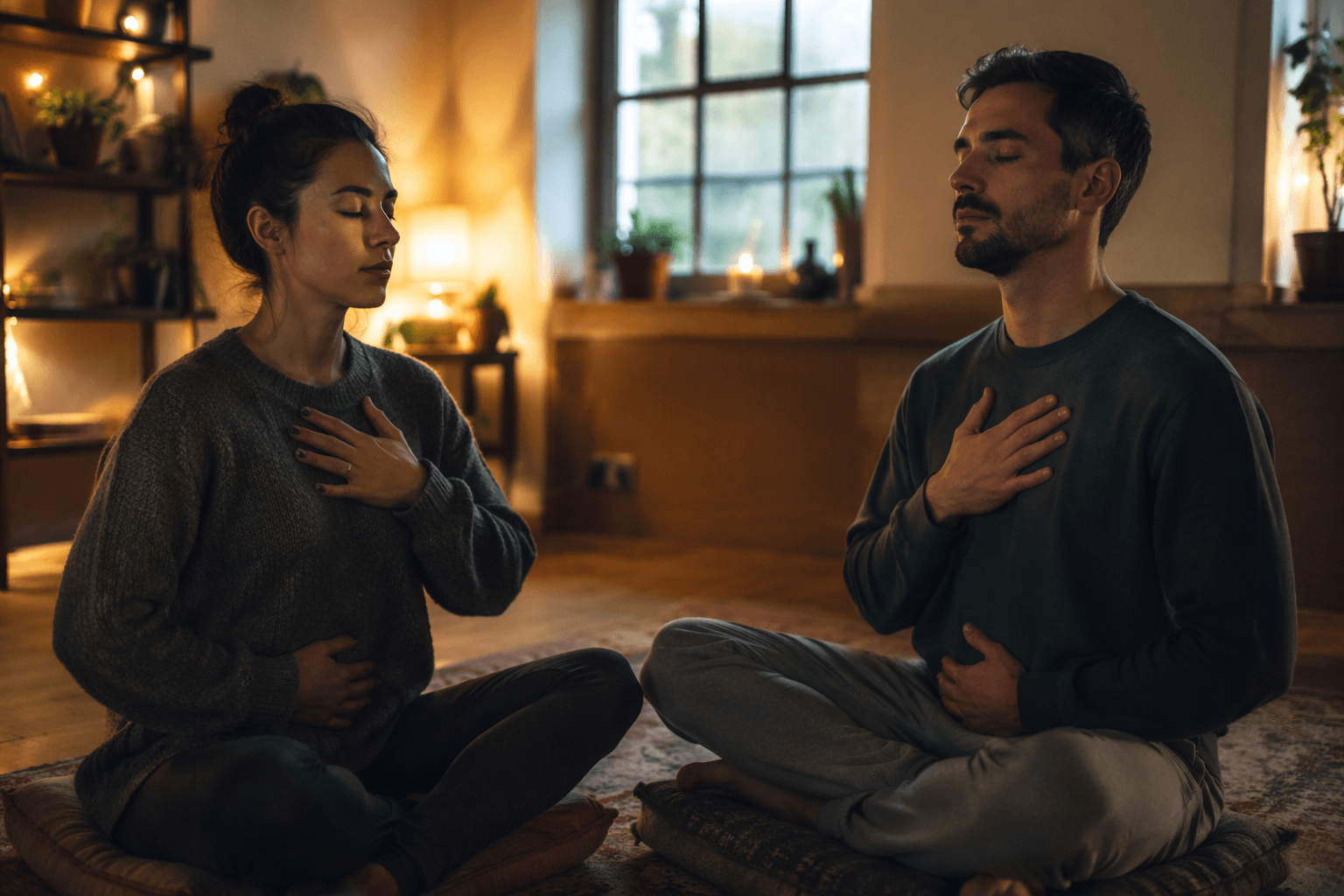
- The 50:50 practice uses the body as an anchor while you are interacting with other people. The point is not to become serene on command, but to keep some embodied awareness online while a conversation is unfolding, especially when your mind wants to sprint ahead.
- The 10-finger appreciation practice brings other people in your life into awareness. It shifts mindfulness from private introspection toward relational recognition, which is often what couples need more of when they are stuck in complaint mode.
If you want to test the idea at home, keep it basic: pause before difficult conversations, feel both feet on the floor, and notice where the tension sits in your body before you answer. Then try one small appreciation practice each day, because attention that only catalogs problems will not change the climate in the room.
The practical takeaway
The Oxford post is smart because it does not oversell mindfulness as a cure-all. It treats relationships as a stress test for the practice, and that is where the evidence feels most honest: mindfulness may help with conflict, attention, and emotional reactivity, but the field is still short of proof that it reliably improves relationships overall.
That is why the most useful move is also the simplest one. The next time a disagreement starts to heat up, take one breath, feel your body, and notice whether you are reacting to the present conversation or to an older trigger wearing a familiar face.
This article was produced by Prism’s automated news system from verified source data, official records, and press releases, then run through automated quality and moderation checks before publishing. The system is built and supervised by the people who set the standards it runs under. Read our full AI policy.
Know something we missed? Have a correction or additional information?
Submit a Tip