Choosing the Right Brushes for Every Miniature Painting Technique
Three brushes cover most of what you'll paint this month - here's exactly what to buy for 40k squads, AoS heroes, and display busts, and what a worn sable is really costing you.

The fastest way to lose a highlight line on a Space Marine pauldron isn't shaky hands. It's reaching for a size 2 round when you needed a size 0 spotter. Getting the brush match right for your actual project this month is more decisive than any technique video, and the minimum kit is smaller than most painters assume. Three brushes, chosen for your specific task, will carry you through basecoating, layering, and detail work on virtually any 28mm project. Everything beyond that is targeted expansion, not necessity.
What You Actually Need Based on What You're Painting
The buying decision changes depending on what's on your desk right now.
If you're working through a 40k infantry squad or a unit of Age of Sigmar battle line troops in the next few weeks, your minimum kit is: one size 1-2 round for layering and general coverage, one size 0 or 00 for picking out straps, gemstones, and eye sockets, and one medium drybrush for raised armor edges and texture passes. That trio covers roughly 90% of the decisions you'll make per model.
If your current project is a named character, an AoS hero on a big base, or a mounted unit where the horse and rider each demand their own painting session, add a flat shader to the list. Flat brushes load well for quick basecoating across broad armor plates, and a short flat can be walked along pauldron edges for controlled highlights without the wobble you get from a round's belly.
For display-quality work on 75-100mm busts or centerpiece models, the scale shifts considerably. Move up to size 2-4 rounds for broad blending passes and size 4-6 flats for large smooth transitions across faces and cloaks. The spotter becomes your most-used brush for pin highlights and eye details at this scale, where every millimeter reads.
Vehicles and terrain are their own category. Large models reward a bigger round or flat for efficient coverage, with a dedicated drybrush doing the heavy lifting on metallics and texture. Synthetics are the right call here; the coarser bristles handle thick pigment and abrasive dry-pigment work without sacrificing the Kolinsky you bought for detail.
Brush Anatomy: What Actually Matters at the Shelf
Three components determine whether a brush performs or frustrates.
The ferrule is the metal sleeve binding hair to handle. A well-sealed ferrule keeps water from wicking up into the core, which is the primary cause of hairs loosening mid-session. Check that it's tight and has no visible gap before buying.
Hair type splits between natural Kolinsky sable and synthetic options, and both have clear use cases rather than a clear winner. Kolinsky sable retains a finer point and has superior snap, the spring that pulls bristles back to their original shape under load. That spring is what gives you control on a thin highlight line. Pure synthetics have closed the gap significantly and are now the better choice for water-heavy workflows, washes, and tasks that involve abrasive paint or repeated scrubbing, such as drybrushing. They're also cheaper and easier to care for, which matters when you're working through a large batch commission.
Handle length is often overlooked. Longer handles suit studio painters working at arm's length; shorter handles suit the close desk-based miniature painter who rests their hand directly on the model or a grip aid. Choose a weight that balances without effort in a tripod grip.
Brush Shapes and What They Do on the Model
Round pointed brushes are the universal starting point. The belly holds paint and feeds it steadily to the tip, making rounds the right shape for layering, blending, and fine line work. A size 0 or 00 handles eye sockets, fine edge highlights, and any detail smaller than 1mm; a size 1-2 covers layering and basecoating on infantry-scale surfaces; a larger round speeds up coverage on big bases or cavalry.
Flat and shader brushes excel at rapid basecoating over flat planes and controlled glazing. Load the belly, press flat to a surface, and you cover ground quickly without the point-control tension of a round. Short flats also work for deliberate edge highlighting on armor plates when controlled pressure is needed.
The spotter is the most underrated brush in the standard kit. Its extremely short bristles and micro point give it almost no flex, which translates to precise dot placement on eyes, pin highlights, and gemstone reflections. If you're skipping eyes because they feel impossible, a proper spotter changes that equation immediately.
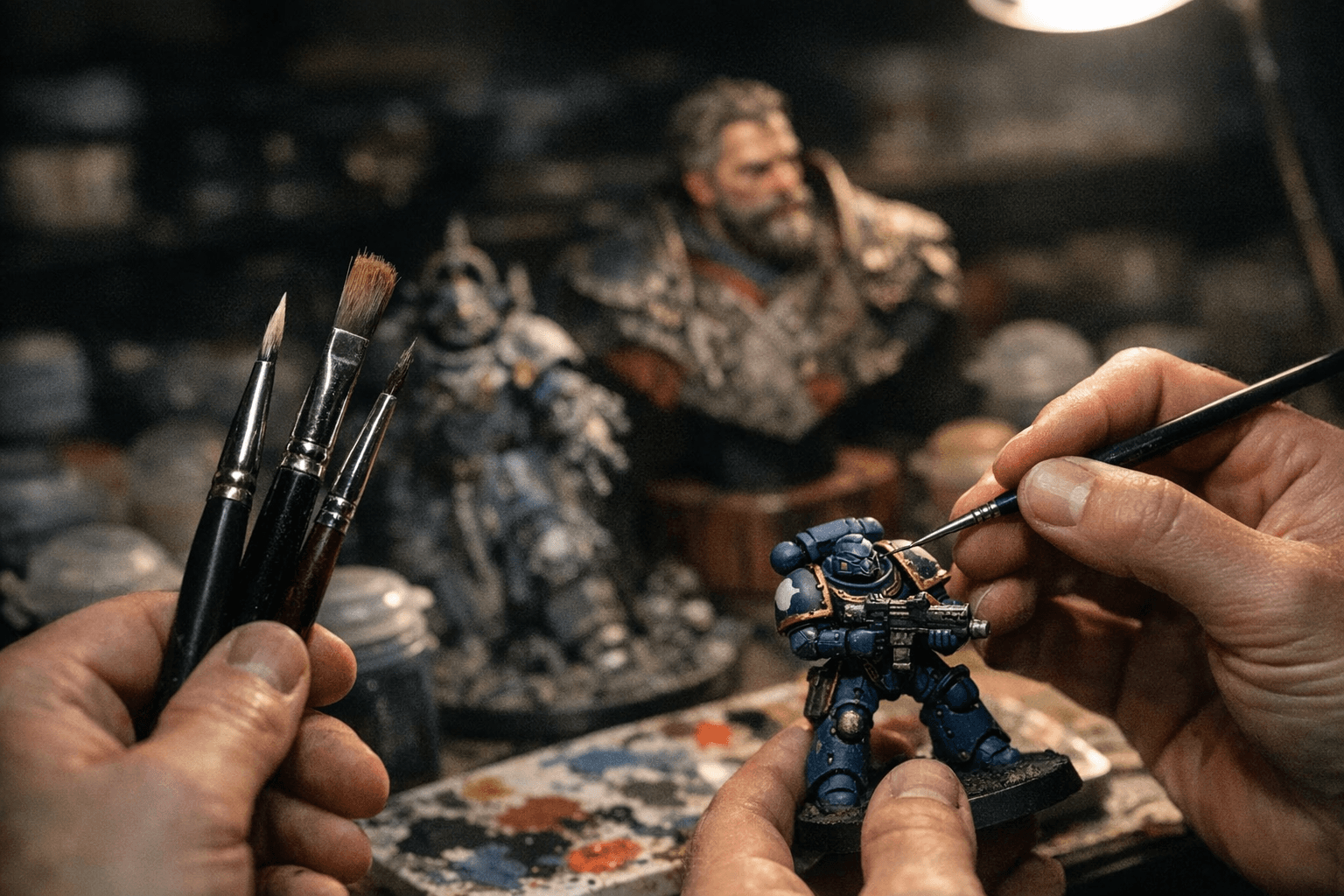
Fan brushes appear occasionally for large soft-edge blending and certain texture effects, but they're a genuine specialty tool, not a priority purchase for most miniature painters. Drybrushes, by contrast, earn their place in almost every paint session. The stiff, short bristles are designed to drag pigment across raised edges and texture, and synthetics handle the stress of that technique without complaint.
Sable vs. Synthetic: Making the Call
For detail and layering work, a mid-priced Kolinsky-style brush offering solid point retention and spring gives you the best return per model. The investment pays off across a full project's worth of layering sessions and, with proper care, across years of use.
For basecoating, washing, drybrushing, and any task involving heavy body paint, full synthetic is the correct answer. The material tolerates rough treatment and thick pigment without degrading the way a fine sable would. Keeping sable brushes away from those tasks is one of the simplest ways to extend their lifespan.
If you're on a budget or building your first real kit, several modern synthetics now rival sable for spring and point quality, especially in water-heavy workflows. Try a single brush from a brand before committing to a full set, test whether it holds its point under your pressure and your paint consistency, then decide.
Caring for Brushes: The Longevity Dividend
A well-maintained size 1 Kolinsky can last years. A neglected one is ruined in weeks. The difference is almost entirely in cleaning discipline.
Rinse immediately after use in plain water. For acrylic paints that have started to dry on the ferrule, work through a gentle brush soap or mild detergent, reshaping the point as you rinse. Avoid hot water entirely - it loosens the ferrule seal and causes bristles to splay.
After cleaning, reshape the point with your fingers while the bristles are still damp and store horizontally or bristle-up. Never rest a brush bristle-down in a jar. For brushes going into long-term storage, a drop of brush conditioner protects the point during dormancy. Travel caps are practical insurance against point damage during transit to game stores or conventions.
When to Retire a Brush
The point won't return after thorough cleaning. Hairs fall out during gentle stroking. Bristles splay and won't reform. Any of these signals means a brush has crossed the line from a tool into a liability. For commission painters, the math is direct: a slightly worn sable loses micro-control and adds time per model, which compresses your effective hourly rate on a batch. Retiring brushes preemptively is an economic decision, not sentimentality.
Your Pre-Purchase Checklist
Before spending, run through four questions:
- Primary task: detail, layering, or basecoating? The answer determines hair type and shape.
- Scale: 28mm armies need sizes 0/1 and a 2/3 round; display 75-100mm busts need sizes 2-4 rounds and a 4-6 flat.
- Hair preference: natural Kolinsky, hybrid synthetic, or full synthetic for budget and workflow reasons?
- Care infrastructure: do you have brush soap and a horizontal storage solution? Without them, even the best brushes degrade fast.
A set of three to six quality brushes chosen for your actual workflow is better value than thirty brushes bought on impulse. The bottleneck to better results at the painting desk almost always comes down to spring, point, and the right size for the right task. Get those three variables right and the brush disappears; all that's left is the model.
This article was produced by Prism’s automated news system from verified source data, official records, and press releases, then run through automated quality and moderation checks before publishing. The system is built and supervised by the people who set the standards it runs under. Read our full AI policy.
Did this article answer your question?