Courtney DeVries champions tactile realism in miniature painting
Courtney DeVries makes a case for finishes that feel real, not box-perfect, and turns that into a practical, welcoming path for painters finding their own voice.

Permission to leave the box art behind
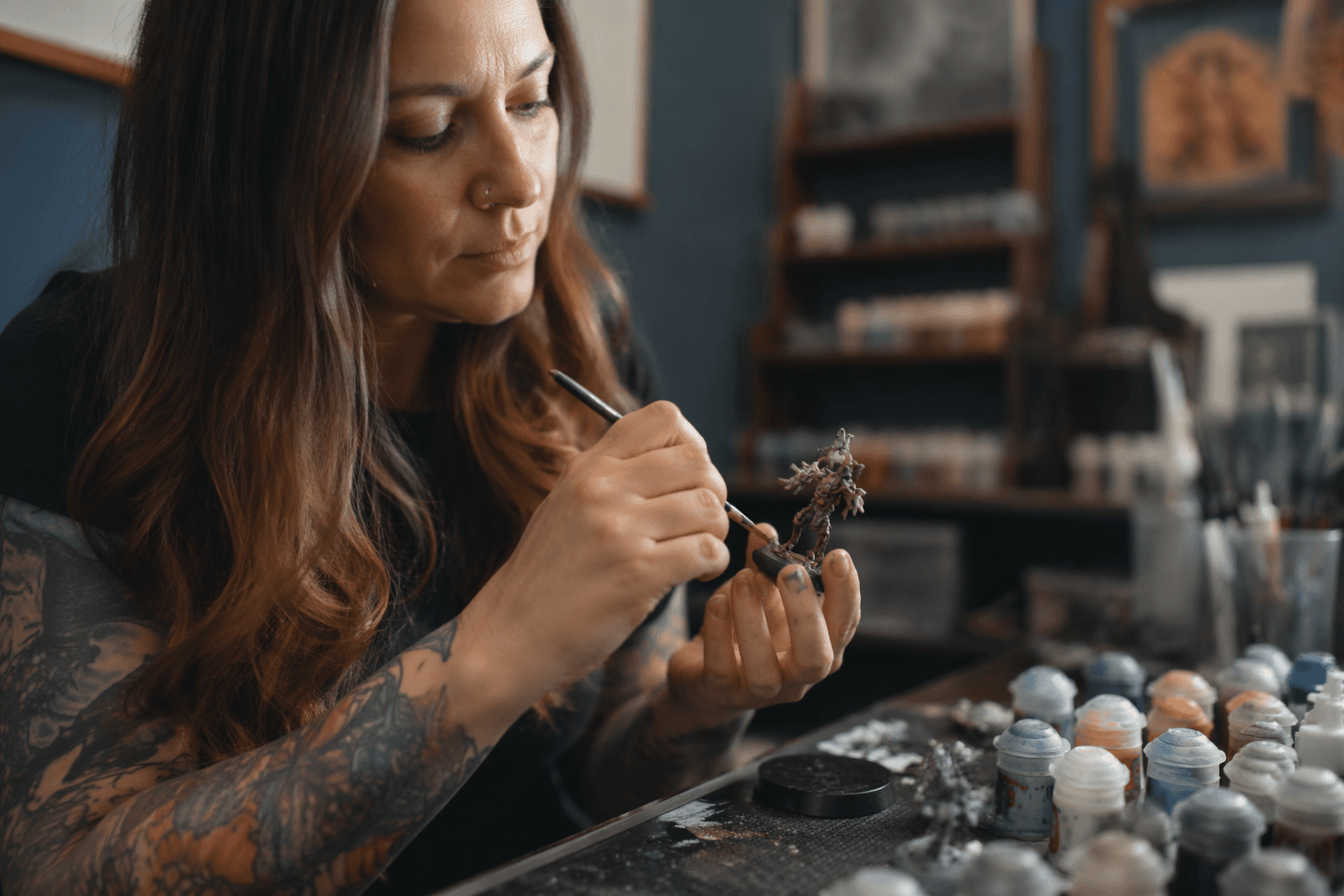
Courtney DeVries makes a quietly radical point for miniature painting: the best finish is not always the most polished one, the brightest one, or the one that matches the box art. Through Figuratively Speaking Minis and The Army Painter’s Factory Team, she argues for paint jobs that feel tangible, grounded, and alive, the kind that look like they could exist in the real world instead of under studio lights.
That idea lands because it speaks directly to one of the hobby’s most familiar pressure points. Painters often compare their work to a preset image and end up treating style like a test they have to pass. DeVries pushes in the opposite direction. Her work is built around observation, natural textures, and colour relationships, which gives painters a way out of style insecurity and into something more useful: a personal standard of realism that can still be bold, expressive, and unmistakably their own.
Tactile realism as a painting philosophy
DeVries is based in Edmonton, Alberta, and Figuratively Speaking Minis describes her as an award-winning miniature painter, instructor, streamer, and commission artist. That mix matters, because her approach is not just about finished display pieces. It is also about teaching painters how to see surfaces more honestly, from worn cloth and weathered armor to skin, stone, and the soft transitions that make a miniature feel physically present.
Her studio emphasizes realistic finishes, bold character work, and a supportive teaching style, which helps explain why tactile realism sits at the center of her voice. She is not chasing realism as a sterile technical category. She is chasing finishes that carry atmosphere, material weight, and a sense of place. The result is a style that invites painters to think less about copying a formula and more about translating what they notice in the world around them.
One of the most useful lessons in that approach is simple: look outward before you reach for another tutorial. DeVries says she likes “mimicking what she sees in nature,” and that instinct can change the way a painter thinks about texture, shadow, and colour shift. Instead of asking whether a model looks like a standard display piece, ask whether the surface reads like something touched by light, weather, or use.
From board game minis to a broader craft
DeVries’ path into the hobby will feel familiar to a lot of painters who came in through games first and painting second. She says she began with board game miniatures, starting with the Jedi from Star Wars: Imperial Assault. From there she moved on to models from Gloomhaven, which she describes as her first photographed minis. That sequence tells a very real hobby story: the entry point was not competition, display, or a perfect airbrushed showcase. It was wanting game pieces to look better on the table.
That origin matters because it reminds painters that a craft voice often develops from play, not from pressure. The table gave her a reason to paint, and the camera gave her a reason to notice improvement. For anyone trying to find a style, that is a strong model to borrow. Paint the minis you actually use, photograph them, and let the images show what is changing in your work over time.
The hobby also stayed alive for DeVries because other people responded to what she was making. She says feedback from others kept her engaged, first as a beginner and later as someone constantly refining technique. That is one of the strongest threads in her story: miniature painting grows faster when it is socially shared. A comment from a peer, a note from a student, or a critique from a judge can do more than a dozen private reruns of the same piece.
What painters can take from DeVries right now
DeVries’ approach offers a few concrete habits that translate immediately to the desk.
- Start with a surface question, not a style label. Ask what the material should feel like, whether that is bone, steel, cloth, skin, or worn leather.
- Use nature as a reference library. DeVries’ interest in natural textures is a reminder that convincing colour shifts and surface wear already exist in the real world.
- Keep photographing your work. DeVries’ first photographed Gloomhaven minis show how useful images are for tracking progress and spotting what your eye misses in the moment.
- Treat feedback as fuel, not verdict. Her growth was shaped by other people’s reactions, which suggests that community response can be part of the process rather than an interruption to it.
These are not abstract principles. They are practical ways to loosen the grip of box-art pressure. If the goal becomes believable texture, a stronger silhouette, or a more honest reading of material, then style stops being a trap and starts becoming a tool.
Why her teaching presence matters
The Army Painter places DeVries on its Factory Team and identifies her as a competition judge and international teacher, with a focus on creativity, inclusion, and the joy of tabletop play. That combination gives her viewpoint a wider reach than a single social feed or a single display cabinet. She is speaking to people who paint for competition, for games, for commissions, and for the simple pleasure of making a figure feel more like a character.
Her teaching philosophy extends that same openness. Figuratively Speaking Minis says her classes offer a safe, non-judgmental space for painters of all ages and experience levels, with offerings ranging from beginner to intermediate and basing. That is an important detail in a hobby that can sometimes feel intimidating from the outside. DeVries is building a setting where people can learn without being flattened by comparison, and where basing is part of the same visual language as the paint itself.
Her presence also shows up beyond the classroom. The Army Painter’s 2026 AdeptiCon coverage lists her among Factory Team members attending the show, which places her squarely inside the hobby’s public-facing culture. That matters because her message is not just personal branding. It is part of a broader push toward accessibility, variety, and the idea that a miniature can be successful for many different reasons.
A style that gives painters room to breathe
Courtney DeVries is useful to pay attention to because she gives miniature painters permission to want something other than the sanctioned look. Her work says tactile realism can be expressive, beginner paths can become serious craft, and feedback from the community can sharpen both confidence and technique. The real lesson is not that every model should look like nature; it is that every painter deserves room to build a visual language that feels honest to them.
That is the relief at the center of her story. Box art can still inspire, but it does not get to define what counts. DeVries opens the door to a different standard, one built from observation, texture, and the pleasure of making a miniature feel real in your own hands.
This article was produced by Prism’s automated news system from verified source data, official records, and press releases, then run through automated quality and moderation checks before publishing. The system is built and supervised by the people who set the standards it runs under. Read our full AI policy.
Did this article answer your question?