Goonhammer spotlights the Clan Ghost Bear Grizzly for painters
The Grizzly gives painters a big Clan silhouette with real Ghost Bear identity. Its camo, weathering, and refit options make it a ready-made display piece.
The silhouette that sells the story
The Grizzly is the kind of BattleTech machine that tells you how to paint it before you ever touch primer. Its 70-ton frame has the kind of broad, steady silhouette that reads as dependable first and dangerous second, which is exactly why it stands out for painters who like models to feel like characters. The Goonhammer overview leans into that identity by placing the mech among Ghost Bears, Wolf's Dragoons, and Alpha Regiment, but the real hobby hook is simpler: this is a Clan BattleMech with enough presence to carry a strong scheme and enough surface area to reward careful finish work.

That makes the Grizzly a natural fit for a narrative build. The idea of a “trooper mech,” a generalist chassis that does a bit of everything, is especially useful here because it suggests reliability rather than flash. On the table, that translates into a machine that wants to look hardened, useful, and credible, not overly specialized or theatrical. For a painter, that is a gift: the model can be built around clean faction markings, campaign wear, or a more dramatic showcase finish without fighting its own identity.
Why the Ghost Bear read matters
The strongest starting point is Clan Ghost Bear itself. The Grizzly was developed by Clan Ghost Bear and introduced in 2947, so it already carries long-form faction history in its armor plates. Its standard armament, a Gauss rifle, LRM-10, large pulse laser, medium pulse laser, and small pulse laser, gives the sculpt a practical, workmanlike look that fits a machine meant to survive in mixed roles rather than dominate one narrow niche.
For painters, that matters because the weapon loadout shapes how the model feels in color. A Gauss rifle invites polished gunmetal, heat staining, and a slightly more restrained treatment than the rest of the body. The missile launcher and pulse lasers give you smaller points of contrast, places to break up the armor with lens glow, hazard marks, or sharper edge highlights. Even if you never think about the rules, the visual spread of weapons makes the Grizzly a very paintable mech.
The model’s history adds another useful layer. Production ceased in 3013, and surviving machines were relegated to green Provisional Garrison Clusters. That creates a clean divide between a proud Clan machine and one that has clearly seen enough service to be pushed into second-line work. If you want the Grizzly to feel used but still respected, that detail gives you permission to lean into chipped panels, faded markings, and field repairs without losing the mech’s dignity.
Ghost Bear colors give you a clear lane
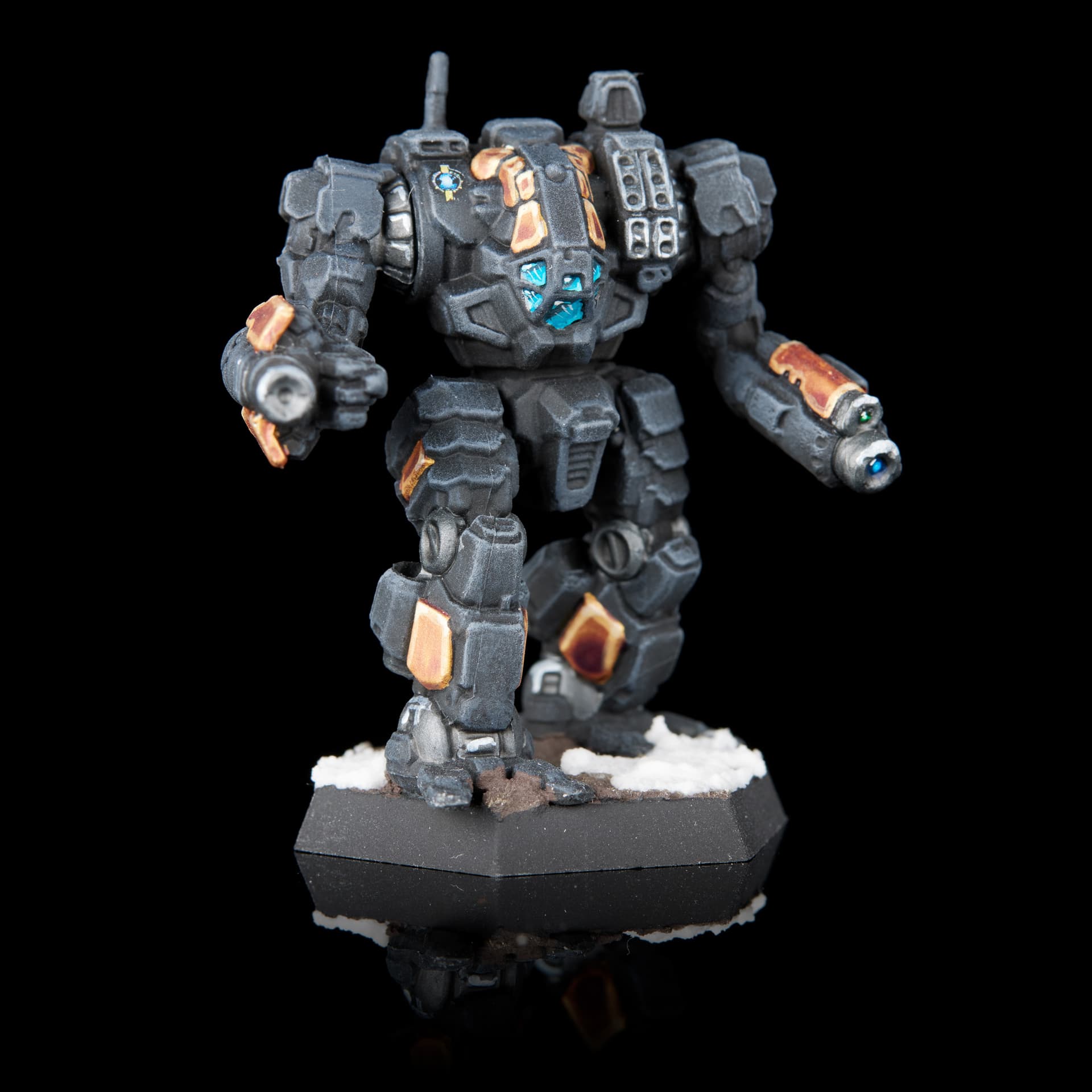
If you want the most immediately recognizable version, Clan Ghost Bear Alpha Galaxy is the obvious anchor. The canonical scheme uses shaded charcoal grays blended with a blue-gray camouflage pattern, plus small white rocks with a black crescent moon outline. Its insignia is equally distinctive: a silver bear’s head on a gold sun-shaped field surrounded by golden laurels.
That palette is excellent for painters because it does several jobs at once. The charcoal gray keeps the Grizzly grounded and heavy, the blue-gray camo breaks up the bulk, and the white rock motif gives you a crisp accent that can be repeated on shoulder panels, base details, or command markings. The silver bear emblem on gold is a perfect focal point for a shoulder pad, chest plate, or banner plate, and it gives the whole model a strong faction signature from a tabletop viewing distance.
The scheme was canonized on December 1, 2004, which is a nice reminder that this is not a vague “Clan-ish” look. It is specific, repeatable, and already tied to Ghost Bear identity. If you are painting the Grizzly as a straight Clan Ghost Bear machine, you have a clear language to work from: cool neutrals, disciplined camouflage, and one sharp ceremonial emblem to make the model read instantly.
Weathering a machine that was never the Clan’s darling
The Grizzly becomes even more interesting once you lean into the fact that it was not a glamorous star performer. Sarna describes it as a generalist design that excels at no one thing, with a reputation for poor engineering. That sounds like rules chatter at first, but it is actually fantastic hobby fuel. A mech with a reputation for rough joints and awkward maintenance begs for grime in the recesses, worn edges around moving parts, and small signs of battlefield fatigue that make it feel lived-in.
On the bench, that could mean heavier wear around the knees, ankles, and arm mounts, where a model like this would plausibly show the scars of hard use. A Gauss rifle barrel can take a cold metallic finish with subtle soot. Joint housings can be darkened to suggest oil, dust, and repeated field servicing. If you want the mech to look like it has come through a long campaign, the “poor engineering” angle becomes a visual story rather than a technical footnote.
That same reputation also supports a more restrained, credible paintjob. The Grizzly does not need neon accents or aggressive freehand to make sense. It wants to look like something a Ghost Bear commander would actually keep in the line because it gets the job done. That is a great match for painters who enjoy showing function through finish.
Later variants open the door to different looks
The Grizzly also has enough later history to justify alternate paint approaches. During the Combine-Ghost Bear War, Star Captain Scott’s customized version became famous enough that the Grizzly 2 later became a standard refit. That version keeps the Gauss rifle, swaps the pulse lasers for an ER large laser and six ER micro lasers, and replaces the missile launcher with an ATM 9 carrying ammunition suited to urban fighting.
That update practically invites a different visual language. A Grizzly 2 can be painted as a harsher city-fighter: dust-streaked gray, chipped corner armor, darker heat staining, and a base full of broken concrete or street debris. It still reads as Ghost Bear, but it can feel more purpose-built for knife-range fighting in a damaged urban zone. If you prefer a more industrial, modified look, this is the version that lets you push farther from parade-ground neatness.
The Grizzly 3, first produced in 3138 by Jötunn BattleWorx, offers yet another angle. A later manufacturing run gives you permission to paint the machine with fresher factory tones, sharper panel contrast, and cleaner marking placement. That makes the chassis useful across eras, from battered veteran to refurbished line machine to newly issued production piece.
Base it like a machine that has mass
The Grizzly’s 70-ton body deserves a base that supports its weight visually. Snow, broken rock, and dark rubble all work especially well because they echo the cool Ghost Bear palette and make the mech feel grounded. The small white rocks and black crescent moon motif from Alpha Galaxy can be echoed in the basing for a subtle tie-in that makes the whole model feel deliberate.
The best Grizzly paintjobs make the chassis feel both specific and believable. When the silhouette is this strong, the right scheme does more than mark allegiance. It turns a heavy Clan machine into a finished story, one that carries Ghost Bear identity in every panel line and still looks ready to stomp across the battlefield long after the first glance.
This article was produced by Prism’s automated news system from verified source data, official records, and press releases, then run through automated quality and moderation checks before publishing. The system is built and supervised by the people who set the standards it runs under. Read our full AI policy.
Did this article answer your question?