Harlequin vehicles and a wild kitbashed fire support bug inspire painters
Prismatic Harlequin vehicles steal the first click, but the wild Sylvaneth-Vespid-T'au bug and fresh Horus Heresy tanks make this a conversion-rich reference pack.
Start with the Harlequin vehicles
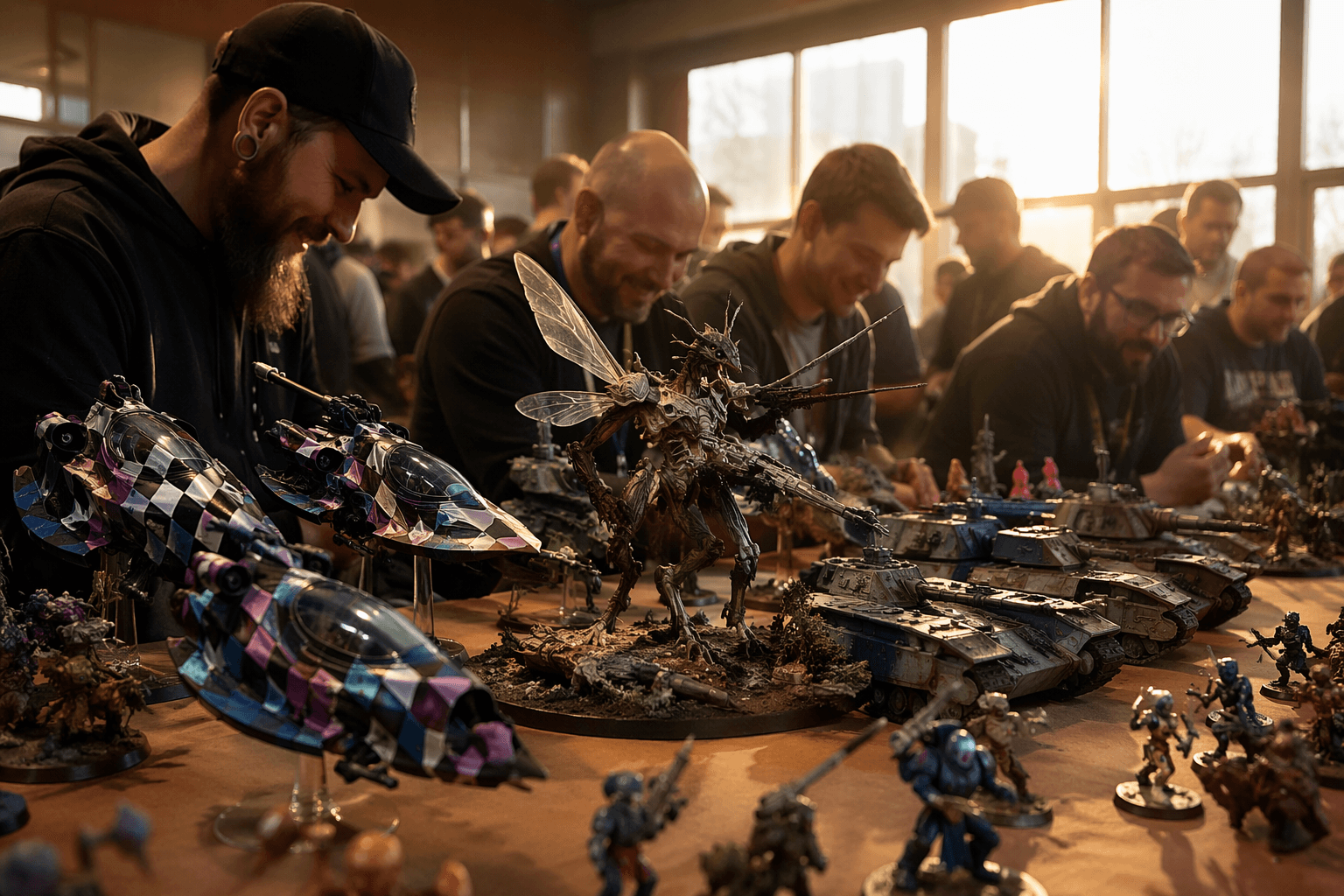
The first thing to click is the set of prismatic Harlequin vehicles, because they do the rare hobby trick of being loud and readable at the same time. The scheme leans on pearl-like colour shifts, NMM gold, and the classic Harlequin diamond pattern, which gives you a vehicle that feels ostentatious without dissolving into visual noise. That balance matters for Aeldari work in particular: the faction’s design language already lives in bright colours and geometric patterning, so the piece shows how to push the flash while still keeping the silhouette clear.
What makes these vehicles especially useful for painters is the discipline behind the spectacle. The diamonds anchor the eye, the gold gives a hard-edged premium finish, and the prismatic pearl effect adds movement across the panels without needing a dozen competing spot colours. If you are planning an Aeldari transport, skimmer, or any other highly stylized chassis, this is the kind of reference that teaches you where to put the drama and where to leave the eye a place to rest.
Why the scheme works for tabletop distance
Harlequin armies are often remembered for their bright colours and diamond motifs, but the strongest versions of that look still respect contrast. The vehicle treatment here uses that tradition well, turning a familiar visual language into something that feels fresh instead of generic. From across a gaming table, the repeating diamond pattern and metallic accents keep the model legible; up close, the pearl shift gives it that polished, gallery-piece finish painters chase when they want a centerpiece that photographs well.
That combination is the real lesson for your own projects. You do not need to invent an entirely new palette to make an Aeldari vehicle stand out. You need a repeatable pattern, a metallic focal point, and one or two finish effects that do the heavy lifting, exactly the sort of controlled excess Harlequins reward.
The kitbash that should send people to the bits box
The other immediate save is the fire support bug made from a Sylvaneth mount, a Vespid rider, and T'au parts. That mash-up is pure conversion culture: a fantasy beast base, a grim-tech alien rider, and enough T'au hardware to sell the model as battlefield kit rather than display-only whimsy. It is the sort of build that makes the whole hobby feel bigger, because it shows how far a model can travel once you stop treating the box art as the final stop.
For painters, the value is not just the novelty. A conversion like this gives you natural zones to separate with colour and texture. The Sylvaneth form can carry organic bark, bone, or chitin cues, the Vespid rider adds an alien focal point, and the T'au components create a practical military finish that keeps the whole thing grounded. If you have ever wanted a fire support creature that looks like it belongs in a strange frontier war, this is exactly the kind of silhouette to study.
Use the release wave as a modeling reference pack
The roundup does not stop at eye candy. It also ties the hobby mood back to the current Horus Heresy release cycle, where new tank models are rolling out and the modeling team is taking a look at them. Warhammer Community’s pre-order coverage singled out the Falchion Super-Heavy Tank Destroyer and the Spartan Prometheus Assault Tank, with the broader release wave also including the Whirlwind and other heavy armour in the conversation. For painters, that matters because new tank kits are always reference gold: they show what Games Workshop is pushing visually right now, from weapon loadouts to paneling and scale cues.
That release wave is especially useful if you paint large Imperial or Age of Darkness vehicles. The Falchion brings an aggressively destructive profile, while the Spartan Prometheus Assault Tank reads as a heavy transport with serious battlefield presence. Even if you are not building Horus Heresy tanks yourself, these kits are worth opening as style guides for weathering, hazard placement, and how to break up broad armor plates without overcomplicating the finish.
Why the hobby conversation feels so alive here
What makes this roundup worth a painter’s time is that it captures several kinds of inspiration at once. You get a polished vehicle scheme, a genuinely inventive conversion, and a fresh product wave all in the same place, which is basically the ideal ecosystem for hobby motivation. It is also a reminder that miniature painting culture now moves across images, reviews, and release coverage in one continuous stream, so a strong idea can come from a Bluesky post, a tank review, or a pre-order announcement just as easily as from a formal painting article.
That matters because the best hobby references are not always the most technical ones. Sometimes the most useful thing is a model that makes you want to try a pearl effect over metallics, or a conversion that convinces you to raid your bits box for an unlikely chassis. This roundup delivers both, and then folds in the current Horus Heresy tank wave so the inspiration has somewhere immediate to go.
The take-away for your next project
If you are choosing where to spend your attention first, start with the Harlequin vehicles, then study the fire support bug, then look at the Falchion and Spartan Prometheus as heavy-armour reference. That order gives you the quickest payoff: a finished-looking paint approach, a conversion idea with real bite, and a current release frame for anyone planning a big tank project. The prismatic Harlequin scheme is the hook, but the real value is how the whole roundup turns one eye-catching image into a practical set of cues for your next build.
This article was produced by Prism’s automated news system from verified source data, official records, and press releases, then run through automated quality and moderation checks before publishing. The system is built and supervised by the people who set the standards it runs under. Read our full AI policy.
Did this article answer your question?