K.C. Holt paints 18-inch Yuna commission in display-scale detail
K.C. Holt’s 18-inch Yuna commission turns a Final Fantasy icon into a display-scale painting lesson in skin, fabric, and contrast.
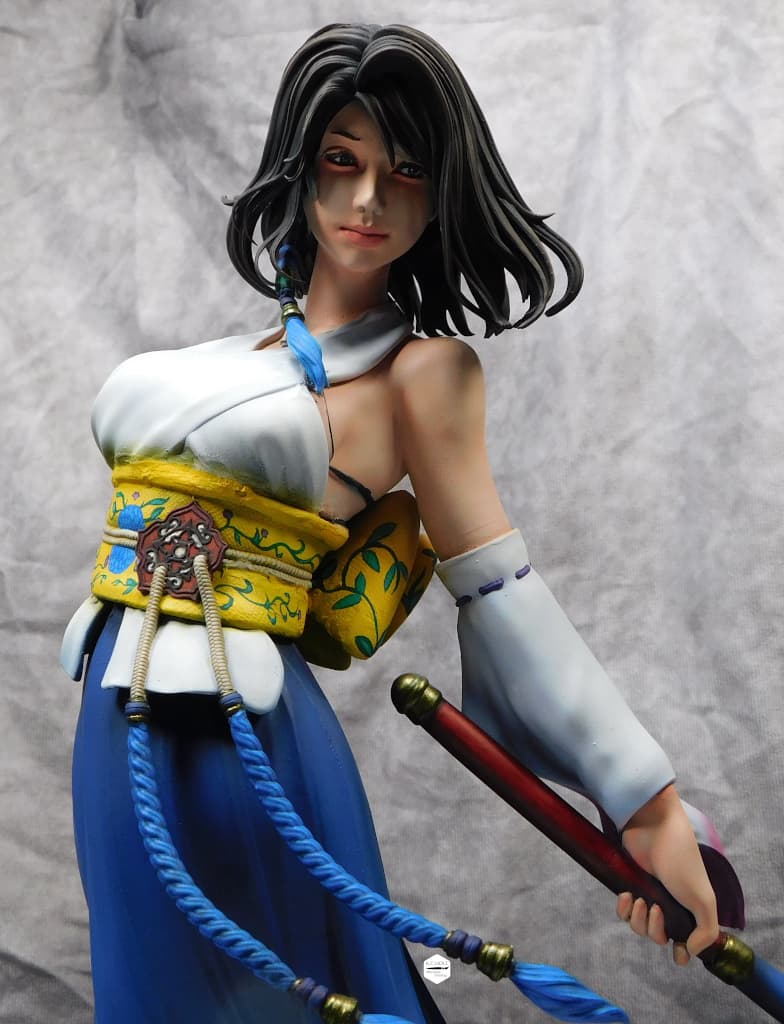
K.C. Holt’s 18-inch Yuna commission is the kind of piece that changes the conversation the moment you see the scale. Instead of reading as a standard gaming miniature, the 3D resin print from Final Fantasy X demands the priorities of display work: cleaner blends, stronger composition, and a sharper plan for where the eye should land first. Holt painted it with Reaper Miniatures Master Series Paints, and the finished result sits comfortably between character art and high-end hobby craftsmanship.
Why display scale changes the job
At 18 inches tall, Yuna is no longer asking for the same decisions you make on a 28mm figure. Large-format resin gives you room to push transitions, but it also exposes every hesitation in the brushwork, which is why Holt’s note that the piece was challenging but worth it fits the format so well. On a project like this, the face, hands, and costume edges have to work together as a single visual system, not just a collection of good local colors.
That is the first big lesson hiding inside the commission: scale changes what counts as “finished.” A tabletop miniature can survive on tight edge work and a fast read across a gaming distance. An 18-inch Yuna has to hold up from arm’s length, where skin tone transitions, cloth folds, and decorative accents all compete for attention.
Skin, fabric, and focal contrast at larger size
Yuna’s design makes an especially useful study because the character is built from a balance of softness and structure. Skin needs smooth, believable blending, but fabric needs enough separation to keep the silhouette readable. On a display piece this size, those two surfaces cannot be painted the same way, because the eye expects skin to breathe and fabric to catch light in more deliberate, graphic ways.
That is where focal contrast matters most. A recognizable character like Yuna already carries built-in viewer recognition, so the painter does not need to invent the story from scratch. Instead, the job becomes guiding the viewer toward the face, costume details, and other signature elements with contrast that is stronger than what you might use on a standard gaming miniature.
For painters planning their own large-format pieces, the practical takeaway is simple:
- Keep skin transitions soft and controlled so the face reads as lifelike rather than over-rendered.
- Push fabric contrast a little harder than you would on a troop-sized model so folds remain visible at display distance.
- Reserve the strongest contrast for the focal point, usually the face, then let supporting areas settle back.
- Treat the silhouette as part of the paint job, because on a figure this tall, the outline does half the storytelling.
Why Holt’s paint choice fits the job
Reaper Miniatures says Master Series Paints are designed for plastic, printed, metal, or resin models, and that triad system of shadow, midtone, and highlight lines up neatly with a commission like this. For a large resin print, the triad approach gives a painter a practical way to build depth without losing consistency across broad surfaces. It is especially useful when you need to keep skin and costume colors coherent over a much larger area than a standard gaming mini.
That compatibility matters here because the piece is a 3D resin print, not a stock plastic kit. Resin display pieces often reward painters who think in layers and value families rather than one-off colors. Holt’s choice of paint system reinforces the larger point of the commission: large-format work is less about forcing a tabletop workflow onto a bigger model and more about using tools that support slow, deliberate control.
The painter behind the commission
Holt’s background gives the Yuna piece extra weight. He describes himself as an award-winning professional painter and teacher with more than 30 years of painting experience, and he says he has painted for Games Workshop and Fantasy Flight Games. He has also had work appear at AdeptiCon and Gen Con, which places this commission in the context of a long professional practice rather than a single showcase build.
That matters because the Yuna piece is not just a finished model, it is evidence of a working painter’s rhythm. Holt also says he offers painting clinics and private coaching sessions, so the commission reads as part of a broader circuit of making, teaching, and refining technique. Even his 2026 tracking reflects that habit: he tags Yuna as model 308 out of a 500-mini goal, a reminder that large display projects can sit alongside sustained production without slowing a painter’s momentum.
Why Yuna lands now
The subject itself helps explain why this commission feels timely. Square Enix is currently promoting Yuna merchandise tied to Final Fantasy X’s 25th anniversary, including an acrylic stand, a wedding-dress playmat, and a Play Arts Kai figure. The company’s own storefront framing keeps Yuna visible as one of the series’ signature characters, not just a nostalgic deep cut.
Final Fantasy X first released in 2001, which gives the character a long runway of recognition across multiple generations of fans. The current anniversary push makes a display-scale Yuna feel especially resonant, because the character already sits at the intersection of game memory, collectible culture, and high-end fan art. The fact that Square Enix is still marketing Yuna in 2026 underlines why a commission like Holt’s can travel so easily beyond the miniature-painting crowd.
What the commission teaches beyond the subject
The appeal of this piece is not just that it features Yuna, although that is clearly the shareable hook. It is that the character’s familiarity lets the painting lessons come through immediately. When a well-known figure is painted at 18 inches, the painter has room to refine skin, separate fabric planes, and use contrast with much more intention than a standard gaming miniature allows.
That is the real crossover appeal here. Holt’s Yuna works as a portfolio piece, a commission milestone, and a reminder that display-scale resin can stretch the same skills miniature painters use every day, just with more room to show them off. The model may be larger than tabletop expectations, but the fundamentals remain the same: control the values, protect the focal point, and make every surface earn its place in the read.
This article was produced by Prism’s automated news system from verified source data, official records, and press releases, then run through automated quality and moderation checks before publishing. The system is built and supervised by the people who set the standards it runs under. Read our full AI policy.
Did this article answer your question?