Loot Studios Shares Practical Miniature Photography Tips for Painters
Loot Studios says your bad miniature photos aren't your camera's fault, and a window plus a sheet of white paper might already be all you need.

You've spent forty hours on a single miniature. The blending is clean, the OSL reads across the room, the basing tells a story. Then you prop it up on your desk, fire off a quick photo, and the result looks flat, muddy, and nothing like the model in front of you. If that cycle of frustration sounds familiar, writer Luiza Romagnoli has a direct answer in a piece published by Loot Studios: stop blaming your camera.
The piece, titled "Don't Blame Your Camera for Bad Miniature Photography," makes its central argument plain from the first paragraph: "Your miniature photos look bad, and it's probably not your camera's fault." That single reframe shifts the whole conversation away from gear and toward something every painter can control immediately, whether they own a flagship smartphone or a decade-old DSLR sitting in a drawer.
The real culprit: light
The article's diagnosis is consistent throughout. "The goal is to control the light, which is the single most important element of any miniature photography tutorial." Not focal length. Not sensor size. Not post-processing apps. Light.
This is the kind of insight that sounds obvious once someone says it, but it runs counter to the instinct most of us have when a photo disappoints us. The natural reaction is to assume the hardware is the problem, especially when scrolling through crisp, gallery-quality shots in communities full of people using expensive camera rigs. Romagnoli's piece argues that the gap between those shots and your own on-desk snaps is almost certainly a lighting gap, not a technology gap.
Starting with what you already have
The simplest fix the article offers requires exactly two things: a window and a piece of white paper. "This simple setup," the piece states, "can produce better results than most cheap artificial lights. It's the perfect starting point for anyone just getting into miniature figure photography."
The logic here is sound to anyone who has shot anything in natural light. A north-facing window (or any window with indirect daylight) produces soft, diffused illumination without harsh shadows. The sheet of white paper functions as a basic reflector or sweep, bouncing light back into the shadow side of the mini and providing a clean neutral backdrop. The fact that this combination can outperform dedicated budget lighting rigs is a useful calibration for painters who assume they need to spend money before their photos can improve.
The desktop studio setup
For painters who don't have access to a usable window, whether due to room layout, time of day, or inconsistent natural light, the article offers a DIY alternative it calls a "desktop studio" that can be assembled in minutes using items you probably already own.
The key instruction is precise: "Place your mini on the sweep, position your diffused light at a 45-degree angle from the front/side, and you're already 90% of the way to a great photo."
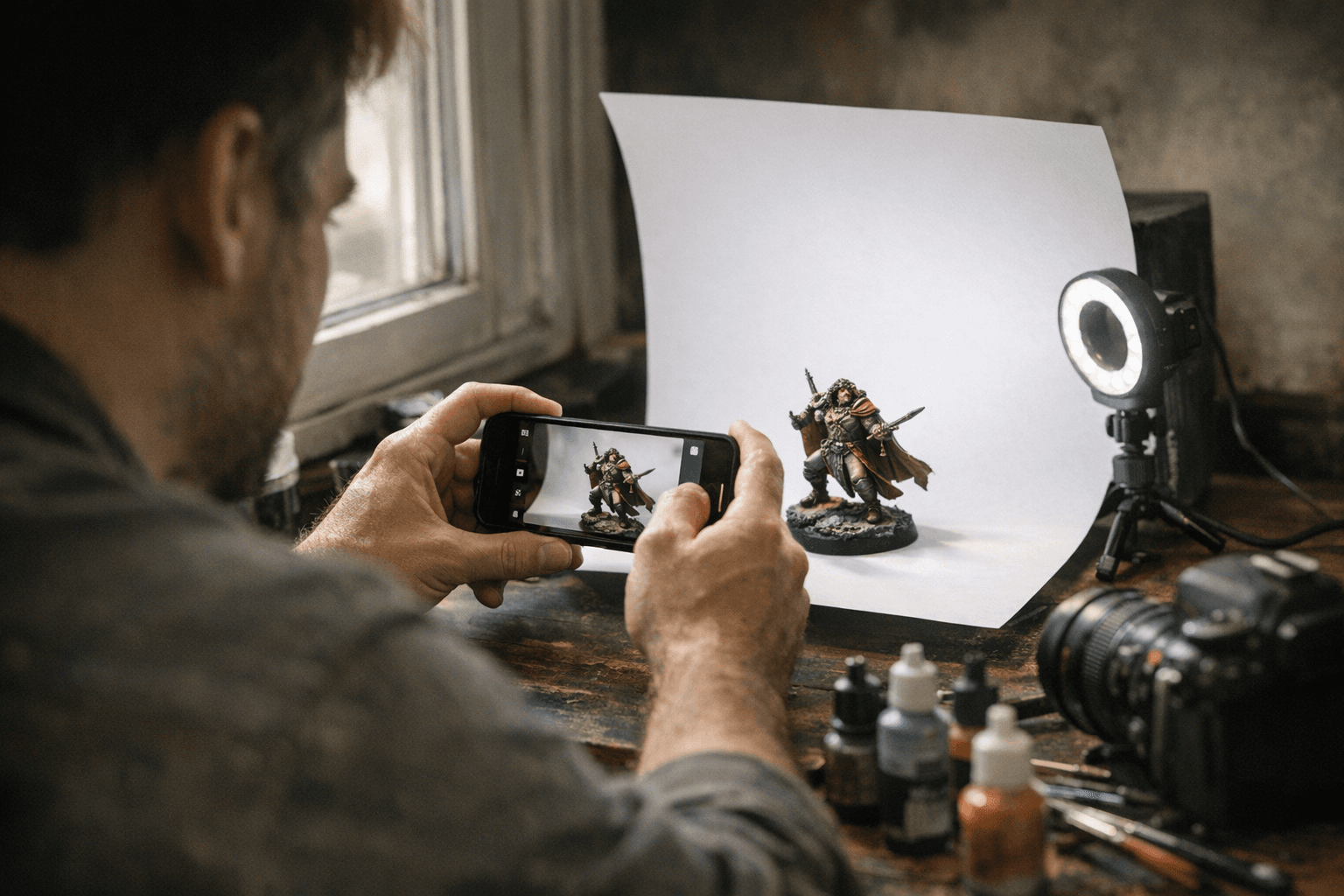
Breaking that down:
- The sweep is the curved background surface that eliminates the hard horizon line behind your mini. A piece of card or thick paper, curved gently from vertical to horizontal, creates this effect.
- Diffusing your light source removes the harsh point-source shadows that flatten detail and blow out highlights. A sheet of white paper or thin fabric in front of a lamp achieves basic diffusion.
- The 45-degree angle from the front/side is the classic portrait lighting position, and it works on miniatures for the same reason it works on faces: it creates dimensionality, separating planes and revealing texture rather than flattening them.
Together, these three elements, a sweep, a diffused source, and a deliberate angle, form a setup you can recreate on any desk in any room without buying a single piece of dedicated photography equipment.
Ranganathan, Master Lorekeeper, as the test subject
To demonstrate the difference these techniques make in practice, the article uses Ranganathan, Master Lorekeeper, a miniature from Loot Studios' Arcane Archive bundle, as the subject for a photography comparison. The before-and-after approach grounds the advice in something concrete rather than leaving it as abstract principle. Seeing the same figure photographed under different lighting conditions makes the argument visceral in a way that text alone cannot.
Ranganathan is a strong choice for this kind of demonstration. A lorekeeper figure presumably carries fine detail, robes, scrolls, intricate facial work, exactly the sort of surface complexity that collapses under flat or poorly directed light and comes alive under a well-positioned diffused source. The Arcane Archive bundle is available through Loot Studios' previous release catalog, alongside Fantasy and Sci-Fi monthly subscription options.
Why this matters for how you share your work
There is a quiet frustration that runs through the hobby when painters who are genuinely skilled at their craft underrepresent their own work online because they cannot bridge the gap between what the mini looks like on the table and what their photos show. Poor photography doesn't just affect social media posts; it shapes how painters perceive their own progress. When every photo looks worse than the actual model, it's easy to assume the painting is the problem.
The Loot Studios piece is practical in the specific way the hobby needs: it does not assume you will buy a lightbox, a macro lens, or a studio flash. It meets you at your desk, with your phone, and tells you to move toward the window. The escalation path, from window light to a DIY desktop studio with a diffused lamp at 45 degrees, requires zero investment at the first step and minimal investment at the second.
The article closes with the kind of energy that the hobby runs on: "Now, go grab your camera, and let's create something legendary!" It's a small line, but it captures the point. The gear question is already settled. The light is the work, and the work can start right now.
This article was produced by Prism’s automated news system from verified source data, official records, and press releases, then run through automated quality and moderation checks before publishing. The system is built and supervised by the people who set the standards it runs under. Read our full AI policy.
Did this article answer your question?