Reductive enamel painting gives Trench Pilgrims a grimy, trench-worn finish
A reductive enamel workflow turns Trench Pilgrims into mud-caked, trench-worn killers faster than a clean layer-up. It also keeps the whole warband unified.
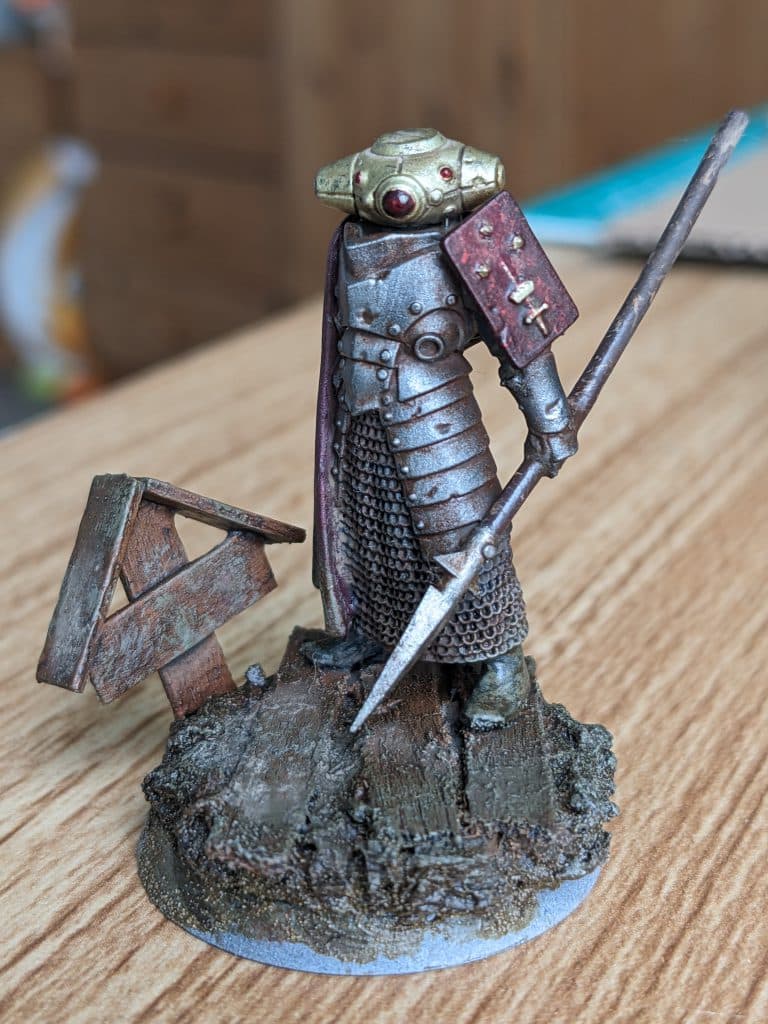
Reductive enamel painting gives Trench Pilgrims something a standard layer-up often struggles to deliver: a finish that feels dragged through mud, smoke, and ruin instead of politely built up one clean step at a time. Lee Dandy Dale’s approach turns that roughness into the point, using a method that is bold enough for grimdark spectacle but simple enough to stay approachable if you want dramatic results without leaning on advanced freehand or elaborate airbrush blends.
That matters because Trench Crusade does not ask for parade-ground neatness. Its setting is an alternative World War I where, more than 800 years after the Crusades, the war between Heaven and Hell still rages in 1914. The Trench Pilgrims fit that world perfectly: they are not officially sanctioned by the Holy See, yet the Church still blesses their crusades, and the lore paints them as disorganized processions of the mad, maimed, God-touched, and guilt-ridden.
Why the reductive approach suits Trench Pilgrims
The real appeal of the reductive enamel workflow is that it changes what your paint job is trying to do. Instead of chasing a smooth, polished finish and then trying to dirty it up afterward, you start with the expectation that the model should look battered, stained, and operational from the beginning. That makes the method especially strong for a warband that routinely charges across No Man’s Land in suicidal assaults and shows up armed with whatever it can scrape together, from old muskets to scourges and Molotov cocktails.
Speed without losing character
Layer-up painting can absolutely produce a strong result, but it often asks you to solve too many problems one at a time. The reductive approach trims that workload by treating weathering and grime as core parts of the scheme, not as last-minute decoration. For a force like Trench Pilgrims, that means you can spend your energy on contrast and mood rather than polishing every surface into a clean showcase finish.
Contrast you can control
Dale’s method is useful because it gives you room to decide how much definition the mini should carry. A cleaner style can flatten the faction’s identity, while a controlled reductive finish lets shadows, stains, and worn edges do the talking. That balance is a big part of why the technique feels so effective on Trench Crusade models: the miniatures still read clearly at arm’s length, but up close they look battered and alive.
Grime that feels earned
The best grimdark paint jobs do not just look dirty, they look like the dirt belongs there. Enamel work and controlled distressing help Trench Pilgrims feel lived-in rather than merely weathered for effect. That is the key difference between a model that looks painted and one that looks like it has survived the kind of battlefield Trench Crusade describes, where faith, desperation, and scrap metal collide in the same trench.
Basing is part of the story, not an afterthought
Dale does not treat the base as a separate project from the miniature, and that is exactly the right call for this faction. Simple materials such as corkboard, coffee stirrers, broken planks, and rough textures are enough to build a battlefield that feels muddy, improvised, and unstable. A cleaner duckboard can suggest order and discipline; shattered planking and uneven ground tell a much harsher story.
That distinction matters because the Trench Pilgrims are defined by disorder. Official lore describes them as processions of the desperate and the half-broken, often led by Prophets or Prophetesses and driven by Castigators. The same logic that makes a battered, uneven base feel right also makes the paintwork more convincing, because both parts of the model reinforce the same narrative: these fighters are surviving by faith and grit, not by military polish.
Build the base to match the finish
When the groundwork is muddy and improvised, the reductive enamel finish has somewhere to land. The stains, chips, and worn edges feel connected to the environment rather than floating on top of it. That makes the whole model read as one object instead of a miniature plus scenic decoration, which is exactly the kind of integration grimdark armies need.
What this method does better than a standard layer-up
The strength of Dale’s approach is that it scales. If you are painting one character for display, the technique gives you atmosphere and texture without demanding display-model perfection. If you are painting a whole Trench Pilgrims warband, it becomes even more valuable because the same finish language can run across infantry, characters, and other warband elements without the army looking random or overworked.
That army-wide consistency is one of the biggest payoffs. A reductive enamel scheme can unify old muskets, scavenged gear, religious iconography, and battered cloth under the same visual logic of dirt, wear, and sacrifice. It is also a cleaner fit for Trench Crusade than a bright, parade-ready style, because the faction is not meant to look like it has just marched out of a cathedral. It is supposed to look like it came back from the trench and never really left.
Dale’s article also sits comfortably inside the wider push to make Trench Crusade’s hobby side more explicit and more usable. The Trench Wire launched on April 17, 2026 with twice-weekly content covering rules, lore, modelling, painting, interviews, photography tips, and more. At AdeptiCon 2026, the Blood in the Water narrative event filled all 48 spots, the game ran its first competitive event with help from Goonhammer, and new Crusade Se7ens paint boxes with The Army Painter signaled that the visual identity of the setting is becoming increasingly formalized.
That momentum fits the bigger picture. Trench Crusade’s Kickstarter drew 20,170 backers and $3,331,943 against a $66,666 goal, and the game’s growing ecosystem now has the kind of hobby support that makes a project like this feel more than a one-off tutorial. Reductive enamel painting is not just a neat trick for one unit. It is a smarter way to use the bottles you already own, and for Trench Pilgrims, it crosses the threshold from merely painting a warband to making one look like it has truly lived in the mud of 1914.
This article was produced by Prism’s automated news system from verified source data, official records, and press releases, then run through automated quality and moderation checks before publishing. The system is built and supervised by the people who set the standards it runs under. Read our full AI policy.
Know something we missed? Have a correction or additional information?
Submit a Tip