Sean Kotch’s Konflikt ’47 force blends lore, theme, and painting
Sean Kotch's Axis force turns Konflikt ’47 lore into a paint plan, using fezzes, horror units, and a tight palette to make the army read as one eerie story.

A force built to look like it belongs to the setting
Sean Kotch’s Konflikt ’47 Axis army is a strong case study in narrative painting because every choice seems to point back to the same idea: this is not just an Axis collection, it is a force shaped by the Green Vault, secrecy, and strange wartime science. Warlord Community’s Hobby Champions feature spotlights the army as a showcase piece, but what makes it stick is the way the visual identity and the faction lore reinforce each other at every level.
That matters in a game like Konflikt ’47, where the setting is already doing half the storytelling for you. Warlord describes the Axis as being remade by the Green Vault, a shadowy secret-society network centered on Dresden and its Rift, and frames the game itself as one of heroes, horrors, monsters, and mechs. Sean’s force leans directly into that tone instead of fighting it, which is why the army reads as cohesive rather than simply well painted.
Start with the lore, then let the paint follow
Sean says Konflikt ’47 was not on his radar until discussion around the new edition started circulating, and that his interest grew through late-night hobby sessions while watching Tiki the Hutt’s YouTube livestreams. Community voices such as Mordian Glory also helped pull him in, which is a reminder that niche systems often spread through people talking paint, lists, and lore in public rather than through pure advertising.
The key turning point for Sean was the setting itself. The Green Vault, the occult secret-society atmosphere, and the horror imagery of units like the Schreckwulfen and Nachtjäger gave him a visual direction before he ever finished the army. That is the first lesson here: when your faction has a strong identity, you can use that identity to decide everything from color temperature to basing to the way you finish infantry details.
For a project like this, the paint plan should answer the lore question. If the army comes from a hidden, ritualized, post-Dresden Axis order, then the models should feel controlled, secretive, and a little unsettling. Sean’s force does exactly that.
Why the fezzes work
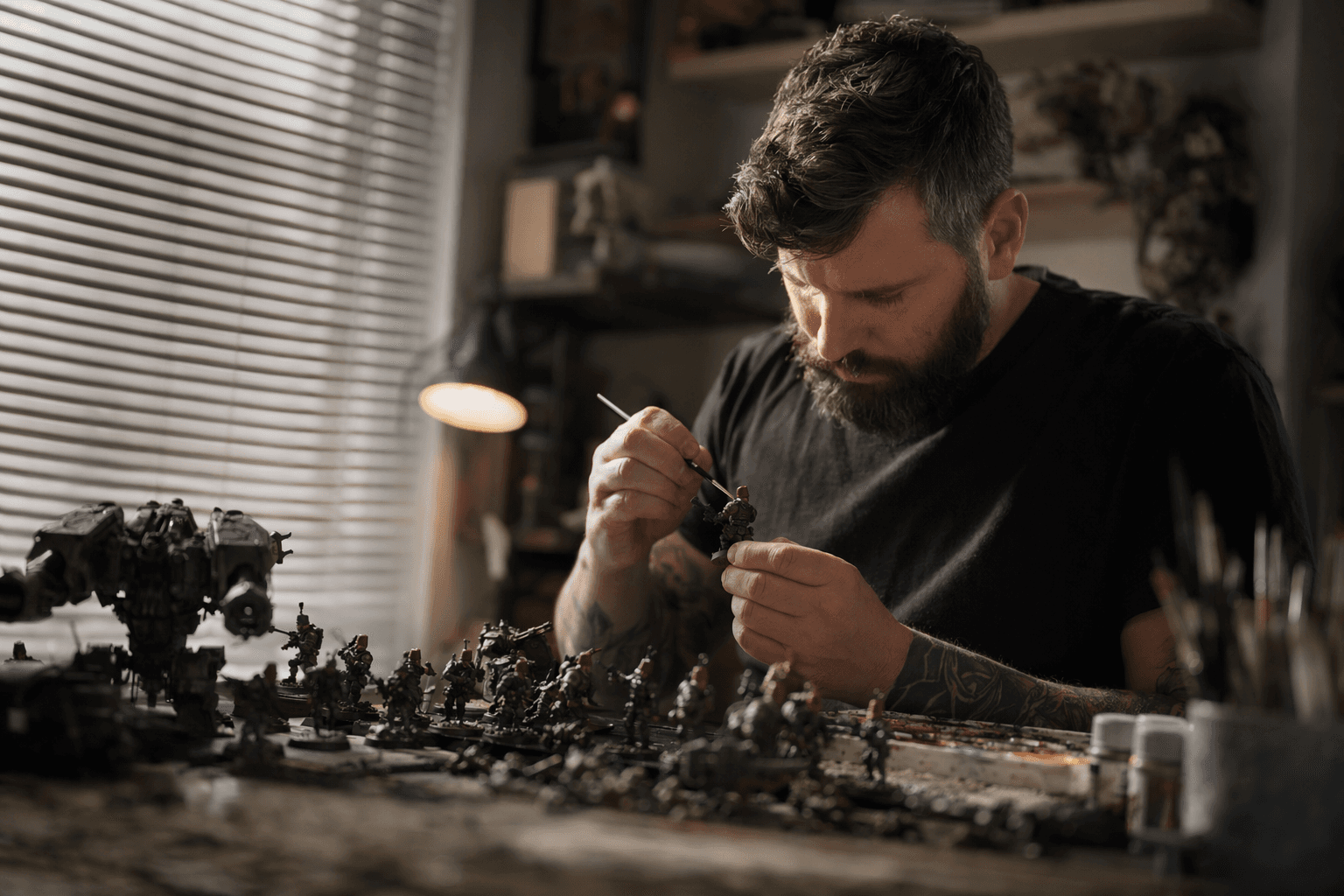
One of the most memorable details in Sean’s army is the use of fezzes on his regular troops. It is a small conversion choice, but it changes the whole read of the force. The heads create a distinct, almost lodge-like look that feels ceremonial and clandestine, which fits the Green Vault interpretation far better than a generic battlefield look would.
That is a useful reminder for any themed army: a single repeated conversion can become a visual signature. Fezzes do more than add character here. They unify the line infantry, make the squad silhouettes instantly recognizable, and give the army a quiet sense of internal ritual. In practical terms, that kind of repeated motif is one of the easiest ways to make a force feel like a faction inside the faction.
- a consistent head swap or helmet style
- a repeated insignia on shoulder pads or vehicle panels
- one accent color that appears on every unit
- basing elements that tie the force to one place or one campaign
If you are borrowing this idea for your own army, think in terms of recurring identifiers:
The point is not decoration for its own sake. The point is to make the army look like it came from the same hidden workshop, the same command structure, or the same world event.
Paint choices that keep the army unified
Sean describes the force as something he started with the intention of simply painting a few miniatures, but it expanded as he became more invested in the faction. That kind of organic growth usually leads to the best narrative armies, because the hobbyist is not trying to complete a shopping list. He is building a story in installments.
What makes the result work is cohesion. The article presents the army as technically clean, but more importantly, thematically coherent. The paint scheme, unit selections, and conversion ideas all serve the same eerie Axis identity, so the army never feels scattered across different visual concepts. That is the real design challenge in an army like this: if the infantry, specialists, and monster units all share the same mood, the collection reads as one force even before it is fully painted.
Basing is part of that language too. While the feature is especially interested in Sean’s troop presentation, the broader lesson is that the base should echo the faction story rather than compete with it. A Green Vault Axis force wants grounding that feels controlled and ominous, not bright and scenic for its own sake. Matching the base to the lore helps every unit sit inside the same world.
The horror units fit the paint story
Sean’s interest in the Schreckwulfen and Nachtjäger is not just a list-building preference. Those units sharpen the army’s visual identity because they embody the setting’s horror side in a way that regular infantry cannot. Warlord’s own description of the Schreckwulfen as an Axis Rift-tech enhancement combining human and canine DNA makes them a perfect anchor for an army that wants to feel occult, experimental, and dangerous.
That matters for painters because it changes the tone of the whole project. Once you include units like the Schreckwulfen, the army can carry darker skin tones, colder metals, muted cloth, and controlled highlights without looking flat. The models are already supposed to feel unnerving, so the paint can stay restrained and let the sculpted horror do the talking.

Sean also says he wants to keep going until he has one of every platoon type painted. That gives the project a long-term collecting arc that many painters chase but few actually maintain. It turns the army from a finished display into an evolving faction chart, and that is especially fitting for Konflikt ’47, where the setting itself keeps expanding.
Why this army lands now
The timing gives the feature extra weight. Konflikt ’47 new-edition pre-orders began on July 4, 2025, Warlord published a 2026 roadmap on January 30, 2026, and the free PDF army lists were updated on March 27, 2026 after Festung Europa landed. That March update added more Axis options, including Der Erntemann, Oberstarzt Albrecht von Zögling, Totenrotte entries, Nachtzehrer, and the Infernospinne, which means the faction is growing in the exact direction Sean’s army already leans into: stranger, more characterful, and more full of visual hooks for painters.
Warlord’s Adepticon 2026 coverage reinforces that momentum. The company showed a community display board with a Sturmriese and used the event to discuss the future of the game with head of product Pete Gosling. Taken together, the releases, the roadmap, and the convention presence show a line that is not standing still. Sean’s force feels timely because it reflects a living game, one where the lore and model range are still actively pushing hobbyists toward more expressive army concepts.
That is why this Axis force stands out. It does not just paint well, it tells the right story for Konflikt ’47, from the Green Vault down to the fezzes on the rank and file.
This article was produced by Prism’s automated news system from verified source data, official records, and press releases, then run through automated quality and moderation checks before publishing. The system is built and supervised by the people who set the standards it runs under. Read our full AI policy.
Did this article answer your question?