Starcraft tabletop starter impresses painters with colored plastic armies
Colored blue Terrans and purple Zerg make this StarCraft starter feel built for the painting desk, not just the table.
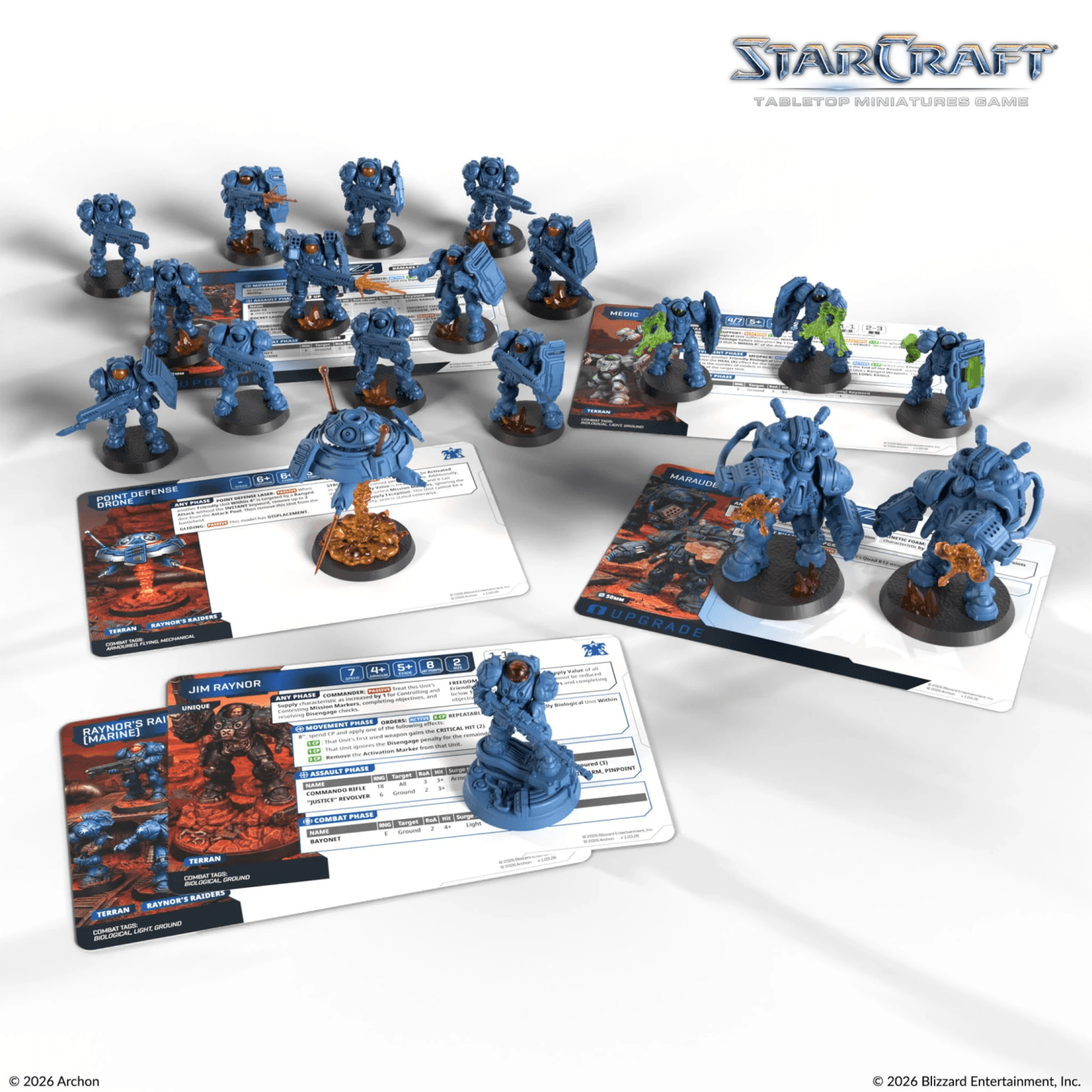
StarCraft has finally shown up in a form miniature painters can actually put on the desk and build around: a full two-player starter with colored plastic armies, terrain, rules, and a cloth mat in the box. What makes the Founders Edition interesting is not just the price tag or the license, but the way it reframes the first hobby decision, whether to paint over the starter material, lean into it, or treat the box as a ready-made project with serious table presence.
A starter set that behaves like a painting project
The Founders Edition lands with the kind of contents painters usually see in a major launch box, not a thin learn-to-play bundle. It includes 19 Terran miniatures, 30 Zerg miniatures, 15 terrain pieces, 43 round bases, 48 cards, 60 tokens, a cloth playmat measuring 54 x 36 inches, a rules reference, an assembly manual, a ruler, and 20 six-sided dice. Retail listings describe the miniatures as unpainted and unassembled, which keeps the box firmly in the hobby lane rather than the board game shelf.
That matters because the set is large enough to create two very different desk experiences. The Terran side gives you a smaller model count with stronger visual identity, while the Zerg half pushes you toward batch work, organic texture, and fast repetition. For painters, that is a better question than “is this a good game purchase?” It is, “what kind of painting session does this box unlock?”
Colored plastic changes the first hour
The biggest visual hook is the colored plastic itself. The Terrans come in blue, the Zerg in purple, and the box also includes transparent effect parts. That makes the starter feel immediately different from the usual grey-sprue mountain, because the material choice already suggests faction identity before a brush touches the model.
For some painters, that is a shortcut toward something table-ready. Blue armor and purple chitin already read as faction-coded, which means even minimal shading and edge work can produce a striking result. For others, the colored plastic becomes a foundation, especially if the goal is a deeper finish, more contrast, or a more unified army scheme. Either way, the set “refuses to behave like a single correct paint job,” which is exactly the sort of flexibility that makes a starter box more interesting than a simple rules buy-in.
The transparent effects are another useful detail. They promise the kind of energy effects and sci-fi cues that can break up a batch painting session and give the armies a few focal points without forcing every model into the same treatment. That is the difference between a starter that gets assembled and one that actually invites experimentation.
Terran and Zerg offer very different desk rhythms
The split between 19 Terrans and 30 Zerg is not just a list of contents, it is a painting map. Terrans naturally lean toward armor panels, cleaner edges, and stronger silhouette reading. They are the sort of models that reward neat contrast, weathering, and faction markings, especially if you want the army to look crisp from gaming distance.
The Zerg side gives the opposite pleasure. Thirty models means a stronger batch-paint opportunity, and the alien forms are likely to reward texture-heavy work, wet blends, and quick color separation. If Terrans ask for discipline, Zerg ask for motion. That makes the box unusually appealing as a hobby-switch test, because one starter can scratch both the “big centerpiece” itch and the “assembly line” itch.
The terrain pieces also matter more than they might in a normal starter. Fifteen pieces of scenery create a small scene-setting ecosystem around the armies, and for painters that means more surfaces with different roles: hard industrial shapes on one side, more organic or corrupted forms on the other. A box like this does not just deliver units. It gives you a little diorama economy to work with.
Why Archon’s name carries weight
The set also arrives with extra credibility because it comes from Archon Studio, the plastic kit specialists behind titles such as Dungeons & Lasers and Masters of the Universe: Battleground. Archon was founded in 2014, and its catalog now also includes Heroes of Might and Magic III: The Board Game, Wolfenstein the Board Game, and Master of Orion: Ad Astra. That history matters to painters because it suggests the company understands sprue design, material handling, and the expectations of people who care about how a kit goes together and how it takes paint.
The StarCraft project is also bigger than a one-off license. Archon announced an official partnership with Blizzard Entertainment on March 26, 2025, with the tabletop miniatures game planned for 2026 and board games in the StarCraft universe following in 2027. The official StarCraft TMG site has described the game as the first official StarCraft release in years, which helps explain why the launch has felt like a genuine hobby event rather than a placeholder product.
Where it sits in the Warhammer conversation
The Founders Edition is being positioned at the same scale of attention as large Games Workshop starter boxes, and that is the right comparison for painters. The real question is not whether it replaces Warhammer, but whether it earns a place beside it as a project worth opening now. With a $199 price point for the Terran-vs-Zerg Founders Edition and a separate Protoss Founders Edition starter listed at $109, the product tree already looks broad enough to support different kinds of hobby budgets and collection plans.
That broader range is part of the appeal. The Founders Edition reads like the big centerpiece purchase, while the promised smaller faction starters suggest a path for painters who want to join the setting without committing to the full two-army box. The game also has add-on characters and expansions in the launch ecosystem, including Jim Raynor & Point Defense Drone, Kerrigan & Omega Worm, and a Zeratul promo miniature, which points to a range of future painting hooks beyond the starter itself.
The launch window tells its own story
The release schedule has been unusually active. Archon said the Founders Edition pre-orders would open no later than March 10, with a target price of $199 for the two-player set and a planned end to pre-orders on March 31. The FAQ later moved that end date to April 17, 2026, and said shipping would begin shortly after and continue for a couple of months. Archon then said demand had exceeded expectations and that it had increased manufacturing capacity and added three new injection machines.
That production response is worth noting because it suggests the box landed harder than a small licensed curiosity. It also lines up with the broader launch trail: a March 31 rules release, a December 3, 2025 appearance at Spiel Essen 2025, and preorder activity that was already pulling in attention before the first wave shipped. For painters, that kind of rollout usually means one thing: a new army project has crossed from novelty into something with real momentum.
A box built to be painted, not just played
The Founders Edition succeeds as a hobby object because it gives painters several ways to engage with it. You can treat the blue Terrans and purple Zerg as a quick route to a finished tabletop force, or you can use the colored plastic as the base for a more ambitious finish. You can batch-paint the Zerg, centerpiece the Terrans, and use the terrain and clear effects to turn the whole box into a display of faction contrast.
That is the real value test here. StarCraft is not asking painters to choose between a game and a project. It is offering a starter set that already understands the appeal of the desk: distinct silhouettes, strong faction identity, textured surfaces, and enough model count to make the first session feel like the beginning of a collection, not just a rules demo.
This article was produced by Prism’s automated news system from verified source data, official records, and press releases, then run through automated quality and moderation checks before publishing. The system is built and supervised by the people who set the standards it runs under. Read our full AI policy.
Know something we missed? Have a correction or additional information?
Submit a Tip