StarCraft Zerg faction spotlight, horde tactics and organic painting cues
The Zerg launch line turns StarCraft’s swarm into a painter’s dream, with 32 mm monsters, swarm counts, and a palette built for slime, carapace, and glow.
The swarm is back, and it is built for painters
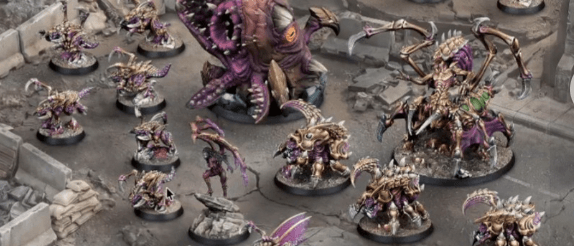
The biggest hook in the StarCraft: Tabletop Miniatures Game Zerg spotlight is not just that the faction is coming, but how clearly it sells itself on the table. The Zerg are presented as the army of horde tactics and area control, which means pressure, spread, and board presence matter more than durable elite duels. That makes them an unusually satisfying faction to paint because every model, from the smallest Zergling to Kerrigan herself, is designed to read as part of one living organism.
The visual language is immediately recognizable: organic forms, segmented armor, chitin-like plates, and a palette that leans into purple flesh and wet, alien texture. The faction’s lore backs that up, too, with the Zerg framed as a collection of alien species driven by evolution and assimilation, constantly absorbing new essences to create fresh strains and bioforms. For a painter, that is a gift: the army is not asking for uniformity so much as controlled variation inside a shared biological identity.
Why the Zerg are such a strong hobby proposition
The May 19, 2026 Zerg faction focus lands because it explains what the faction is for, not just what it looks like. These are highly specialized units, excellent at one job and terrible at others, so the army wants the right bioform in the right place at the right time. That gameplay identity translates naturally into the miniatures, where distinct silhouettes and repeated bodies create the feel of an advancing infestation.
The other keyword that matters is creep. Zerg visuals work best when the models feel like they are spreading across a surface rather than standing on a clean display plinth. Burrow markers, swarm density, and effects work all reinforce that idea, so the faction rewards painters who like atmospheric basing and miniature-scale storytelling as much as crisp edge work.
What is in the launch range
This is not a vague faction tease. The official StarCraft TMG materials describe the game as the first official StarCraft release in years, with Archon Studio and Blizzard Entertainment announcing their partnership in March 2025 and mapping out a 2026 tabletop miniatures game followed by StarCraft board games in 2027. The starter set is set up for Terran and Zerg, with enough miniatures, tokens, and terrain for a two-player small-table game, while a separate Protoss starter set is planned for one player.
The scale matters for painters, and here the line sits at 32 mm. That is large enough to support clean detail on carapace ridges, eyes, teeth, and organic membranes without losing the sense of mass that Zerg models need. The Founders Edition starter bundles make the swarm count concrete: 24 Zerglings, 3 Roaches, 1 Queen, 1 Kerrigan, and 1 Omega Worm on the Zerg side, with all models supplied unpainted and unassembled.
The launch range also looks broad enough to support a real faction identity rather than a token starter presence. Official download files already list Zergling, Queen, Hydralisk, Roach, and Kerrigan kit PDFs, which signals that the faction is being positioned as a core army from the outset. For anyone deciding whether the first purchase is worth it, that matters more than hype: the line already reads like a complete swarm toolkit, not a one-box experiment.
The models that show off the faction best
If you are choosing where the Zerg line comes alive visually, the Zerglings do the heaviest lifting. They establish the massed swarm look immediately, especially when repeated in a unit that can be painted quickly but varied subtly through skin tone, carapace saturation, and basing. Roaches and the Queen then add the heavier bioforms, giving the army a visual rhythm of low, medium, and centerpiece monsters.
Hydralisks are the model that most clearly bridge gameplay and paint scheme. Their long, segmented bodies and weaponized heads invite sharp contrast between fleshy underlayers and armored ridges, which makes them ideal for painters who want to push texture. Kerrigan is the obvious focal piece, but she works best when the surrounding swarm has already established the faction’s visual language.
Early reveals made that clear. Painted Zerglings and Hydralisks have already been shown alongside burrow markers and Terran marines in the background, which gives the range immediate context on the table. Even before the full line is in hand, the faction is already communicating what it wants to be: a mass of living weapons that look better the more they occupy space.
Painting cues that match the Zerg identity
The most successful Zerg schemes will respect the same rule the faction follows in play: repeat the core idea, then vary the execution just enough to keep the swarm alive. Purple flesh is the safest anchor because it instantly reads as StarCraft Zerg, but it works best when layered with bruised blues, sickly reds, or desaturated bone tones. Hard black carapace, or carapace pushed toward glossy burgundy, creates a clean split between organic mass and armor plates.
- Flesh or muscle, where wet translucency and glaze-heavy blending sell the living surface.
- Carapace, where harder contrast and clean plate definition make the shapes read from across the table.
- Effects, where slime, bioluminescent accents, and toxic basing help the models feel like they are emerging from an infestation rather than standing on a display shelf.
A useful approach is to treat the army as three visual zones:
That final piece is especially important for Zerg. Battlefield basing, puddled textures, and creep-style terrain do more to sell the faction than a perfectly tidy neutral base ever could. Because the line is built around pressure and board coverage, the base should help the miniature look like it is advancing through hostile ground, not posing on it.
A launch army that already knows what it is
Jarek Ewertowski has said the game is sized to fit on a 33-inch by 66-inch board, with a full battle featuring roughly 30 to 40 Terrans, more Zerg, and fewer Protoss. That scale explains a lot about the design language around the faction, because the Zerg are clearly being built to fill space, overwhelm sightlines, and make the table feel crowded in the best possible way. When the army is designed around mass and motion, the paint job has to carry the same energy.
That is why the Zerg spotlight matters so much to miniature painters. It is not just a faction preview, it is a ready-made project with a clear silhouette language, a strong launch count, and a visual identity that practically asks for slime, sheen, and swarm density. If the first purchase is meant to tell you whether the line is worth committing to, the Zerg answer that question fast: they are built to look like StarCraft, and they are built to paint like nothing else on the shelf.
This article was produced by Prism’s automated news system from verified source data, official records, and press releases, then run through automated quality and moderation checks before publishing. The system is built and supervised by the people who set the standards it runs under. Read our full AI policy.
Did this article answer your question?