Warhammer Community shows Hippogriff AFV painting guide, Cadian camo details revealed
Ollie’s Hippogriff AFV tutorial is a fast path to Cadian camo, weathering, and a battle-ready Guard vehicle that still feels like part of a full regiment.
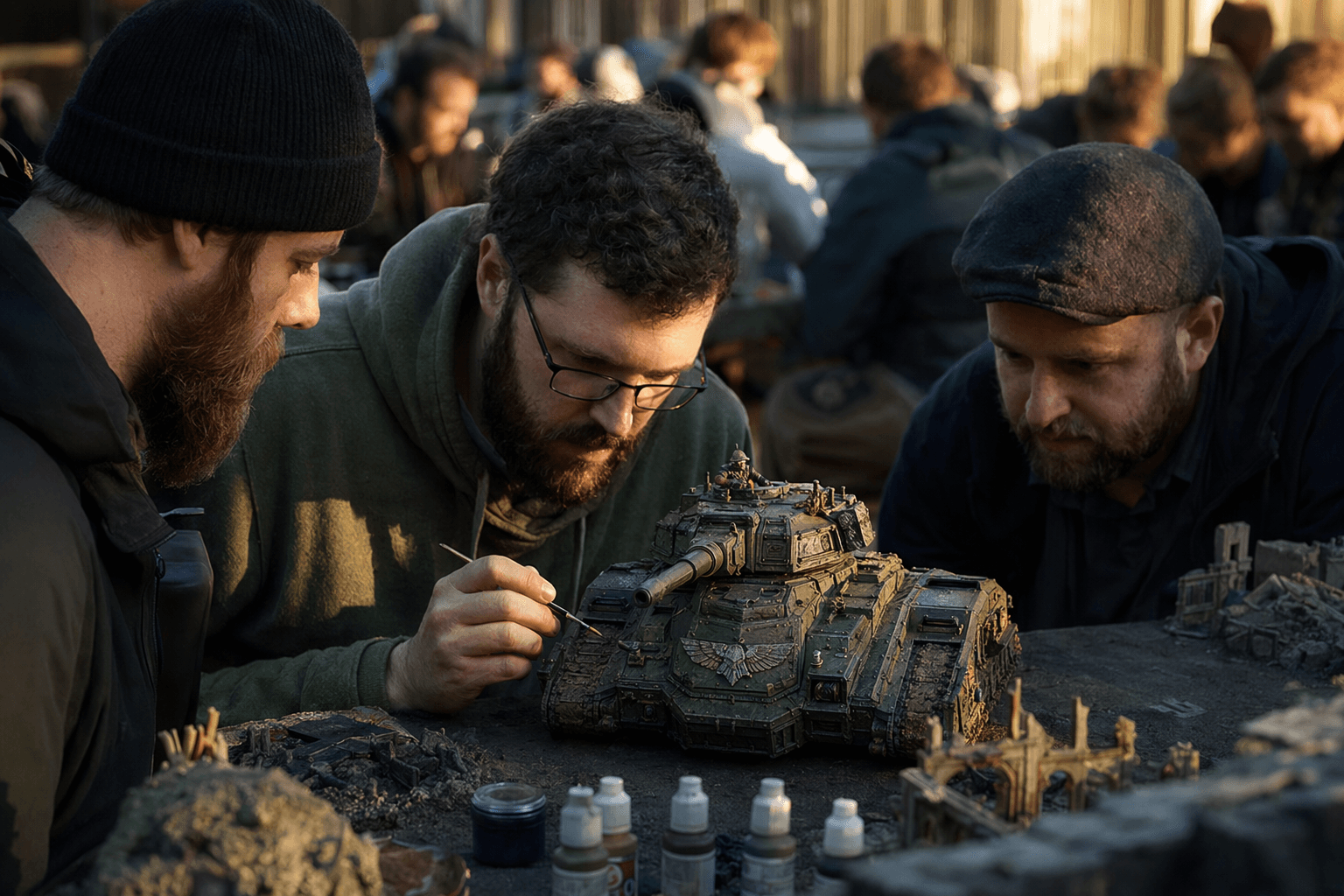
A new Guard vehicle that asks to be painted fast
The Hippogriff Armoured Fighting Vehicle is one of those Astra Militarum kits that immediately tells you how it wants to look on the table: fast, practical, and a little battered from hard service. Warhammer Community’s 7 minute 41 second painting video leans into that identity, describing the vehicle as a speedy, agile support craft with turret-mounted weapon loadouts that can flex into escort duty, reconnaissance, or a hard countercharge.
That matters for painters because the model is not being sold as a fragile display piece. It is a battlefield machine, and that gives you a clear visual language to work with: large armour plates, a military silhouette, and plenty of surface area for camouflage, dust, chips, and panel contrast. If you have ever stared at a fresh vehicle kit and wondered how to make it look useful instead of just new, the Hippogriff arrives with the answer built into its lore.
Why the Cadian camo choice is the real takeaway
Ollie’s tutorial paints the Hippogriff in the camouflage pattern commonly used by Cadian Shock Troops, and that is the most immediately copyable part of the whole video. The official method gives you a ready-made scheme that can be dropped straight into an existing Astra Militarum force without forcing you to repaint your infantry, tanks, and support vehicles from scratch.
That is the practical win here. Cadian camo is already one of the easiest ways to unify a mixed Guard collection, because it reads as standard issue military hardware rather than a one-off hero model. If your army already has Cadians, the Hippogriff can slot in as a believable addition to the motor pool. If your force is broader and more ragtag, the same pattern can still act as a common visual thread tying different units together.
The steps that create the biggest payoff
The studio tutorial is useful because it shows where the biggest visual gains come from on a large AFV. On a vehicle this size, you do not need every rivet to be a masterpiece to get an impressive result. The most important choices are the ones that establish scale and battlefield use: the main camouflage blocks, the separation between armour sections, and the wear that breaks up the flat panels.
The fastest path to a table-ready result is usually the one the video implies:
1. Establish a clean, solid base so the camouflage has a strong starting point.
2. Block in the Cadian-style pattern so the hull immediately reads as Guard.
3. Add definition to edges, recesses, and weapon housings so the model does not look toy-like at arm’s length.
4. Finish with weathering, dust, or battle wear that makes the AFV feel like it has rolled straight out of an Armageddon campaign.
That sequence matters because it front-loads the parts your eye catches first. A vehicle with believable camo and grime will look finished much sooner than one with delicate spot details but no coherent overall read.
Where the studio approach may be more elaborate than you need
The official method is strongest as a reference, not as a prison sentence. For a single showcase model, you may want to follow every highlight and stencil exactly. For an army vehicle that has to sit beside infantry, tanks, and other support kits, some of the finer studio refinements can be simplified without losing the effect.
That is especially true on a kit like the Hippogriff, where the shape itself does a lot of the work. The turret, the weapon loadouts, and the compact support-vehicle profile already communicate purpose. What really sells it on the table is not ultra-fussy micro-detailing, but clean camouflage transitions and enough weathering to make the model feel used. If you are painting to expand a force rather than to chase display trophies, this is the kind of kit where speed and restraint can be a strength.
Why this vehicle fits the larger Armageddon wave
The Hippogriff is not arriving in a vacuum. Warhammer Community first previewed Armageddon: The Return of Yarrick at AdeptiCon on 26 March 2026, then said the Hippogriff AFV and Centaur RSV would be available to pre-order from Saturday, 25 April 2026. The wider release is built around Commissar Sebastian Yarrick’s return to Armageddon and the fight against Wazdakka Gutsmek’s Speedwaaagh!, with Games Workshop leaning heavily into vehicle warfare and mechanized Astra Militarum detachments.
That context helps explain why the Hippogriff painting guide feels so useful. This is an expansion designed around armored infantry, transport, and hard-working support vehicles, so the paint scheme has to do more than look pretty. It has to make a new kit feel like it belongs in a functioning regiment that has been fighting on the same war zone for a long time. A shared camo language does exactly that.
What the rules tell painters to expect from the model
The 16 April 2026 rules article introduced the Hippogriff AFV alongside Commissar Graves and the Centaur RSV, and the unit profile gives even more clues about how it should be painted and presented. Third-party rules summaries list it as a 1 to 2 model unit costing 70 points per model, with Movement 12 inches, Toughness 8, 7 Wounds, and a 3+ save.
That profile reinforces the painting brief. This is a medium-weight battlefield vehicle, not a towering super-heavy, so it benefits from a finish that suggests speed, resilience, and constant use rather than ornate parade trim. The weapon options, including the Vigilator Cannon, Chiron Gatling Cannon, Melta Cannon, and Heavy Lascannon, also suggest that the model will often be built to match a particular battlefield role, which makes weathering and camo even more valuable as unifying details.
The simplest way to make it look like part of your army
If you want the Hippogriff to sit naturally beside the rest of your Astra Militarum collection, keep the big picture in mind. Match the camo family you already use on Cadian Shock Troops, echo the same grime and dust tones found on your existing vehicles, and repeat a few familiar spot colors on lenses, weapons, and trim. That is usually enough to make a new AFV feel like it has always belonged in the regiment.
The strength of Ollie’s guide is that it makes the Hippogriff look both fresh and familiar. It is a new release with its own role, but it is also a practical reminder that Guard vehicles work best when they look like they have survived something. For painters who want the fastest route to a convincing tabletop finish, that is the whole lesson in one model.
This article was produced by Prism’s automated news system from verified source data, official records, and press releases, then run through automated quality and moderation checks before publishing. The system is built and supervised by the people who set the standards it runs under. Read our full AI policy.
Did this article answer your question?