Warhammer Community traces Chaplain evolution, offering Space Marine painting inspiration
Chaplains have gone from stark black icons to flexible chapter canvases, and that evolution gives painters clearer cues for armor, bone, and heraldry.
Why Chaplains still matter on the painting desk
The Chaplain is one of the cleanest read models in Space Marine iconography: black armor, skull imagery, and a crozius that instantly tells the story before a base coat is dry. Warhammer Community’s look back at Chaplains through the ages shows that this is not just lore nostalgia, it is a practical painting reference built from decades of sculpt changes, chapter identities, and hobby presentation.
That history begins after the launch of second edition Warhammer 40,000 in 1993, when a new class of Chaplains made a splash in White Dwarf Issue 180 in 1994. That matters because White Dwarf is Games Workshop’s monthly hobby magazine, packed with news, features, pictorials, rules, and painting content, so the Chaplain’s visual language has always been tied to how the company teaches the hobby as much as how it writes the lore.
The core look: black armor, bone, and authority
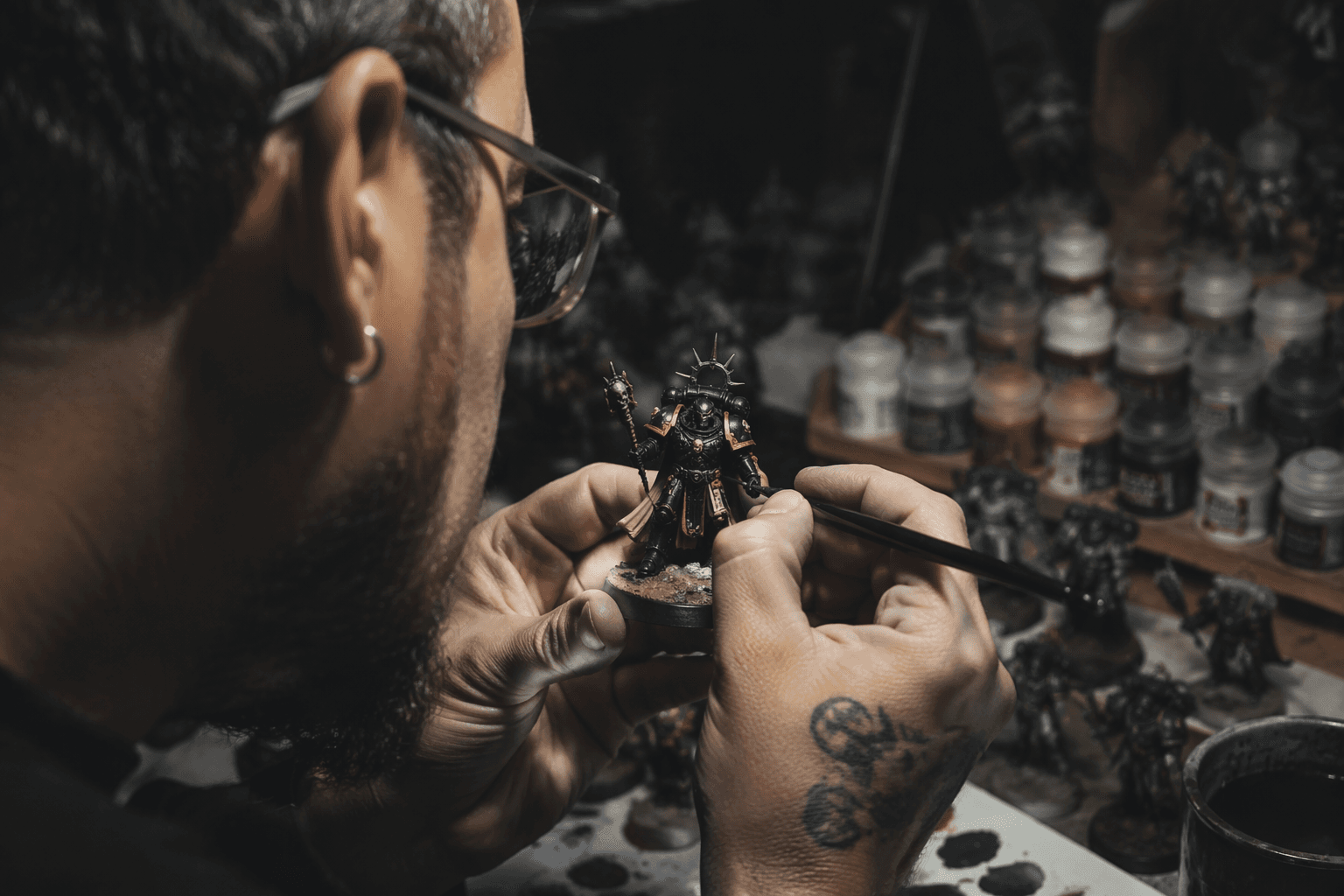
For painters, the enduring Chaplain recipe is simple to describe and tricky to execute well. The black power armor gives you a huge canvas for edge highlighting and weathering, while the skull-faced helmet or bone details create a bright focal point that breaks up the darkness. The crozius arcanum adds a second centerpiece, and the current lore reference describes it as a formal symbol of office, often topped with an Imperial Eagle or winged skull.
That combination is why Chaplains are such a reliable test of control. Black armor punishes sloppy highlights, bone wants careful layering or smooth contrast, and the crozius invites a choice between polished metal, weathered relic, or ornate ritual object. Add purity seals, scrollwork, and chapter markings, and the model becomes a compact lesson in contrast management.
How the sculpt history changes the paint challenge
The earliest Chaplain iterations established the modern silhouette, but later versions raised the stakes in different ways. The Blood Angels’ Chaplain Lemartes arrived in 1998 as the first of his kind shown with a jump pack, turning a static priest of war into a more dynamic painting subject. That shift changes how you approach the model: once a Chaplain is airborne, the eye follows the whole silhouette, so the black armor has to read cleanly from every angle.
Named characters also expanded the Chaplain into chapter-specific identity pieces, with Games Workshop pointing to figures such as Dark Angels Interrogator-Chaplain Asmodai and Space Wolves’ Ulrik the Slayer. Those designs give painters more than one route into the archetype. You can lean into strict black-and-bone chapter tradition, or you can fold in the visual language of a specific force, from Dark Angels severity to Space Wolves ornamentation.
The Terminator Chaplain changed the scale of the job
By the time the fourth edition era arrived, the Terminator Chaplain had become a major visual event, and a 2006 version pushed the concept to a much larger, more imposing scale than earlier iterations. That size matters on the painting table because bigger armor plates reward cleaner edge work, broader transitions, and more confident placement of chapter symbols. The model is less about hiding mistakes and more about making every decision visible.
Games Workshop clearly knows that appeal still has mileage. Warhammer Community described Terminator Chaplains as extremely popular in a 2023 painted-community feature, and the company brought out a new Terminator Chaplain Tarentus miniature for Warhammer Day in 2020. For painters, that is a strong signal: the Terminator Chaplain is not just a relic of older ranges, it is still a live showcase for black armor, relic metals, and ceremonial detail.
What the modern Jump Pack Chaplain opens up
The newest Jump Pack Chaplain continues the same line of evolution, but with a different hobby payoff. Warhammer Community said the miniature has no Chapter-specific markings, which means you can paint it for any codex Chapter, not just Blood Angels. That is a practical gift for painters because it removes the pressure of matching a sculpt to a single background and turns it into a flexible centerpiece for nearly any Space Marine force.
It also changes the balance of the paint job. A blanker, more universal sculpt gives you freedom to push chapter iconography yourself, whether that means more transfers, more freehand, or a stronger color accent on the base and weapon. If the older Chaplain was about inheriting a tradition, the new one is about deciding how much of that tradition you want to keep and how much you want to rewrite.
Painting takeaways from each design element
- Black armor treatment: Chaplains reward disciplined edge highlighting. On older, simpler sculpts, strong lines do most of the work; on larger Terminator bodies, you can build a more layered finish with subtle transitions and controlled gloss or matte contrast.
- Bone details: Skull helmets and bone ornaments are the easiest way to make the model read fast at arm’s length. They also create a natural break from the black, so they are ideal places to push warmer shading or slightly brighter highlights.
- Crozius styling: The crozius is the perfect place for character. A winged skull, Imperial Eagle, or other sacred top works as a focal point, and the shaft can carry metallics, hazard striping, or relic wear if you want to push the story.
- Icon density: Dense ornamentation can either slow a model down or make it look richer. Older or more restrained Chaplains let the silhouette do the work, while newer, larger, or named versions invite transfers, seals, scrolls, and chapter-specific markings without overwhelming the scheme.
A chapter identity tool, not just a nostalgia piece
The deeper story here is that Chaplains have always been used to express what a Chapter believes about itself. Games Workshop has already singled out Chaplain Xavier as the first Salamanders character to get a miniature before Vulkan He’stan, which shows how often the role has been used to establish identity before other named heroes arrive. That is a huge clue for painters: Chaplains are not only about black armor, they are about the visual language of a Chapter made plain.
That is why the archetype keeps coming back in new forms. From Lemartes with his jump pack, to Asmodai and Ulrik the Slayer, to Tarentus and the latest Jump Pack Chaplain, each version offers a different ratio of simplicity, detail, and chapter flavor. The result is a model line that stays useful no matter how your painting style develops, because it keeps asking the same question in new ways: how much authority can you fit into black, bone, and a single sacred weapon?
This article was produced by Prism’s automated news system from verified source data, official records, and press releases, then run through automated quality and moderation checks before publishing. The system is built and supervised by the people who set the standards it runs under. Read our full AI policy.
Did this article answer your question?