Warhammer guide explains object source lighting for miniatures
OSL fails when it looks like bright paint, not light. Use a simple checklist, brighter source, soft falloff, targeted surfaces, and real shadow.

A tiny screen in a chest plate or a lantern blazing across a cloak only works as object source lighting when the miniature looks like it is being lit, not outlined in neon. That is the trap that catches most OSL attempts: the effect starts as a glow, then turns into random bright patches because the source, the falloff, and the shadows never line up. The same problem sits underneath every version of the technique.
Why OSL goes wrong so often
The biggest mistake is treating OSL as decoration instead of physics. The Army Painter’s 2024 guide centers on the core point: OSL can come from torches, glowing plasma coils, magic swords, lava, or toxic sludge, and it changes the normal top-down lighting assumptions by moving highlights and shadows to match the new source. If the brightest spots are placed where the light would not naturally land, the illusion collapses immediately.
On Warhammer Community, Ed puts it from the painter’s side: the hardest part is making the light feel believable because you are trying to convince the eye that opaque plastic is actually emitting light while still dealing with real-world ambient light and shadow. That is why so many models end up looking muddy instead of luminous: the light source is not stronger than the surrounding paint, the fade-out is too abrupt, or the lit areas ignore the shape of the miniature.
The checklist that makes OSL read as light
Start with the source brightness. The actual light source needs to be the brightest point in the scene, whether it is an eye lens, a plasma coil, a sword, or a torch flame. For smaller effects, tiny lights and screens can be handled with a delicate tint and a few glazes at the end, which keeps the effect controlled and stops the whole model from being overpowered.
Then check the falloff. Light does not stop at the edge of a glowing part, and it does not stay equally strong across the model. The physical rules that matter most for miniature painting are simple: lit areas should be brighter than unlit areas, light travels in straight lines, and intensity falls off with distance. That means the brightest glow should sit nearest the source, then soften as it reaches armor plates, cloth folds, weapon casings, or a nearby face.
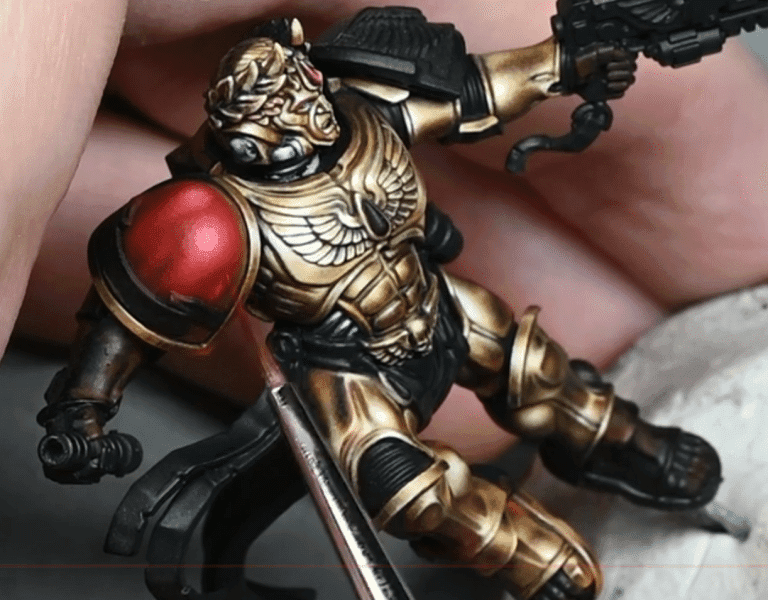
After that, look at affected surfaces. OSL should only hit the parts that the light would actually reach. A lava base can throw heat up the lower half of a model, as Max Soule showed with his Be’lakor army, where resin poured over cotton wool created lava splashes and the colors were pushed far up the body and wings for a hard underlighting effect. A sword or lantern should light the armor edges, hands, and nearby fabric first, not every flat panel on the miniature.
Finally, check the surrounding shadow. Good OSL is not just about adding brightness. It also means leaving some areas colder, darker, or more desaturated so the lit zones have something to contrast against. Torches or lanterns can justify building the whole paint scheme around the light source, which is exactly why the dark portions matter. Without that shadow, the model loses depth and the glow becomes a flat yellow or blue stain.
Start small before you chase the big effects
The March 2024 Citadel Colour Masterclass examples ran from a glow around eyes to a full miniature or diorama lighting scheme. A screen, visor, rune, or power cell is a better first target than a full torchlit cloak, because the painter only has to control a small pool of reflected color.
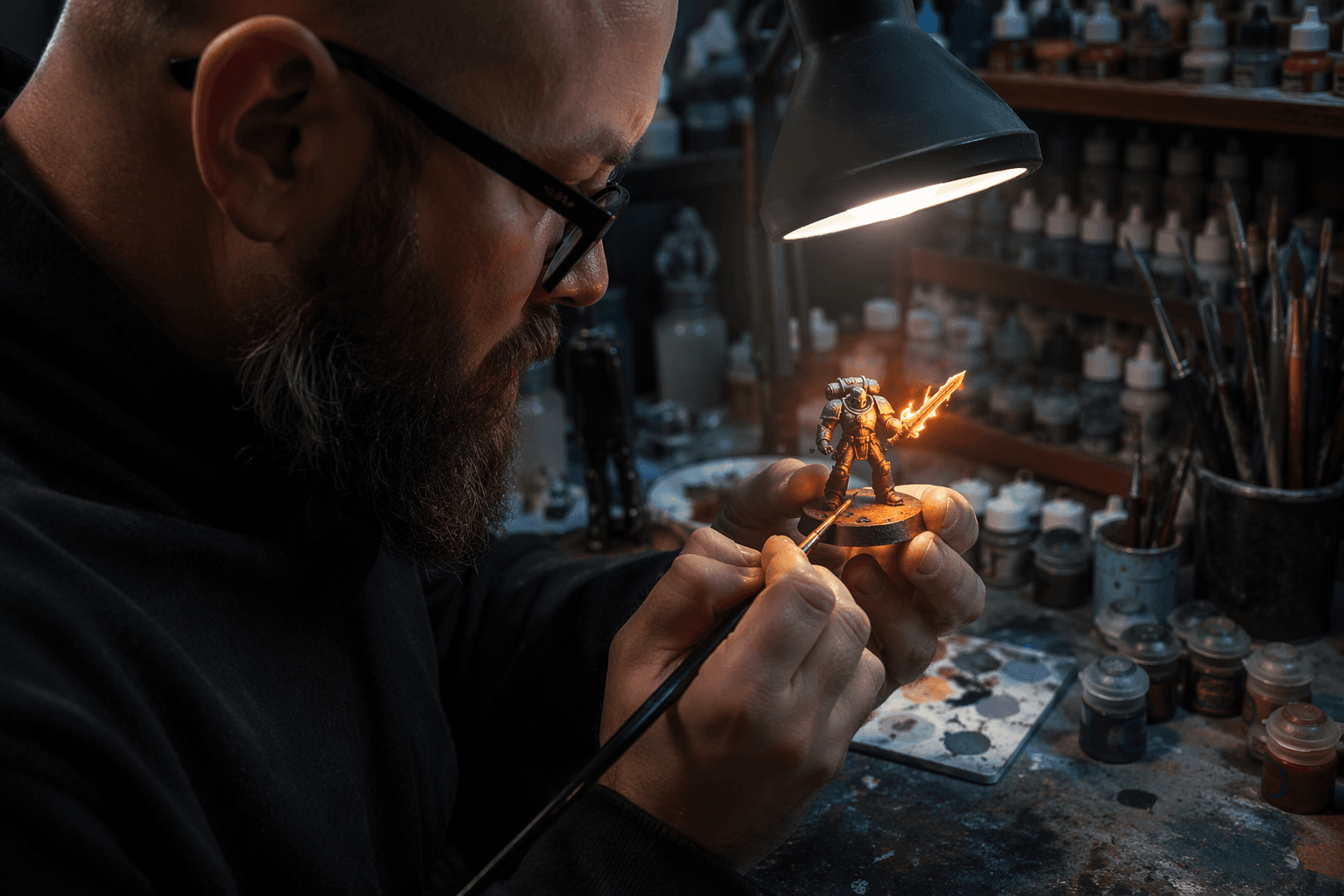
Once that works, the next step is to expand the reach of the glow without losing the shape underneath. A few glazes can tint nearby armor or a weapon casing, but the underlying paint job still has to survive. If the effect buries the miniature in one bright tone, it has gone too far.
Victoria Lamb and early OSL examples
Light Miniatures credits Victoria Lamb with introducing the miniature-painting community to OSL, and identifies *The Rescue of Sister Joan* and *Firey Angel* as early examples. Lamb won the Slayer Sword at Games Day Australia 2001 with *The Rescue of Sister Joan*, and Victoria Miniatures says the piece became known as one of the first examples of OSL in the gaming miniature hobby.
The Golden Demon Compendium lists awards from 1999 through 2006, including the 2001 Slayer Sword win along with multiple Gold, Silver, and Bronze finishes.
Why Warhammer keeps returning to OSL
Warhammer Community keeps spotlighting OSL because it is one of the few effects that can instantly change the mood of a model without depending on a specific game release or sculpt style. A Castellan Crowe painted as though the sword itself lit the armor turns a standard Grey Knight into a scene. The same is true of the Be’lakor lava build, where the underlighting sells heat and menace in a way flat paint never could.
Citadel Colour Masterclass keeps pairing OSL with dramatic lighting on skin and faces, and Ed pointed to Adrian Smith’s Horus-and-Emperor artwork as inspiration.
The practical test before you commit to OSL
Before you add the glow, ask four things in order: is the source bright enough, does the light fall off naturally, are only the right surfaces catching it, and does the surrounding shadow stay intact? If the answer to any of those is no, the effect will usually read as paint first and light second.
Start with a small source, keep the falloff honest, limit the effect to surfaces the light can actually reach, and protect the shadows that make the glow believable.
This article was produced by Prism’s automated news system from verified source data, official records, and press releases, then run through automated quality and moderation checks before publishing. The system is built and supervised by the people who set the standards it runs under. Read our full AI policy.
Did this article answer your question?