Glasgow Producer KAVARI Calls Minimal Techno Trend a Horrible Plague
Glasgow producer KAVARI calls the rush of EDM and dubstep acts converting to 130BPM minimal a "horrible plague" consuming electronic music's identity.
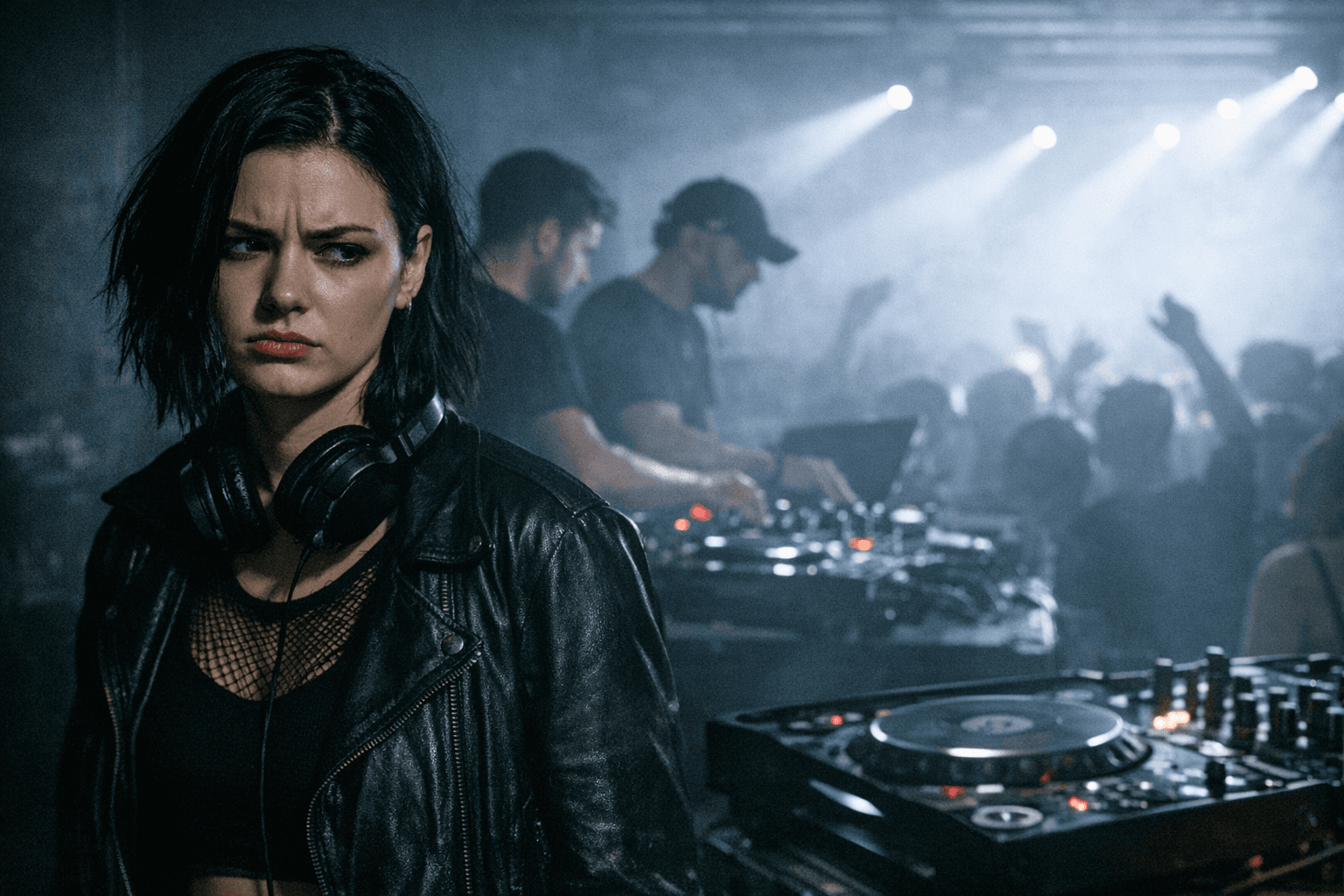
Cameron Pickthall does not mince words. The 24-year-old Liverpool-born, Glasgow-based producer and DJ who performs as KAVARI has publicly labeled the flood of EDM, dubstep, and trance producers pivoting to minimal techno a "horrible plague" on electronic music, and the rant landed exactly as intended: virally.
The frustration is specific. Minimal techno sits in the 125–130 BPM range, a tempo that KAVARI argues has become algorithmically palatable enough to absorb entire subgenres without demanding that their practitioners actually understand the form. In a Mixmag interview, she framed it in economic terms: "it's all just the big names or one style to fit a particular crowd. I guess in part it's capitalism." KAVARI herself works at the opposite end of the aesthetic spectrum, blending deconstructed club, ambient, breakbeat, industrial techno, and noise into an approach that earned her coverage in The FADER and a debut EP after going viral on social media, as well as opening slots for Ethel Cain on global bookings.
The genre she is defending has a precise, documented origin: Detroit, Michigan, early 1990s. Robert Hood, a founding member of the Underground Resistance collective, and Daniel Bell built the template, with Hood's 1994 M-Plant track "Minus" widely cited as one of the first fully recognized minimal techno records. Hood defined the sound as "a basic stripped down, raw sound. Just drums, basslines and funky grooves and only what's essential." The aesthetic is explicit in that definition: restraint as a deliberate choice, not a default.
The genre's European expansion complicated that purity almost immediately. Ricardo Villalobos, the Chilean-born German producer born in 1970, brought minimal into dialogue with microhouse through labels including Perlon and Playhouse. By the second half of 2006, critics were already noting that "minimal" had become a contradictory descriptor, applied to tech house sounds far more maximal than anything Hood had envisioned in Detroit.
What followed is the Ibiza-core pipeline, and it is arguably the mechanism KAVARI is actually targeting. The 2010s saw Ibiza shift its gravitational centre from arena EDM toward darker underground sounds, with Villalobos, Solomun, Marco Carola, and Jamie Jones among the architects of that transition. Tale of Us, the Milan-born duo of Carmine Conte and Matteo Milleri, crystallized the resulting aesthetic into a brand: their Afterlife label and event series, launched in the mid-2010s, fused atmospheric tension with trance-adjacent motifs into what they call "romantic techno," designed to "stir hearts and minds rather than merely move feet." In 2017, they signed to Deutsche Grammophon, classical music's most prestigious imprint. By 2024, Afterlife held a residency at Hï Ibiza. DJ Mag named the duo among the top 100 alternative DJs in 2018.
Keinemusik, the Berlin collective that coalesced around 2009 when founding member Reznik relocated to the German capital, navigated the crossover differently. Their stated mission is "the spirit of refining House and Techno off the beaten path," but so is their inclusion in the 2020 Grand Theft Auto V "Cayo Perico Heist" update, a mainstream penetration point few underground collectives can claim. Their blend of Berlin techno minimalism with Afrohouse elements tracks a genuine countertrend: according to MIDiA Research, Afrohouse grew 778% year-over-year on the sample platform Splice by early 2026, suggesting the producers doing interesting things at 130 BPM are doing so by importing from elsewhere rather than flattening everything to a single palette.
That distinction, between curated minimalism and copy-paste minimalism, is the crux. Ibiza Spotlight reported in 2025 that "the electronic music scene [is] inundated with labels, producers and DJs delving into Minimal," and made the structurally important observation that "Minimal in-and-of itself is not a genre." It is an aesthetic approach. When it is working, in Hood's Detroit originals or in Keinemusik's hybrid sets, the stripped-down architecture amplifies the craft underneath. When it is not working, there is no craft left to amplify.
The precedents for KAVARI's frustration run long. Deadmau5 said at the 2014 Ultra Music Festival that popular EDM "all sounds the same." Avicii argued in 2013 that most of the genre lacked "longevity," a pointed observation given that his own True album from that year incorporated bluegrass as a deliberate counter-move. The artists who survive these consolidation cycles tend to share one trait: they cross-pollinate rather than conform.
The practical lesson for producers considering a move into minimal is embedded in the scene's own history. Tempo alone is not a genre: the 130 BPM floor is a meeting point, not a destination. Arrangement density should communicate intent rather than satisfy an algorithm; Hood's early records worked because every remaining element had been consciously chosen to stay, and every stripped element served a function in the negative space. Sound design operates the same way: the difference between Josh Baker, DJ Mag's 2024 breakout producer of the year, and a generic Ibiza-core facsimile is not the BPM but the specificity of what happens inside the groove. DJ function matters too: minimal rewards patience and arc-building, a fundamentally different skill set from the peak-moment engineering that EDM and dubstep culture prizes. Importing those mixing habits into a minimal set produces precisely the homogeneity KAVARI is describing.
London's FUSE label is currently platforming a wave of emerging names including Toman, Elliot Schooling, Liam Palmer, Casey Spillman, and Rossi, demonstrating that the form can still generate genuine voices. Whether those voices survive the Ibiza-core pipeline intact is the question the scene is actively asking, and KAVARI's "horrible plague" framing, however blunt, puts a name to the mechanism doing the damage.
This article was produced by Prism’s automated news system from verified source data, official records, and press releases, then run through automated quality and moderation checks before publishing. The system is built and supervised by the people who set the standards it runs under. Read our full AI policy.
Did this article answer your question?