How to Make Minimal Techno: 11 Need-to-Know Techniques, Arrangement and...
Learn 11 practical techniques for producing minimal techno, from sound selection and kick layering to clap curation, delay filtering, arrangement and keeping things intentionally sparse.
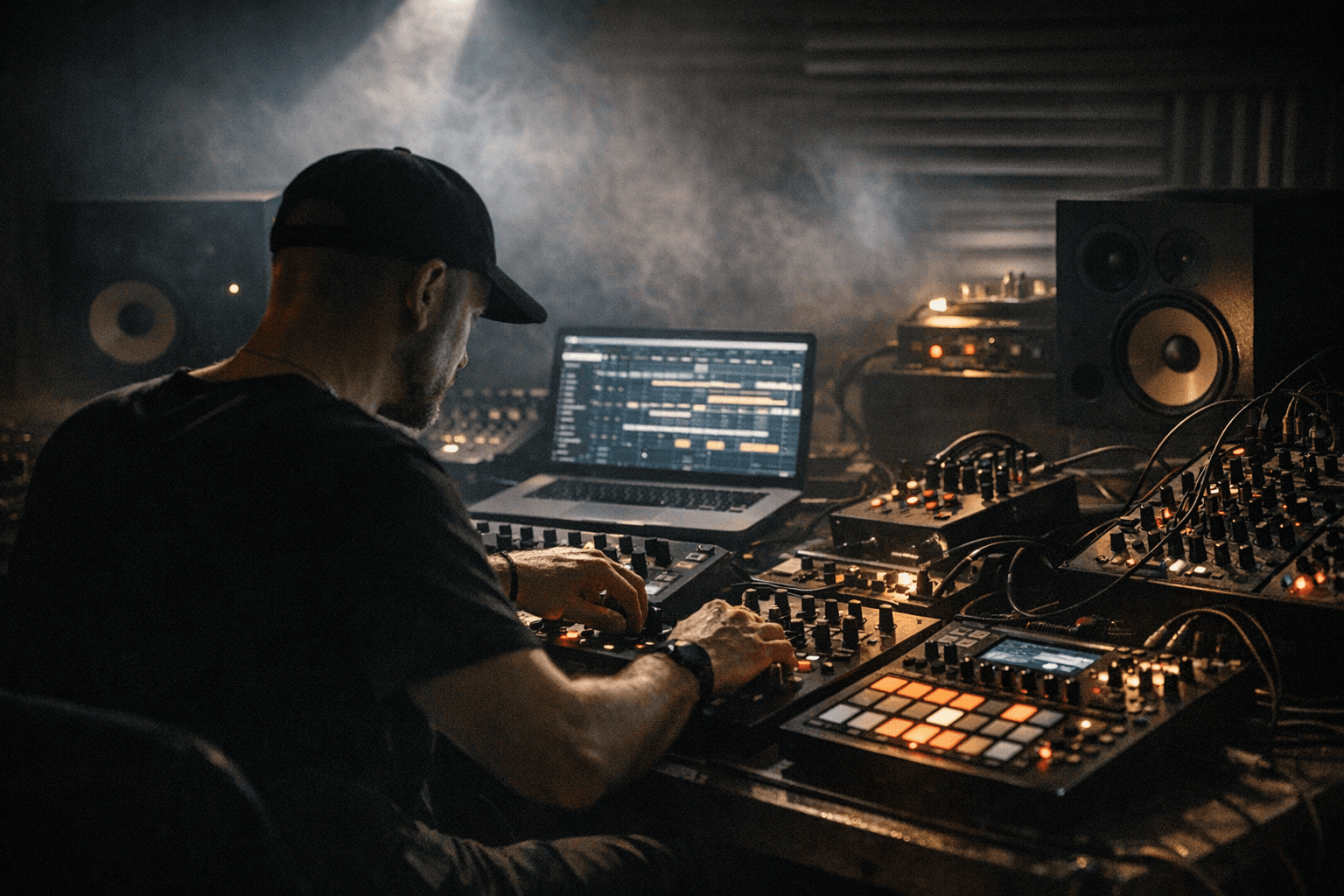
“This evergreen production guide gathers essential techniques for producing techno (covering styles including minimal techno), with practical sections on choosing style and sounds, building rhythm and percussion, sound design for dark textures and subby basslines, arrangement and”
1. Choose your minimal techno style and palette
Minimal techno sits on a spectrum: stripped-down groove, microhouse-leaning warmth, or darker, industrial textures. Decide early whether you want hypnotic repetition, groovy swing, or stark percussive loops, that choice drives tempo, swing, and sound selection. Limit your palette to a handful of sources (one kick family, one clap family, a bass voice, and a couple of textures) so choices later in the project stay cohesive.
2. Focus on few, perfectly crafted elements
“Especially if you’re creating more modern, minimal techno, the aim isn’t to have as many sounds blaring together as possible – it’s to have few elements that are designed perfectly to fit together to make a cohesive whole. Instead of spending all your time building dozens of tracks, concentrate on just a few, and make each sound as strong as it possibly can be, for the benefit of your tune as a whole.” Translate that into practice by making each channel earn its place: sculpt a kick that nails the groove, a bass that fills the sub, and percussion that defines the pocket. If something isn’t contributing on its own, mute it, minimal techno rewards subtraction.
3. Layer kicks strategically to cover energy bands
“Sometimes it’s the combination of two sounds that make a unique whole. It’s standard practice in most electronic genres to combine multiple kicks into something that has its energy in all the right places. But it’s not so simple to make sure you don’t end up with a crowded mess of clashing sounds.” Use layering to get both punch and sub presence: a clicky top kick for attack, a low sine or processed kick for sub. Align phase or use small time offsets to avoid cancellation, and carve frequency space with narrow EQ cuts so layers complement rather than fight.
4. Build percussion with intent, grooves over fills
Percussion in minimal techno is economical but essential: shuffling hats, tiny rides, and stiff percussive hits create momentum without overpowering the mix. Program variations across 16–64 bar loops to keep the hypnotic feel engaging: micro-variants, delayed transients, or gated textures are your friends. Keep velocity maps simple and use snap points to lock feel with the kick.
5. Curate claps, because packs favor snares
“Techno is one of the most heavily clap-influenced genres out there, but you’ll often find that most sample packs and synth presets lean far more heavily towards snares. For the techno producer, having a big selection of claps is a must, especially seeing as you’ll want to find the one that fits your track absolutely perfectly. [...] Use your delay’s filters to mix in its signal and make the mix a little less busy and crowded. Again, keeping things subtle is key in techno production.” Collect and audition dozens of clap hits. Layer short, mid, and long clap tails to taste, and prioritize the clap that locks with your groove rather than the loudest or most complex hit. When you find “the one,” treat it like a lead instrument: tune, gate, and EQ it into place.
6. Use delay filtering to preserve space
“Use your delay’s filters to mix in its signal and make the mix a little less busy and crowded.” When you add delay to percussion, synths, or claps, route the effect return through a high-pass and low-pass to remove mud and ultra-bright build-up. Keep delay levels subtle and automate wet/dry or filter cutoff during denser sections to maintain clarity. Delays should add movement, not clutter, roll back feedback and dampening to keep tails tasteful.
7. Design dark textures and subby basslines
Dark minimal techno relies on texture and the right sub foundation. For bass, start with a clean sine or triangle for sub and add a textured upper layer (distorted square, filtered noise, or granular pad) to give character. Use gentle saturation, band-limited distortion, and multiband compression to glue layers without losing sub clarity. Sidechain to the kick with tasteful release times so the groove breathes without pumping the entire mix.
8. Mix with restraint: carve, seat, and test on systems
Minimal arrangements magnify every choice, a cluttered low end or honky midrange shows immediately. Use surgical EQ to carve overlapping instruments, set high-pass filters on non-bass elements, and use mid/side where appropriate to widen textures without disturbing mono compatibility. Test on club, laptop, and phone speakers, what reads as subtle on studio monitors can become muddy on smaller systems.
9. Arrange for hypnotic motion, note the source truncation
The original guidance for this guide included “arrangement and” and the source text ended there; that trailing fragment is preserved verbatim. For practical arrangement work, think in long-form blocks (32–64 bars) rather than constant change: introduce elements slowly, remove to create space, and use automation on filter, reverb, and micro-timing to evolve. Minimal tracks live on small variations, delay throws, EQ drops, or the removal of a top element can function as a “drop” in a club setting.
10. Keep effects subtle; let timing and dynamics do the work
“Again, keeping things subtle is key in techno production.” Favor small, musical tweaks: short reverbs, low-level delays, and light saturation. Automate micro-movements (tension via filter sweeps, transient shaping) instead of large, obvious FX sweeps. Subtlety creates a club-friendly dynamic where the room and system magnify nuance.
11. Make each sound earn its place, quality over quantity
Reinforce the earlier advice: concentrate on a handful of parts and make each perfect, tune, process, and place them in the stereo and frequency field deliberately. When every element has a clear job, your track breathes and the groove takes priority over gimmicks. As you refine, mute aggressively: if the track loses momentum when an element is off, it’s doing its job.
- Start a project with only kick, clap, bass, and one texture; if you can make that groove move you, build from there.
- Create a “clap bank” folder and audition 50+ options; tag the ones that sit well with your kick.
- When layering kicks, solo the low end to check for phase and use a narrow EQ to remove conflicts.
- Route delays to returns and place HP/LP filters on the return channels immediately.
Practical tips you can apply right now
Editor's note The article preserves verbatim excerpts from source material, including this original fragment: “This evergreen production guide gathers essential techniques for producing techno (covering styles including minimal techno), with practical sections on choosing style and sounds, building rhythm and percussion, sound design for dark textures and subby basslines, arrangement and” and Loopmasters excerpts: the item 9, the item 11 quote (provided twice in the source material), and the item 12 excerpt containing an ellipsis and the delay/filter sentence. Those verbatim lines are used here exactly as supplied.
Closing practical wisdom Minimal techno rewards discipline: fewer, better sounds, careful rhythmic choices, and space-preserving effects make a small mix read as massive on the dancefloor. Start strict, then relax: once you’ve nailed the core elements, add one deliberate extra texture or move per 32 bars. Treat silence and subtraction as your production tools, the groove will thank you.
This article was produced by Prism’s automated news system from verified source data, official records, and press releases, then run through automated quality and moderation checks before publishing. The system is built and supervised by the people who set the standards it runs under. Read our full AI policy.
Did this article answer your question?