Late Night Minimal Techno Triggers Unique Brain Responses, Neuroscience Reveals
At 4 AM, a 125 BPM minimal groove does something peak-time chaos can't: it runs on tonic dopamine and near-zero structural uncertainty, giving the fried brain a scaffold instead of a storm.
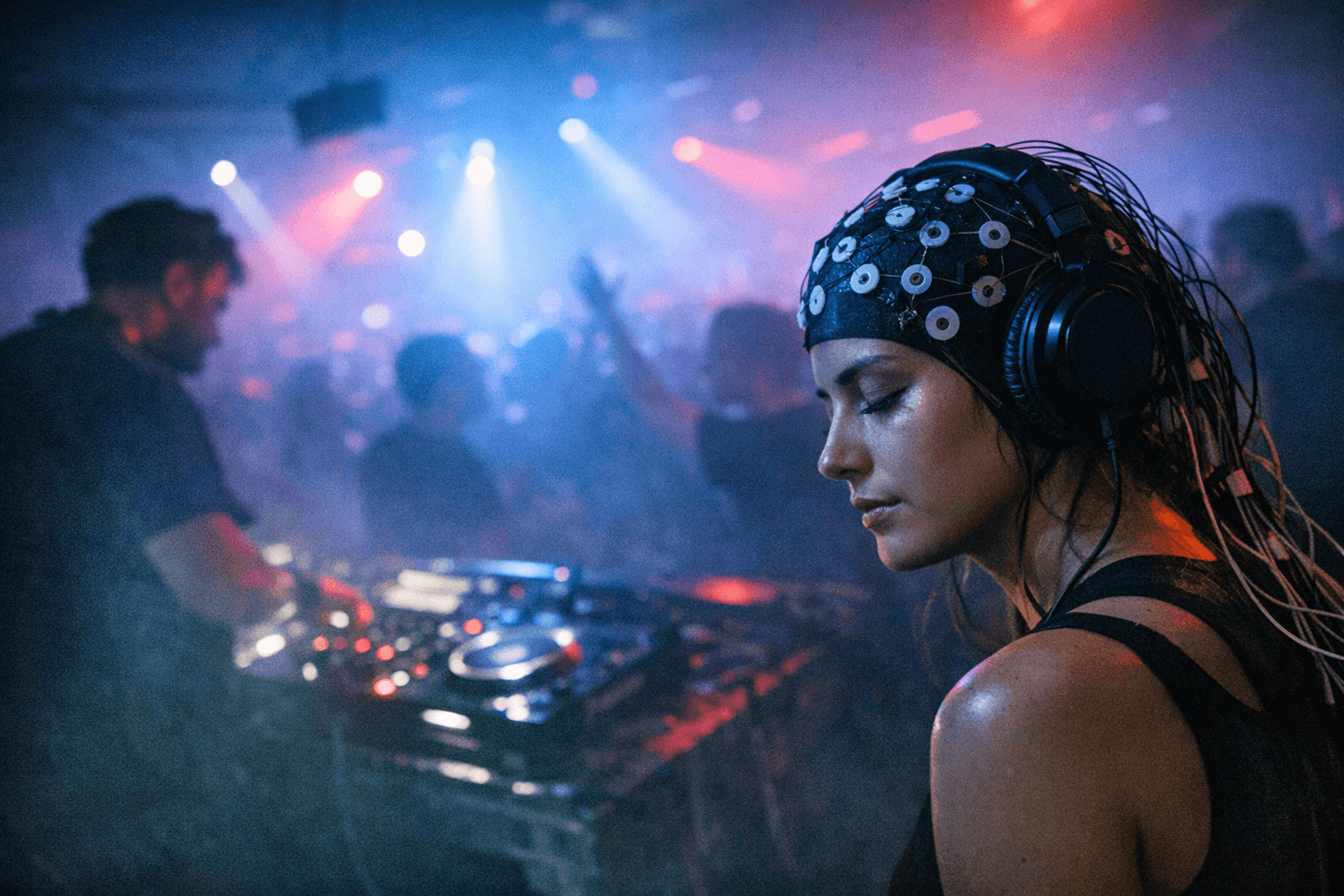
Bass instruments are especially effective at inducing people to dance to periodic pulse-like beats, and research suggests this may exploit a neurophysiological mechanism whereby low-frequency sounds shape the neural representations of rhythmic input by boosting selective locking to the beat. For minimal techno, that mechanism isn't a footnote. It's the whole architecture.
A study published in PNAS recorded the electrical activity of volunteers' brains while they listened to rhythmic patterns played at either low or high-pitched tones, finding that brain activity and the rhythmic structure of the sound became synchronized, particularly at the frequency of the beat. Cortical activity at the frequency of the perceived beat is selectively enhanced compared with other frequencies in the EEG spectrum when rhythms are conveyed by bass sounds. It's a finding that reframes the sub-bass anchoring of minimal techno not as a production aesthetic but as a direct line into the brain's timing circuitry.
What makes that line especially powerful at 4 AM is the state of the brain receiving the signal. By the afterparty hours, the cortical regions responsible for high-level prediction and attention are depleted. The driving force of the music, according to analysis from MidnightRebels, transitions to subcortical pathways. Minimal techno, anchored by low-frequency sub-bass, is built precisely for that handover. The genre isn't fighting for cortical bandwidth. It works with what's left.
The neurochemical picture compounds this. Minimal techno, according to MidnightRebels' analytical feature published March 22, 2026, "operates on a different neurochemical economy." Rather than triggering the sharp phasic dopamine spikes that a peak-time bass drop delivers, it provides a stream of tonic dopamine via a predictable beat. The distinction matters enormously for a fatigued nervous system. Where phasic hits demand energy and recovery, tonic dopamine sustains a steady, low-cost reward state. The brain stops burning fuel trying to predict what comes next because, at near-zero structural uncertainty, there is nothing to predict.
That predictability isn't flatness. It's precision engineering. The steady, predictable beat of techno can serve as an external timekeeper for our movements, potentially improving the ability to perform repetitive physical tasks with precision. In the context of a late-night floor, a 125 BPM minimal techno track threading through the subwoofers turns the crowd's residual motor function into something close to effortless groove-locking. The exhaustion lifts. The second wind arrives.
The micro-details carry their own neurological weight. MidnightRebels described how variations within a minimal track, specifically the opening of a filter or the introduction of a shaker, deliver micro-rewards that keep the listener engaged without demanding the energy of a bass drop. Each small change registers as a moment of novelty within a deeply stable framework. Research has observed that continuous rhythmic music increases connectivity in the brain's alpha frequency bands, leading to a state of deep focus and reduced sensitivity to external changes. A deepening filter sweep does exactly that: it marks time without breaking the spell.
MidnightRebels also pointed to studies showing that listening to predictable music mitigates mental fatigue decrements, giving the exhausted brain a structure to settle into. The specific studies are not named in MidnightRebels' piece, and the claim warrants further sourcing, but it aligns with what the science of neural entrainment and low-frequency processing already suggests: the sub-bass is not wallpaper. Rhythmic stimulation by bass sounds leads to enhanced neural representation of the beat and meter. At 4 AM, that enhancement isn't a bonus. It's the reason the room is still dancing.
This article was produced by Prism’s automated news system from verified source data, official records, and press releases, then run through automated quality and moderation checks before publishing. The system is built and supervised by the people who set the standards it runs under. Read our full AI policy.
Did this article answer your question?