Mobile gaming nears $107 billion, but growth remains uneven
A tiny slice of publishers is pulling mobile gaming toward $107 billion, while downloads slide and live-service spend gets more concentrated.

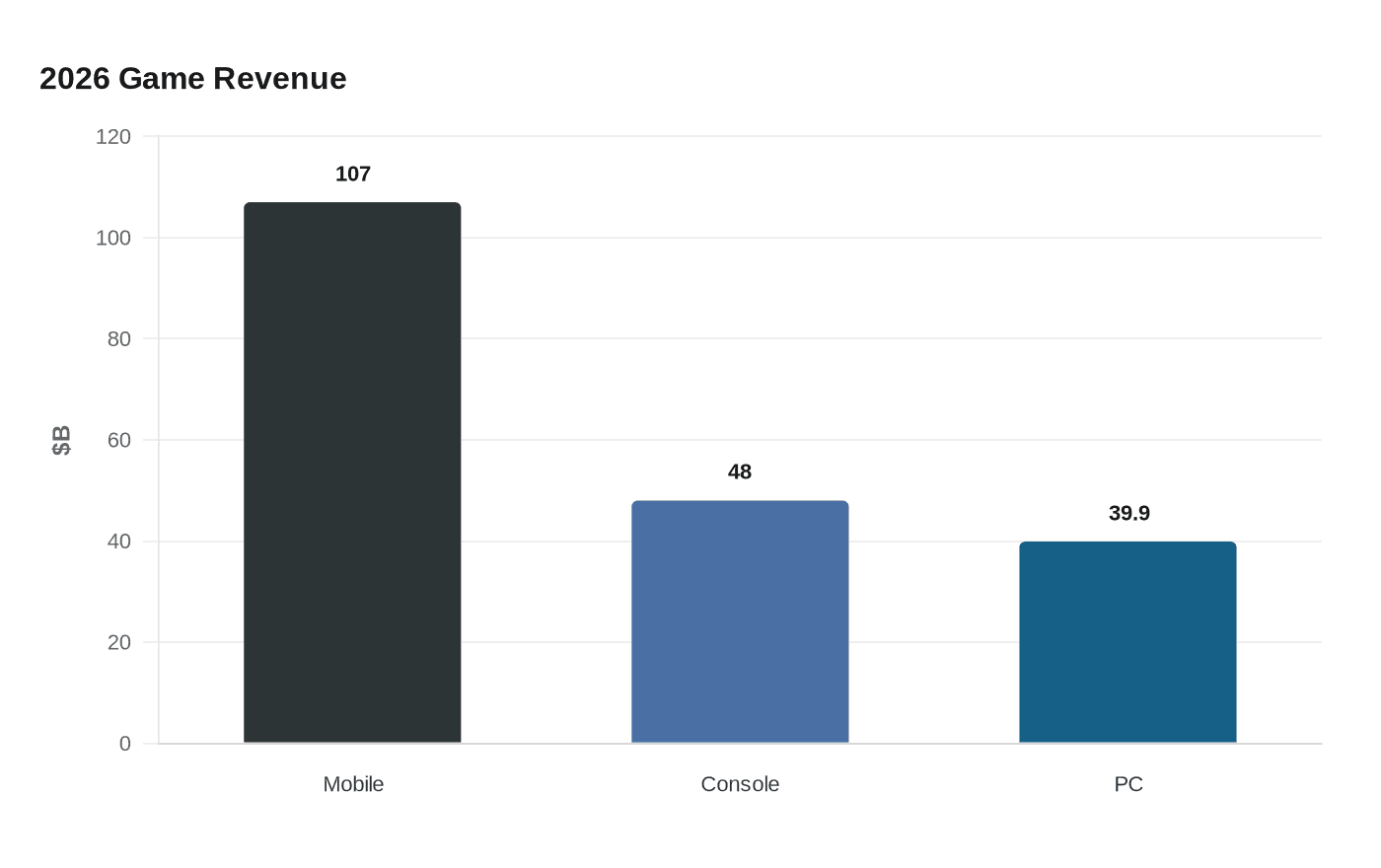
The march toward $107 billion in mobile gaming revenue is being powered by a narrow set of hits, not a broad-based boom. Newzoo’s 2025 Global Games Market Report puts mobile at $107 billion in 2026, or about 52% of the global games market, ahead of console at $48 billion and PC at $39.9 billion.
That headline number, though, is only part of the picture. Statista’s mobile-games forecast lands much higher, at $134.22 billion in worldwide revenue for 2026, which shows how much the category shifts depending on whether a forecast is tracking games alone, broader mobile spending, or different measurement methods. Even Newzoo’s own numbers point to a market that is growing, but not evenly: it projected the global games market at $188.8 billion in 2025, up 3.4% year over year, with mobile at $103.0 billion and roughly 55% of total games revenue.
Sensor Tower’s State of Mobile 2026 makes the concentration problem even clearer. Global mobile in-app purchase revenue rose 10.6% year over year to $167 billion in 2025, but mobile games themselves generated $81.75 billion in IAP revenue, up just 1.3% from 2024. At the same time, mobile game downloads fell 7.2% to 50.4 billion for a second straight annual decline, even as players logged 444.63 billion hours in mobile games, up 0.9% year over year.
The spending is also getting tightly clustered. Sensor Tower found that games from the top 1% of publishers captured 92.5% of IAP revenue and 79.8% of downloads. That kind of split helps explain why publishers are reading the Q1 and Q2 2026 revenue map so closely, with top titles quickly adjusting live-ops, monetization, and user-acquisition strategy to fit the market’s shifting shape.
For players, that means a market that increasingly rewards sequels, safer monetization bets, and live-service formats that can hold attention for months rather than one-shot launches. Smaller mobile games are left fighting harder for visibility, especially as rising user-acquisition costs, IDFA and App Tracking Transparency changes, and turbulence in China continue to reshape the post-pandemic correction. The Game Developers Conference’s 2025 State of the Game Industry survey also found 11% of developers had been laid off in the past year, a reminder that the revenue gap is changing not just which games win, but which teams can keep building them.
Mobile is still heading toward a bigger total than console and PC, but the path to $107 billion is looking less like a tide lifting the whole harbor and more like a few giant ships pulling the water with them.
This article was produced by Prism’s automated news system from verified source data, official records, and press releases, then run through automated quality and moderation checks before publishing. The system is built and supervised by the people who set the standards it runs under. Read our full AI policy.
Did this article answer your question?