Choosing the Right DCC Decoder for HO and N Scale Locomotives
Three decoder "gotchas" cause most returns: wrong current rating, bad speaker fit, and missing stay-alive. Here's how to buy right the first time.
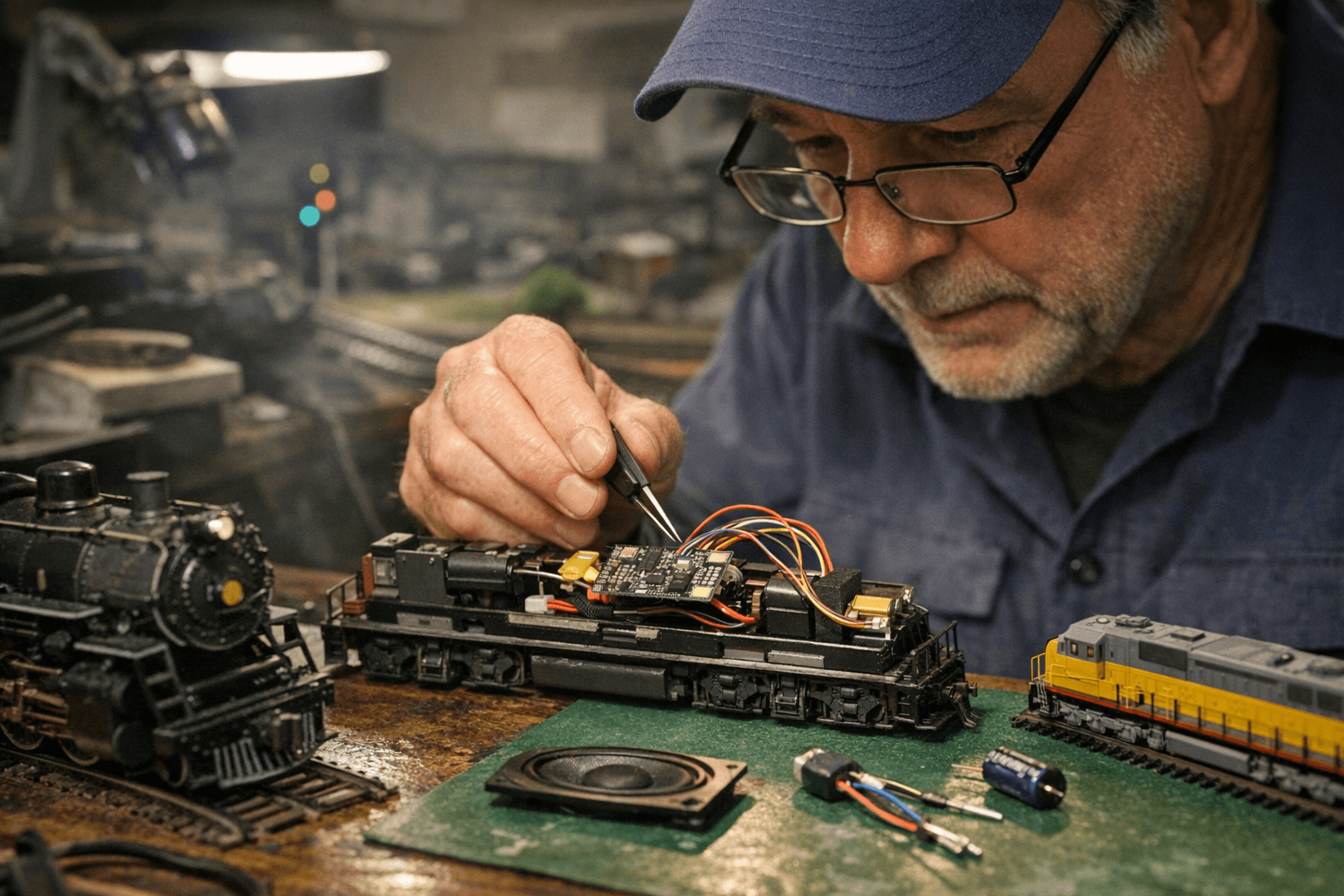
Wrong decoder, wrong locomotive. It's one of the most common (and frustrating) sources of returns at hobby shops and show tables, and it almost always traces back to one of three mismatches: motor current, lighting and keep-alive fit, or sound and speaker space. Before you hand over your card for that ESU LokSound 5 or Soundtraxx Tsunami2, run through the checklist below. A few minutes of homework eliminates hours of re-work on the workbench.
The Three Gotchas That Cause Most Returns
Gotcha #1: Motor current mismatch
Every decoder carries two current ratings: a continuous amp figure and a higher short-term stall rating. If your locomotive's stall current exceeds the decoder's continuous rating, thermal shutdowns and eventual board failure follow. For standard HO power units pulling heavy consists up a grade, target a decoder rated at 1.0 to 1.5 amps continuous; the Digitrax SDXH167D, for example, is rated at 1.0 amp continuous and 2.0 amps peak. For smaller N scale installs, a board like the Digitrax DZ126PS (measuring just 10.6mm x 8.7mm x 2.86mm) delivers 1.0 amp for track voltage up to 20 volts. The fix: test your loco's stall current on a DC power pack with a cheap inline ammeter before you buy anything. Choose a decoder rated comfortably above that reading, not barely above it.
Gotcha #2: Wrong socket or form factor
Most modern HO locomotives ship with either an 8-pin NMRA socket or a 21-pin PluX interface (PluX22 and PluX16 are the most common variants). Plugging a PluX22 board into an 8-pin socket is not possible, and trying to adapt one is the kind of project that ends badly at 11 p.m. the night before a club meet. N scale shells add another layer of complexity: many frames simply have no room for a standard plug-in board, which means a tiny 6- or 8-pin drop-in or a solder-in decoder is the only path forward. TCS (Train Control Systems) offers a drop-in K1D4-NC specifically for Kato N scale locomotives without motor clips, using surface-mount LEDs. If your installation requires soldering, be honest with yourself about your comfort level. Solder joints need to survive repeated shell removals for maintenance, and a cold joint on a motor lead will produce mysterious slow-speed stutters that take forever to diagnose.
Gotcha #3: Sound decoder without space for a speaker
Sound decoders from Soundtraxx (the Tsunami2 line) and ESU (LokSound 5) add prime mover rumble, authentic horns, bell, and brake squeal, and they do it convincingly. The Soundtraxx Tsunami2 runs up to 16 sound channels through a 2-watt, 8-ohm amplifier. The catch is that audio quality depends almost entirely on the speaker you pair with it, and the speaker has to fit. In HO, a 28mm round speaker tucked into a steam tender or diesel long hood is workable. In N scale it becomes a serious puzzle: low-profile speakers and purpose-built acoustic chambers inside tenders are the standard solution, not the exception. Before purchasing a sound decoder, confirm the speaker footprint and depth fit your shell, and pre-listen to the sound project file on the manufacturer's website to verify it matches your prototype's era and road number.
The Skimmable Decision Checklist
Before you commit to any decoder, answer these five questions:
- What socket does my locomotive have? (Pop the shell and look: 8-pin, 21-pin PluX, or bare solder pads.)
- What is the motor's stall current? (Measure it, or look it up for your specific model on a manufacturer spec sheet.)
- Do I want sound? (Yes means budgeting for a speaker, acoustic chamber, and roughly double the decoder cost.)
- Does my track have dirty-rail or power-interruption problems? (Yes means adding a stay-alive or supercapacitor module to the shopping list.)
- Which programming interface do I already own? (Ops Mode on the main, Programming Track Mode, or a PC utility: confirm your decoder supports it.)
Stay-Alive: The Overlooked Essential
Stay-alive capacitors and small battery modules are often the last thing a new DCC buyer adds and the first thing an experienced one specifies from the start. When track voltage dips below the NMRA-specified minimum of 7 volts, decoders shut down. Sound decoders are the most sensitive: a sound board that cuts out mid-horn is jarring, and repeated resets stress the decoder electronics. Soundtraxx markets its CurrentKeeper accessory specifically to address this. Any layout with rail joiners that tarnish, curves where wheel contact is inconsistent, or yards with lots of frogs is a stay-alive layout. Budget for it alongside the decoder itself, not as an afterthought.
CVs, Features, and Long-Term Flexibility
Configuration Variables (CVs) are the programming parameters that control everything from momentum and braking behavior to directional lighting logic and function button mapping. If you operate equipment from multiple manufacturers, a decoder with flexible function remapping means you can standardize button assignments across your roster rather than re-learning which button triggers the ditch lights on each different loco. Advanced lighting CVs support epoch-correct marker lights and independently controlled headlights. Load-based dynamic braking and multi-speed-step operation are worth evaluating if you run long passenger trains or coal drags where realistic deceleration matters. Check the CV list before you buy, not after.
Programming Tools and Vendor Support
A decoder with poor documentation will cost you time that the price difference never compensates for. Many well-supported decoders, including the ESU LokSound and Soundtraxx Tsunami2 lines, ship with detailed wiring diagrams, accommodate common locomotive wiring quirks like multiple pickup points, and receive free sound file and firmware updates. Confirm that the decoder vendor offers a PC utility, handheld programmer compatibility, or both. Programming on the main (Ops Mode) is convenient for fine-tuning; a dedicated programming track is essential for reading CVs back from the decoder to verify your changes took hold.
Installation: Four Non-Negotiable Habits
Even a perfectly chosen decoder can be ruined by a rushed installation.
1. Disconnect all power before soldering. Every time, no exceptions.
2. Test the motor and lighting on a DC pack first to confirm polarity before the decoder goes anywhere near the locomotive.
3. Use heat-shrink tubing and mechanical strain relief on every wire. A wire that flexes freely at the shell seam will fatigue and break.
4. Document the installation: photograph the wiring before you close the shell and label every function wire. Future-you, troubleshooting at 2 a.m., will be grateful.
Questions to Ask at the Counter or Show Table
Use this mini-script the next time you're standing in front of a dealer or talking to a vendor at a show:
- "My loco has [8-pin / 21-pin PluX / bare pads]. Which of your boards fits that socket without an adapter?"
- "The motor's stall current is around [X] amps. What's the continuous rating on this decoder?"
- "I want sound. What speaker size does this board support, and do you stock a matching enclosure for [HO tender / N scale shell]?"
- "Does this decoder have a stay-alive port, or do I need to add an external module?"
- "What programming software do you recommend, and is it free?"
A dealer who can answer all five confidently is a dealer worth building a relationship with.
Standardizing Across Your Roster
One underrated payoff of thoughtful decoder selection is long-term maintainability. If your entire HO fleet runs PluX22 sound decoders from the same family, you can swap boards between locomotives for diagnostic testing, stage upgrades locomotive by locomotive on a consistent budget, and apply CV changes fleet-wide without re-learning a new interface each time. Non-sound decoders let you start operating on DCC immediately at lower cost, with the option to upgrade individual locomotives as budget allows. The choice is not sound versus no sound: it is which locomotive earns sound first.
Getting the decoder selection right before the purchase is the single most effective way to keep your DCC transition on track. A decoder rated above stall current, sized for the socket, paired with an appropriate speaker and a stay-alive module, will run reliably for years. One that falls short on any of those counts will find its way back to the counter before the season is out.
This article was produced by Prism’s automated news system from verified source data, official records, and press releases, then run through automated quality and moderation checks before publishing. The system is built and supervised by the people who set the standards it runs under. Read our full AI policy.
Did this article answer your question?