Colas Rail Class 43 HSTs gain new life in infrastructure monitoring roles
Colas Rail's yellow Class 43s are working models of the real thing, with live clues for weathering, formations and the modern details HST builders should copy.

Colas Rail’s Class 43 HSTs are exactly the kind of prototype that rewards close looking at the workbench. They began life in 1976, but the story has not frozen there: these power cars are still being adapted for future main-line use, still earning their keep in infrastructure monitoring, and still offering modellers a very current set of clues for bodywork, formation and finish.
Why the Class 43 still matters
The biggest mistake with an HST project is treating it like a sealed-off nostalgia piece. Network Rail said 16 Class 43 power cars are being fitted with ETCS digital signalling equipment as part of the £1.4 billion East Coast Digital Programme, with completion expected by the middle of 2026. That puts the type squarely in the present tense, not the museum case, and it gives modellers a clear warning: if you are building a modern-era HST, the assumptions you make about fittings and presentation need to match an actively evolving fleet.
That matters because the Class 43 still carries enormous visual weight on British layouts. The long nosed profile, the roofline, and the familiar HST proportions are instantly recognisable, but Colas Rail’s monitoring examples show how much the same shape can change when it is put to work in a new role. A model that captures that shift will feel much more convincing than one that simply repeats a preserved-era livery and calls it done.
What Colas Rail’s monitoring HST is doing
Key Model World’s behind-the-scenes video at Colas Rail’s Rugby Maintenance Depot is useful because it frames the HST as working infrastructure kit, not a static exhibit. The Network Rail Infrastructure Monitoring trains are instantly recognisable in their yellow paint scheme, and Colas Rail’s Class 43 power cars are increasingly visible in that role. That gives modellers a strong visual brief: this is a train you want to model as active, purposeful and slightly utilitarian, not polished for display.
Network Rail describes the New Measurement Train as using sensory equipment, including a laser sensor, to measure rail-head profile. Colas Rail says its Class 43 fleet is also used for Plain Line Pattern Recognition, overhead line equipment inspection and route-learning duties, so the same basic HST shape turns up across several kinds of inspection work. For a model, that means thinking beyond the headline yellow and asking what sort of service details belong on the vehicles, from workaday grime to the overall impression of a machine that spends its life on the network rather than in storage.
The fleet size also helps with planning. Key Model World says Colas Rail operates 10 Class 43s, which tells you this is not a one-off oddity but a manageable, recurring fleet theme. If you like consistent sets on a layout, that opens the door to building a small but believable roster of monitoring power cars and support stock rather than a single isolated unit.
Formation and maintenance details worth copying
Colas Rail said in November 2025 that it won a contract to operate and maintain the New Measurement Train fleet from December 2025. That fleet comprises two Class 43 power cars and five Mark 3 coaches, and Colas said its freight division has been involved in operating the NMT since 2015. It will now carry out both heavy and light maintenance too, which underlines that this is a working seven-vehicle formation, not a token heritage lash-up.
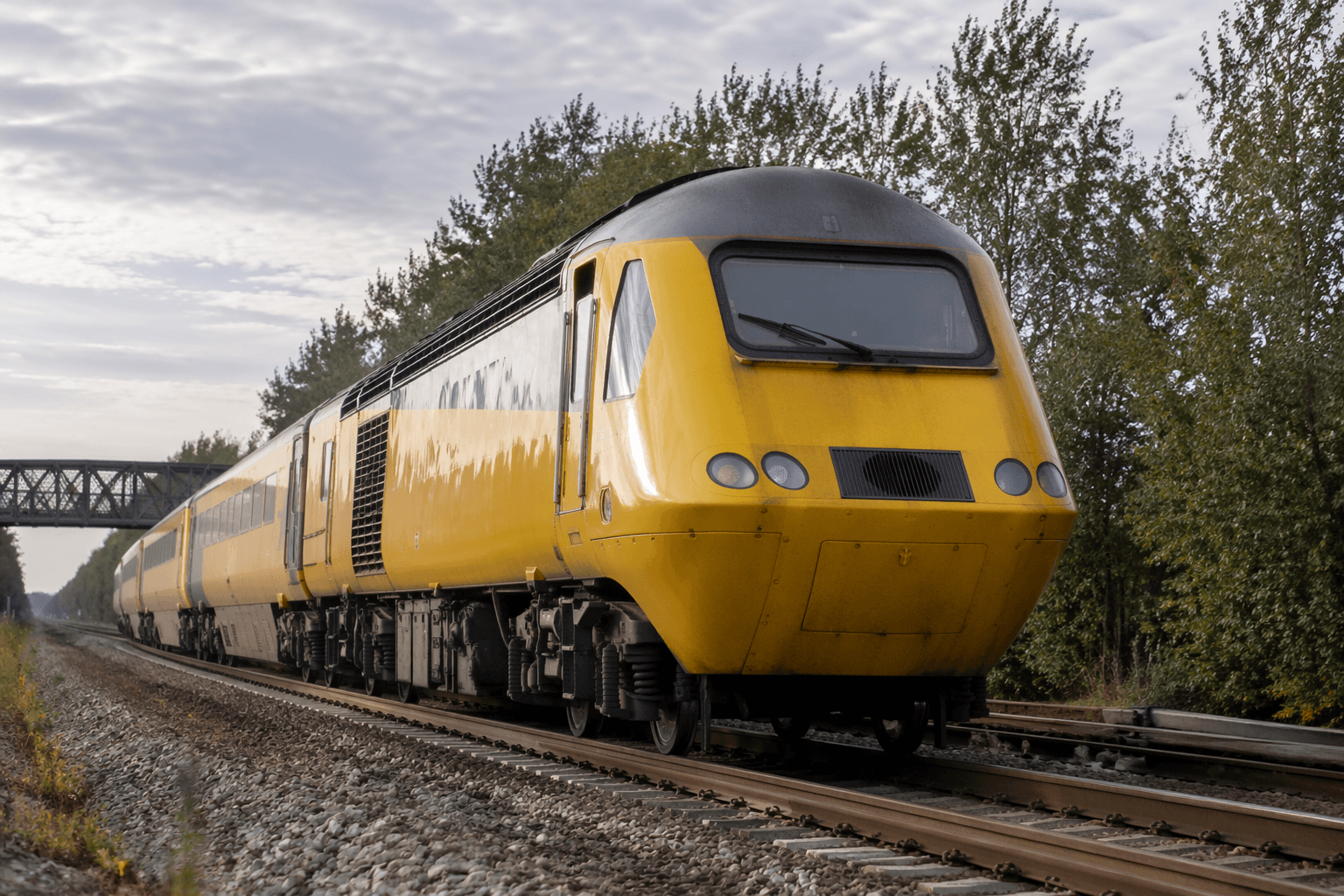
For modellers, that formation detail is one of the easiest wins to get right. If the prototype is built around two power cars and five Mark 3s, a model set that ignores the coach count or shuffles in the wrong stock immediately loses the look of the real train. The maintenance angle matters as well, because a depot-supported set should read differently from a long-distance express: cleaner in some places, operationally worn in others, and clearly maintained as equipment rather than pampered as a showpiece.
- Keep the formation honest to the prototype: two Class 43 power cars and five Mark 3 coaches.
- Treat the yellow paint as an operating scheme, not a pristine factory finish.
- Add only the sort of visible wear that fits a Rugby-based maintenance set in regular service.
- Model the train as infrastructure machinery, with the same purposeful feel as the real NMT and inspection workings.
The Safety Task Force naming gives the livery a backstory
The most model-friendly naming story in the Colas Rail fleet is 43277 Safety Task Force. Colas Rail unveiled the refurbished power car at Rugby Depot on 3 March 2023 and renamed it in honour of Network Rail’s Safety Task Force, which was established in 2019. Network Rail said the STF was created with three main aims: remove unassisted lookout working, ensure line blocks are protected and make sure work on track meets the 019 standard.
That gives the locomotive a backstory that matters far beyond the nameplate. Simon Ball at Colas Rail linked 43277 directly to infrastructure monitoring work, and Nick Millington at Network Rail tied the Safety Task Force to better planning and safer working on the railway. For a modeller, that means the loco is not just a colour variant, but a specific machine with a specific purpose, which is exactly the kind of detail that makes an HST project feel grounded.
The limited-edition Colas Rail model also gives a useful reference point for presentation. Key Model World’s production samples of the Colas Rail HST model debuted on 12 December 2025, and the finished limited edition was in stock on 6 February 2026. It paired 43277 Safety Task Force with 43257 in Colas Rail’s orange, black and yellow livery, which is a strong reminder that these locomotives can be modelled as a matched, contemporary fleet rather than as unrelated individual power cars.
What to lift straight into your own HST project
The prototype tells you where to spend your effort. The monitoring role calls for accurate yellow treatment, believable service wear and a formation that matches the real seven-vehicle NMT set, while the Rugby Depot connection points to the practical world of maintenance, not just the glamour of main-line running. The ETCS work on 16 power cars also keeps the type firmly in the modern railway, which means a current-era HST can be as valid a modelling subject as any 1970s or 1980s express.
That is the real value of Colas Rail’s Class 43s for model railway work: the train still looks like the classic HST that entered service in 1976, but every detail around it says the prototype is still changing, still working and still worth getting right.
This article was produced by Prism’s automated news system from verified source data, official records, and press releases, then run through automated quality and moderation checks before publishing. The system is built and supervised by the people who set the standards it runs under. Read our full AI policy.
Did this article answer your question?


