Hornby April 2026 preview highlights Deltic, Rocket, and Class 37s
Hornby’s April drop blends two instant-display stars with practical rake-builders, and the Class 37s plus Mk3 coaches are the smartest gap-fillers.
The headline buys: two locomotives that sell the month on sight
Hornby’s April preview is strongest where model railways are often at their most emotional: the locomotives that make you stop scrolling. The DP1 Deltic in NRM livery and Stephenson’s Rocket sit at opposite ends of British railway history, but each has a very clear buyer in mind. One is a polished collector piece with deep Hornby heritage, the other is a landmark steam name that even casual visitors recognise immediately.
DP1 Deltic: the nostalgia piece with modern engineering
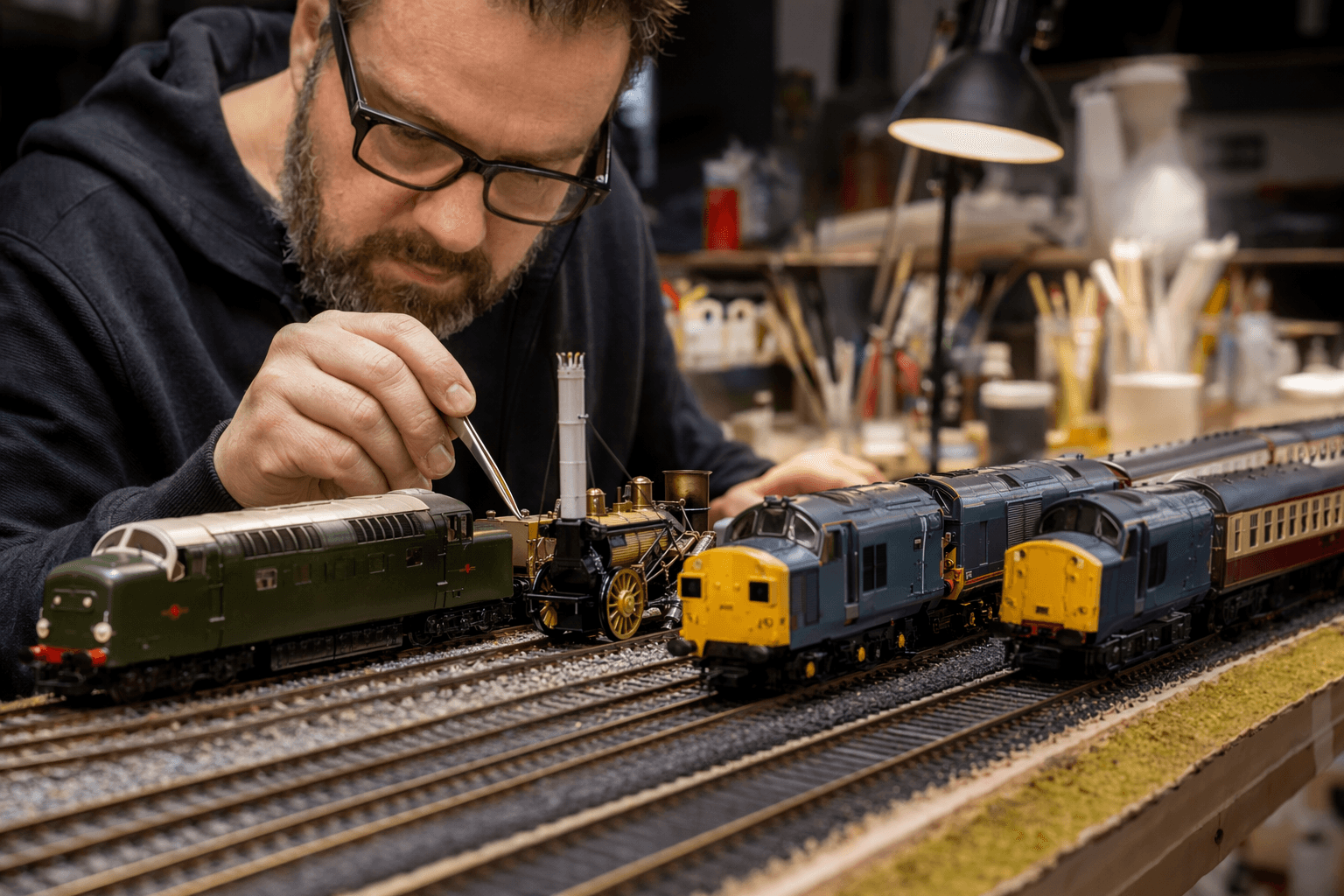
If you want the release most likely to disappear first, the DP1 Deltic is the one to watch. Hornby positions it as a modern take on one of the most famous British experimental diesels, and the appeal is doubled by the backstory: the model is based on a 3D scan of the preserved prototype at Locomotion, Shildon. That gives it a strong authenticity hook, but it also makes the model feel like a proper statement piece rather than just another repaint.
The specification is the sort of thing that makes serious buyers lean in. Hornby lists a die-cast body, 21-pin DCC socket, coreless motor, dual flywheels and dual bogie drive. In practical terms, that means it is aimed at modellers who want a heavy, refined running model with enough technical credibility to justify a place at the front of a premium era 4 fleet. The heritage angle matters too: Hornby notes that the original DP1 appeared on the cover of the second edition Hornby Dublo catalogue in 1960, which is exactly the kind of detail that turns a new release into a display conversation starter.
For layout use, this is the locomotive for the collector who still wants to run trains. It will pair naturally with other blue diesel-era stock, but it also works as a stand-alone exhibition model on a short length of scenic track. If you only buy one prestige diesel this month, this is the one that speaks most directly to Hornby history and British prototype fame.
Stephenson’s Rocket: the heritage icon with broad shelf appeal
Stephenson’s Rocket is the other obvious fast mover, but for a different reason. Hornby presents it as a solo locomotive model for the first time in this form, which immediately sets it apart from more ordinary catalogue filler. The yellow livery gives it a display-friendly presence, while the fixed metal buffers and chain couplings make it feel like the kind of object people want to pick up, study, and show off.
The story attached to Rocket is still powerful nearly two centuries on. Hornby’s product note points back to the locomotive being built in 1829 for the Rainhill Trials, where it helped define the future shape of locomotive development. That makes it an easy sell not just to committed railway modellers, but to anyone building a heritage shelf, a museum-style vignette, or a small scene with strong public recognition.
If DP1 is the “I know exactly what era I collect” model, Rocket is the “I want one perfect icon” purchase. It will likely move quickly because it crosses hobby boundaries. People who might not usually buy British outline steam still know Rocket by name, and that wider recognition is rare enough to matter.
The working-man’s locomotives: Class 37s for layouts that need trains to earn their place
The smartest operational buys in the preview are the Class 37s. Hornby’s Pegasus 37422 and Teesside Steelmaster are offered in both DCC Ready and DCC Sound fitted versions, and that dual format is a real advantage. It lets analogue buyers get in cleanly while also giving sound users an off-the-shelf option for a locomotive class that thrives on slow, purposeful movement and strong identity.
Pegasus 37422: the flexible all-rounder
Pegasus 37422 is the sort of locomotive that fills a lot of gaps without demanding a special layout. Hornby says it began life in February 1965 as D6966, became 37266 under TOPS in 1974, and was renumbered 37422 in January 1986 after reclassification to 37/4. That sequence tells you exactly why the model matters: it represents a machine that lived through several major operating eras and can sit comfortably in mixed traffic, regional, or later-period scenes.
For buyers, that means versatility. If your layout already has parcels stock, engineers’ trains, or regional passenger workings, Pegasus gives you a credible Class 37 that can slot in without forcing the rest of the fleet to shift era. It is one of those locos that makes a layout feel more complete simply by being there.
Teesside Steelmaster: the industrial name with a built-in story
Teesside Steelmaster is the stronger fit if your layout leans into freight, steel, or heavy industry. Hornby says the locomotive was originally 37005, rebuilt as 37501 in April 1985 with a re-wire and new brush unit, then named Teesside Steelmaster in 1987. That name alone carries immediate scene-setting power, and the backstory anchors it to the industrial railworld that many British layouts try to capture.
This is the release that feels like it was made to sit under gantries, beside works sidings, or in a busy yard with wagons waiting to be sorted. If Pegasus is the general-purpose operator, Teesside Steelmaster is the one that gives a layout regional character. Buyers who already own other Class 37s will probably be drawn to the specific identity here rather than the class itself, because this is not a generic diesel in a bright livery. It is a named, era-linked prototype with a distinct place in British Steel history.
The rake builders: the stock that makes the locomotives make sense
The preview is especially useful because it does not stop at halo locomotives. The supporting stock is where Hornby quietly helps people finish trains rather than just buy single showpieces.
Mk3 coaches in GWR livery: the obvious HST gap-fillers
Hornby’s RailRoad BR Mark 3 coaches in GWR liveries arrive as First Open, Buffet and TGS variants, and that combination is the practical heart of the month’s preview. Those are the types that let you build a complete HST consist instead of a half-finished idea. For anyone who already owns powered cars or earlier Mk3s, these are the coaches that make the set feel intentional.
That is also why they are likely to sell well to active operators rather than only collectors. Passenger modellers know how often a layout has the locomotive but not the right coaches to match it. A First Open, Buffet and TGS trio solves that problem neatly, especially for anyone building a GWR-set rake that needs to look coherent from end to end.
RailRoad BR FFA bogie flat wagon: small item, big operating value
The RailRoad BR FFA bogie flat wagon, supplied with two 30-foot containers, is the other quietly useful release. It does not have the headline glamour of DP1 or Rocket, but it is exactly the kind of thing that makes modern layouts feel busy and believable. Intermodal traffic and domestic container workings need this kind of wagon to create believable freights, not just long strings of anonymous stock.
For operators, it is the easy add-on purchase of the month. It fits freight scenes, yard shunting, and through traffic with little fuss, and it pairs naturally with existing container flats or Class 37 workings. If the locomotives are the lure, this is the stock that turns a layout from a collection of trains into a proper railway.
Why this drop works for real layouts, not just wish lists
Taken together, Hornby’s April line-up looks less like a random assortment and more like a carefully balanced buyer’s guide. The prestige end is covered by DP1 and Rocket, both of which will attract fast attention from collectors and display-focused buyers. The operational end is stronger still, because the Class 37s, Mk3 coaches and FFA flat wagon all fill obvious gaps that real layouts need every day.
That balance is part of the wider story. Hornby’s 2026 announcements include multiple Mk3 and Mk4 coach variants across several liveries, which suggests this month’s preview is part of a broader rolling-stock refresh rather than a one-off burst. For modelers, that is the useful signal: the line-up is built to help you finish trains, strengthen eras, and add a locomotive with enough personality to change the feel of a whole shelf.
This article was produced by Prism’s automated news system from verified source data, official records, and press releases, then run through automated quality and moderation checks before publishing. The system is built and supervised by the people who set the standards it runs under. Read our full AI policy.
Did this article answer your question?