ATLAS probes Higgs-top interactions for clues to matter-antimatter asymmetry
ATLAS has sharpened its Higgs-top measurement with 164 fb¹ of Run 3 data, turning rare ttH and tH events into a new test for CP violation.
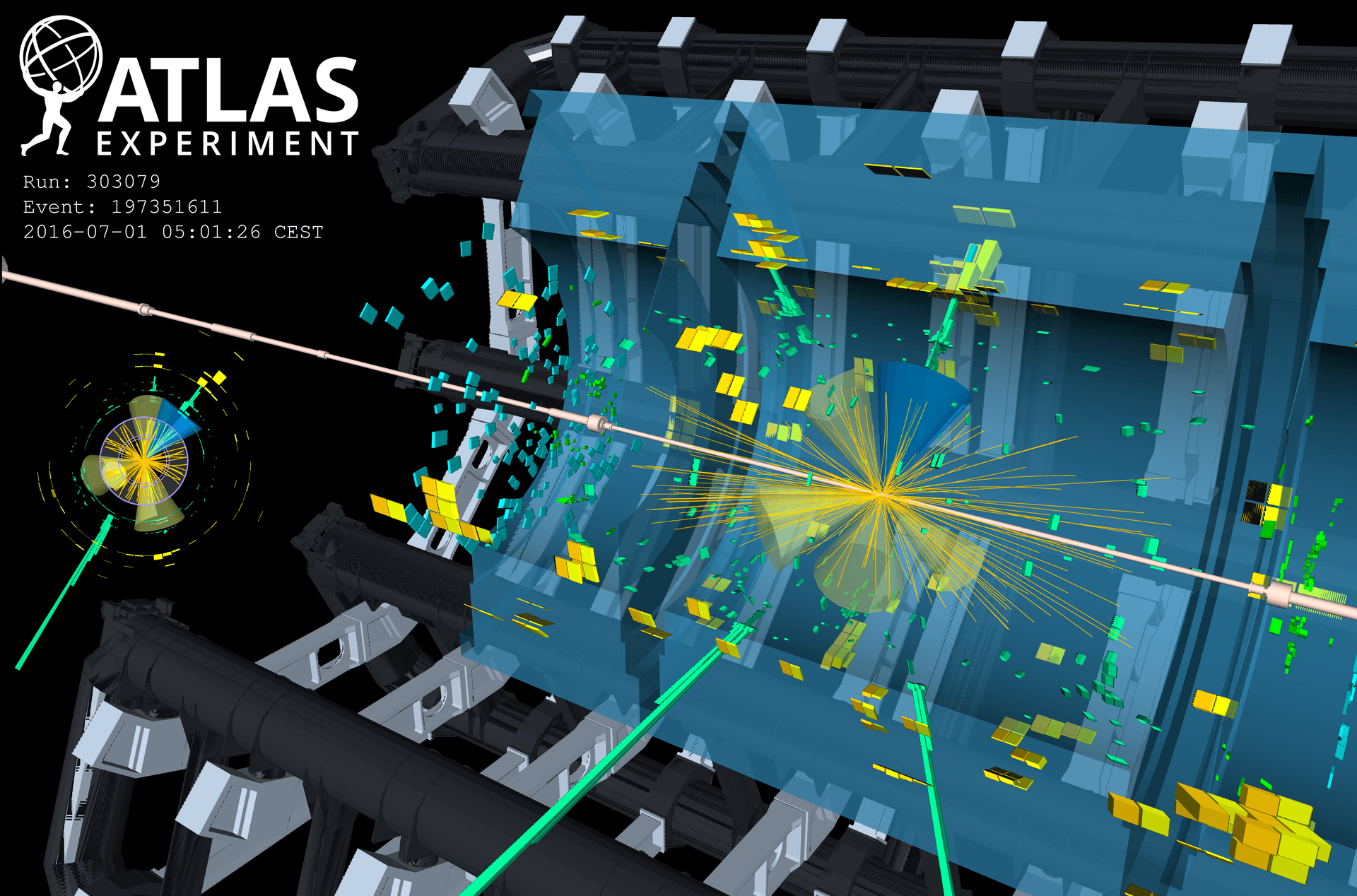
ATLAS used 164 fb¹ of 13.6 TeV proton-proton collisions to study Higgs production with a top-quark pair and with a single top quark, splitting the sample into 32 analysis categories to squeeze out every bit of sensitivity. The collaboration is turning the heaviest known particles into a precision test for one of physics’ biggest open questions: why matter won out over antimatter.
A rare channel with real leverage
The measurement focuses on ttH and tH, two of the most technically demanding Higgs production modes at the Large Hadron Collider. ATLAS reconstructs the Higgs boson in the diphoton channel, H, where it appears as a narrow peak near 125 GeV, then hunts for the event patterns that accompany a top-quark pair or a lone top quark. That is a difficult separation because the tH signature looks so much like other collision processes that it is easy to lose in the crowd.
This is exactly the channel where the Higgs and top quark pull hardest against one another. The top quark has the strongest Yukawa coupling to the Higgs boson of any known elementary particle, so even a small deviation from Standard Model expectations can point to new symmetry-breaking effects. ATLAS is using that leverage to look for new sources of CP violation, the kind of asymmetry that could help explain why the universe is matter-dominated.
What changed in the detector view
ATLAS does not present this as a discovery claim. The advance is operational and analytical: the collaboration has pushed its reconstruction, categorization, and signal extraction far enough to map these rare processes with much more precision than before. The 32-category breakdown lets the analysis separate similar-looking final states with sensitivity coming less from raw event counts than from classification.
ATLAS is no longer only asking whether ttH exists, a question answered years ago. It is now using the same production modes, plus the harder tH channel, as a precision probe for CP structure in the Higgs-top interaction.
Why the top quark is the right place to look
The Standard Model contains CP violation, but the known amount is far too small to explain the matter-antimatter imbalance of the universe. If the Higgs-top interaction carries hidden CP mixing, the effect should show up as subtle distortions in rates, shapes, and relative contributions across the ttH and tH samples.
By comparing how the Higgs behaves when it is produced with a top-quark pair versus a single top quark, the collaboration can probe the structure of the coupling itself, not just the existence of the interaction.
Run 3 now, Run 2 behind it
The new analysis draws on data collected between 2022 and 2024, and it lands on top of a longer ATLAS program that already moved this field from observation into precision measurement. ATLAS first observed Higgs bosons produced with a top-quark pair in 2018; ttH accounts for only about 1% of all Higgs boson production at the LHC.
A Run 2 ttH measurement in the Higgs-to-bottom-quarks channel had a signal strength of 0.81 ± 0.21 and an observed significance of 4.6 standard deviations. The new Run 3 diphoton result extends that effort into a cleaner CP-sensitive interpretation across multiple production and decay paths.
At a CERN Indico discussion on July 2, 2026, ATLAS combined the new result with the earlier Run 2 analysis to constrain the top Yukawa coupling and its CP mixing angle. The combined result rejects the CP-odd scenario with a significance of over 5 sigma, the clearest direct constraint yet on the CP structure of the top-Higgs Yukawa interaction.
The road to the high-luminosity era
The High-Luminosity LHC phase is expected to begin in 2030, and ATLAS expects it to deliver roughly an order of magnitude more data than previous runs. That future dataset will only be useful if the experiment can already separate subtle Higgs-top signatures with high efficiency.
ATLAS is preparing for that jump with major upgrades: a completely new inner tracker, a high-granularity silicon timing detector, and improved trigger and data-acquisition systems. Those additions are aimed at the same bottlenecks exposed by this analysis, where the challenge is not simply seeing an event but classifying it correctly fast enough to preserve the rarest physics.
This article was produced by Prism’s automated news system from verified source data, official records, and press releases, then run through automated quality and moderation checks before publishing. The system is built and supervised by the people who set the standards it runs under. Read our full AI policy.
Did this article answer your question?