Constellation Seeks 80-Year License for Nine Mile Point Unit 1 Reactor
Constellation filed to run its 1969-vintage Nine Mile Point Unit 1 through 2049, the same day the NRC approved Diablo Canyon's first renewal, exposing where the agency's 80-year playbook is ready and where it isn't.

Constellation Energy filed a subsequent license renewal application for Nine Mile Point Unit 1 in Scriba, Oswego County, seeking to run a reactor that first produced electricity in December 1969 through 2049, a full eight decades of operation. The Nuclear Regulatory Commission posted the application for public review on April 2.
The 630-megawatt boiling water reactor holds New York's oldest operating license, currently set to expire in 2029, and ranks among the oldest continuously operating commercial reactors in the country. This filing would be Unit 1's second renewal: the first extended operations from an initial 40 years to 60; this application asks for another 20, from 60 to 80 years.
That distinction carries real technical weight. A second renewal is governed by the Generic Aging Lessons Learned for Subsequent License Renewal report, the GALL-SLR, guidance the NRC issued in 2017 specifically because aging between 60 and 80 years raises issues the original GALL framework was never designed to address. Among the concerns unique to this period: reactor pressure vessel neutron embrittlement, irradiation-assisted stress corrosion cracking, and materials degradation in components that have accumulated decades of hard service well beyond their initial design assumptions. Expanded inspection programs, including one-time examinations triggered after 50 or more years of operation, are part of what subsequent license renewal applicants must now plan and justify.
The NRC posted Nine Mile Point's application on the same day it approved Pacific Gas and Electric's license renewal for Diablo Canyon in California, the agency's 99th and 100th commercial reactor renewals. The contrast is instructive. Diablo Canyon's approval was a first renewal, extending a plant that came online in 1985 toward a 60-year operating life under the standard GALL framework. Nine Mile Point's filing pushes further, asking the NRC to certify that a reactor commissioned in 1969 can safely operate into the late 2040s using a regulatory playbook that has been applied to only a fraction of the country's operating fleet. Where Diablo Canyon represents the NRC's settled process, Nine Mile Point tests whether that process scales.
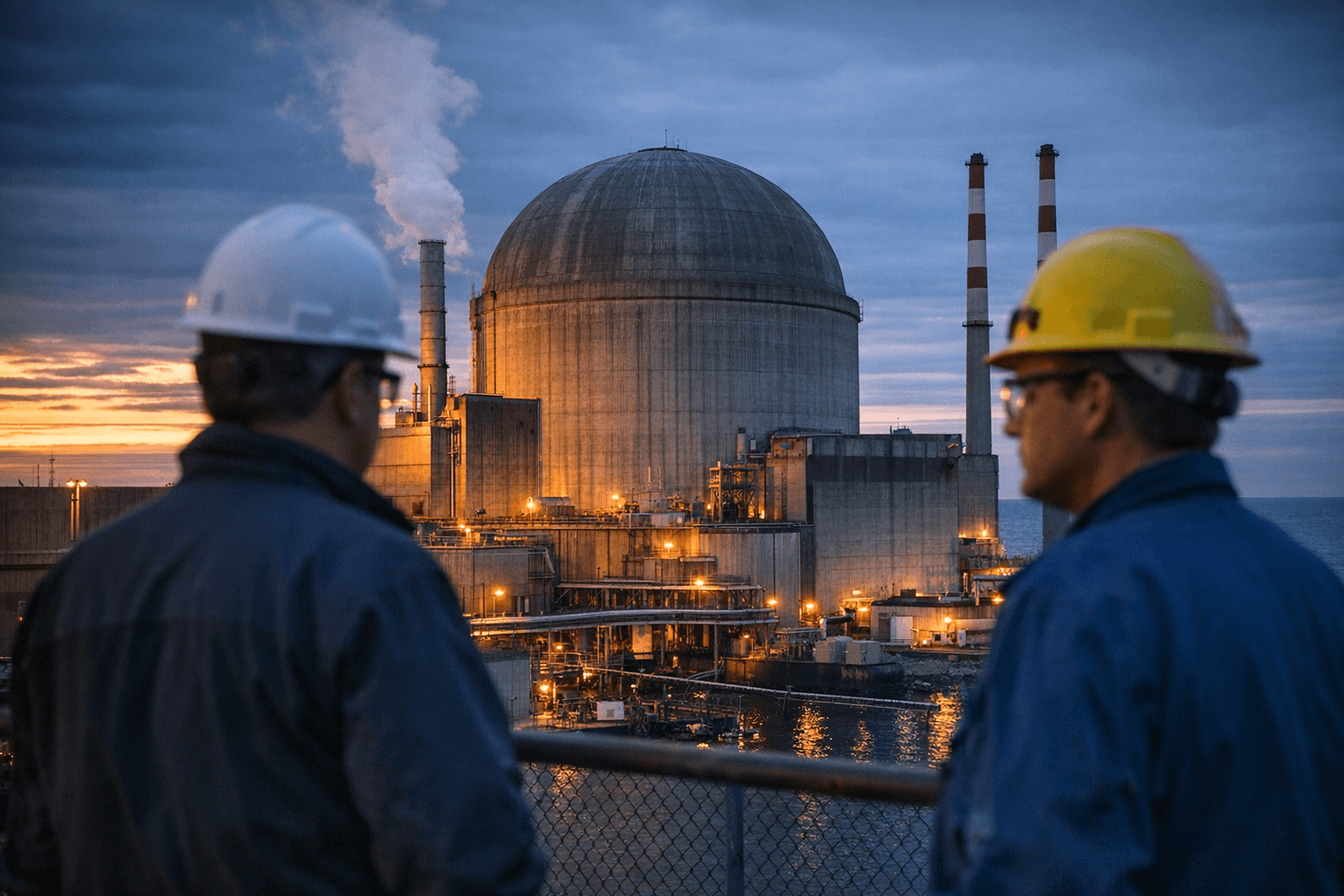
For New York's grid, the stakes are direct. Unit 1 is one of four nuclear reactors in the state that together supply roughly one-fifth of New York's electricity. Replacing 630 megawatts of carbon-free baseload capacity from a facility already fully staffed by roughly 800 workers would require either new construction, at costs and lead times that have proven formidable, or a permanent reduction in firm, zero-carbon generation. The other three New York reactors are expected to pursue renewals as their own licenses near expiration, making Nine Mile Point's application a practical template for what follows.
Under the NRC's timely renewal provision, Unit 1 continues operating while the review proceeds. The agency will first assess the application for completeness before deciding whether to formally docket it; if accepted, safety and environmental reviews follow, with public participation including access to application documents at the Oswego public library. Full review cycles for subsequent license renewals have historically extended over multiple years.
NRC acceptance of this application would signal that the agency is prepared to treat 80-year reactor operation as a standardizable outcome rather than a case-by-case negotiation. Nine Mile Point Unit 1, New York's oldest reactor and one of the oldest in the nation, is now the clearest test of whether that standard is ready.
This article was produced by Prism’s automated news system from verified source data, official records, and press releases, then run through automated quality and moderation checks before publishing. The system is built and supervised by the people who set the standards it runs under. Read our full AI policy.
Did this article answer your question?