Experts Question Whether the Doomsday Clock Still Serves Nuclear Risk Communication
At 85 seconds to midnight, the Doomsday Clock has never been closer to apocalypse - but analysts argue the fear it generates may do more harm than good.
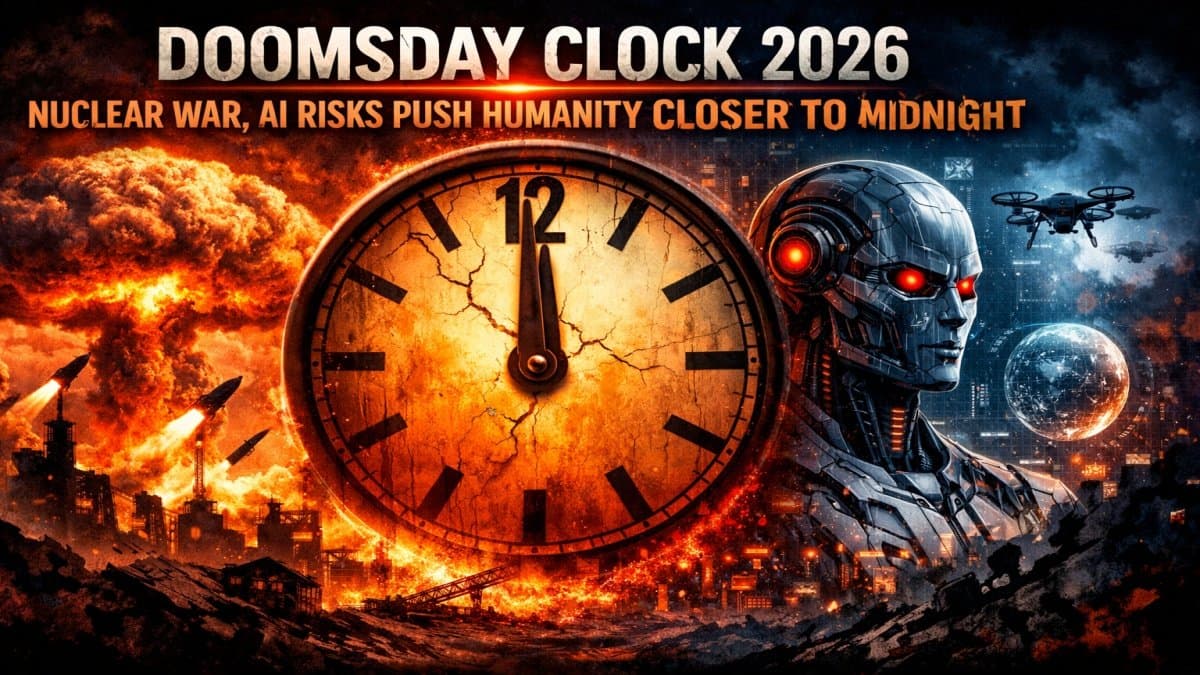
The Doomsday Clock sits at 85 seconds before midnight, the closest it has ever been to the symbolic hour of annihilation since the Bulletin of Atomic Scientists first unveiled it in 1947. That number carries real weight in the nuclear risk community. But a sharp analytical piece published via The Conversation raises a question that cuts deeper than the clock's current setting: does the instrument actually work?
The argument isn't that nuclear risk is overstated. It's that the specific narrative machinery surrounding the Doomsday Clock - permanent, escalating, apocalyptic framing - may now be doing as much damage as the threats it's supposed to illuminate.
From Nuclear Countdown to Everything Clock
Created by the Bulletin of Atomic Scientists, the Doomsday Clock "first represented a slow descent into nuclear vulnerability, with midnight standing as the nuclear apocalypse." That original focus gave the device its moral clarity: one existential threat, one symbolic countdown, one unambiguous warning to world leaders.
That clarity has eroded considerably. The clock now incorporates global warming, disruptive technologies, and the erosion of the rules-based international order alongside nuclear risk. The intention behind that expansion is understandable; existential threats don't arrive in neat categories. But critics argue the shift transforms a precision instrument into something far blunter. When a single clock face is meant to reflect nuclear arsenals, climate trajectories, emerging technologies, and collapsing geopolitical norms simultaneously, the signal becomes harder to interpret and harder to act on.
The geopolitical context around the current 85-second reading makes all of this more urgent, not less. As the analytical piece notes pointedly: "And that was before all-out war broke out in Iran."
The Central Challenge: Does It Actually Prompt Action?
The most probing question the analysis poses is also the most fundamental. "The first question we should ask of the Doomsday Clock is whether it fulfils its stated purpose: prompting transformative action to confront what are widely recognized as existential risks."
Since its very beginning, the clock's purpose was "a call to action meant to shake world leaders - and the broader public by extension - awake from their complacency and indifference." On that mission the Clock has generated enormous media attention and public awareness across nearly eight decades. Whether that attention translates into the transformative policy responses the Bulletin envisions is a different question entirely.
The analysis argues it may not, and that the framing itself is part of the problem. "It's been argued that putting humanity on a permanent, blanket high alert isn't helpful when it comes to formulating policy or driving science." The logic here is well established in risk communication research: sustained maximum-alarm messaging can produce habituation rather than mobilization. When every year brings a fresh announcement that humanity is closer to midnight than before, the announcement itself risks becoming background noise.
The piece goes further, arguing that the architecture of apocalyptic risk communication carries a systemic danger: "We contend that this is the point where the narrative of imminent catastrophe becomes counter-productive: constant apocalyptic scenarios may dull perceptions of risk or be exploited to justify politics driven by urgency and fear."
The Existing Critiques
The Doomsday Clock has accumulated critics for decades, and the analysis acknowledges them directly. "Some have questioned its precision and called it showmanship. Others have described it as shaped by ideology." These aren't fringe objections; they reflect genuine methodological concerns about how a panel of scientists and policy experts translates an extraordinarily complex geopolitical landscape into a single number, measured in seconds.
The ideological critique is particularly pointed. A clock that began as a response to the specific post-Hiroshima moment in U.S. and Soviet relations has evolved into a device that renders judgments across climate science, international law, and emerging technology. Each of those domains has its own expert communities, its own contested data, and its own political valences. Compressing all of it into one symbolic reading invites exactly the accusations of showmanship and motivated framing that critics have leveled.
Mobilizing Fear: The Cold War Template and Its Costs
The analysis grounds its contemporary critique in a specific and well-documented historical case. During the Cold War, the U.S. "strategically stoked a sense of urgency within its population against the potential threat of nuclear war with the Soviet Union." That urgency had tangible, measurable consequences for American society that went well beyond policy debate.
Education became inseparable from propaganda. Schoolchildren learned from Bert the Turtle to "duck and cover," practicing classroom drills against nuclear attacks. Worried citizens built bunkers in their homes as billions of dollars were pumped into the military industrial complex. Anyone who questioned the necessity of these measures risked being labeled unpatriotic or communist, with McCarthyism and the Red Scare providing the political infrastructure for exactly that kind of suppression.
The irony the analysis highlights is stark: "In the end, the sense of a looming apocalypse sacrificed the social and national security of Americans for a threat that never materialized. Ironically, in being fearful of being bombed, Americans exposed their own population to dangerous radioactive fallouts and material via nuclear tests and arsenal production." The fear of nuclear attack drove a domestic nuclear program whose fallout and contamination caused genuine, documented public health harm. The narrative of imminent catastrophe didn't prevent damage; in a very real sense, it produced it.
That pattern is what the analysis describes when it argues that "the narratives of nuclear war and impending apocalypse that underpin the Doomsday Clock have historically been used to project authority and justify dangerous politics of secrecy - legacies that have often come at the expense of public health and well-being."
What This Means for Nuclear Risk Communication
None of this analysis suggests that nuclear risks, or the other threats the Clock now tracks, are not real and serious. The 85-second reading and the outbreak of war in Iran together make that case compellingly on their own terms. The critique is specifically about whether the Doomsday Clock's particular mode of communication serves the goal of informed, effective public and policy response, or whether it has become a mechanism that generates fear more reliably than it generates action.
That is a question the nuclear risk community needs to engage with seriously. The Clock's longevity, nearly eight decades of continuous operation and global media coverage, is itself evidence of extraordinary communicative staying power. But staying power and effectiveness are not the same thing. A device that has watched the world move steadily toward midnight without producing the transformative political action its creators envisioned raises legitimate questions about whether the metaphor has done its work, or whether a new framework for communicating existential risk is overdue.
The gap between where the clock now stands and where international nuclear policy actually sits is not a measurement problem. It is a communication problem, and the Doomsday Clock may no longer be the right tool to close it.
Know something we missed? Have a correction or additional information?
Submit a Tip