Caracas macaws delight residents, while palm removal threatens nesting sites
Caracas’ blue-and-gold macaws still visit Karem Guevara with chicks, but palm removals could strip away the cavities they need to breed.
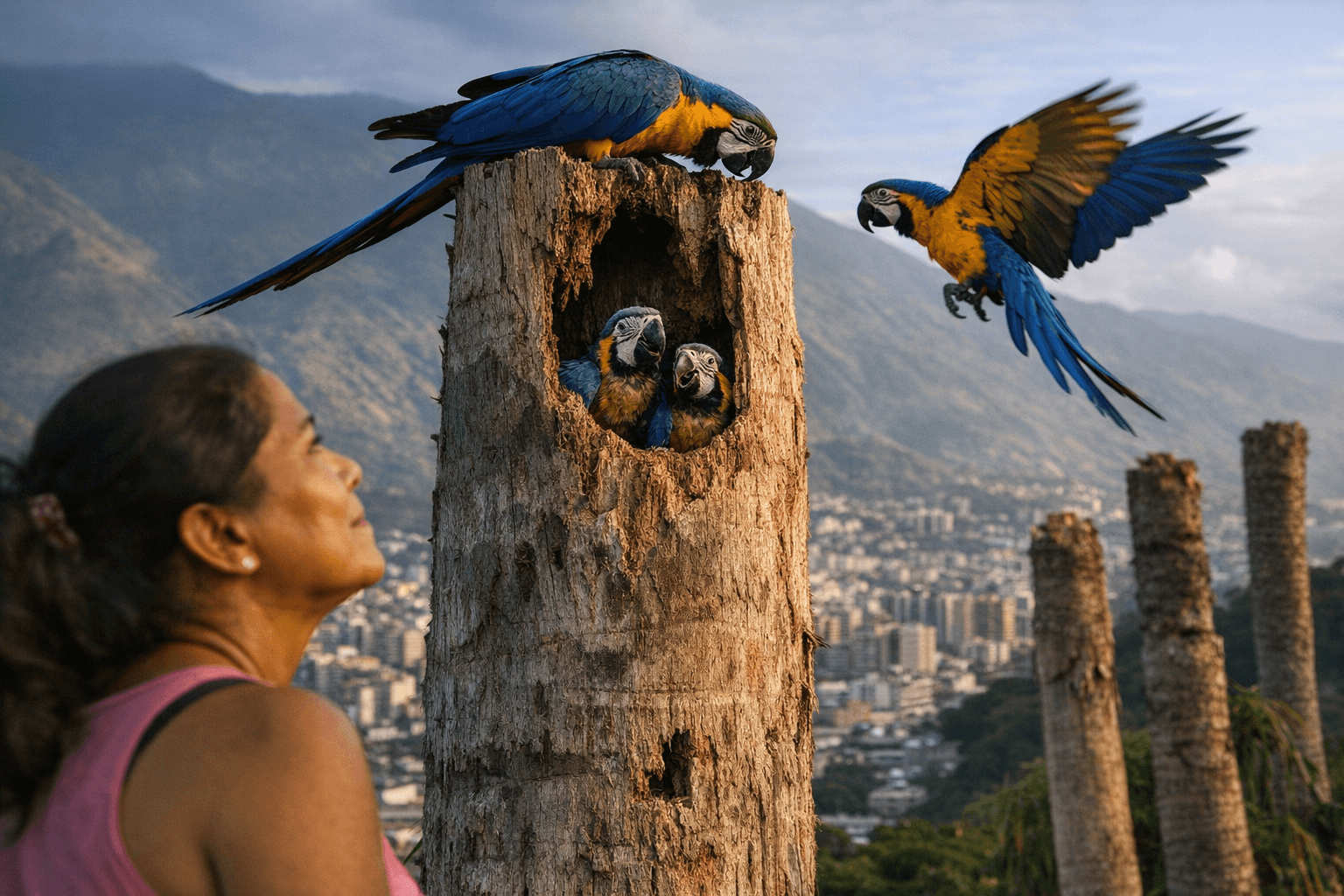
The bright blue-and-gold macaws that sweep into Karem Guevara’s apartment in Caracas have become more than a neighborhood attraction. They have become a daily reminder that the city’s wildlife depends on a few specific trees, and that when those trees go, so does the next generation.
Almost every evening, Guevara feeds the birds sunflower seeds and sliced bananas. Sometimes the macaws arrive with their chicks, a detail that turns a casual urban sighting into something much more personal. For Guevara, the flock feels like family, and for many residents, the blue-and-yellow macaws, Ara ararauna, have become part of Caracas itself.
That connection now runs into a hard reality. City authorities have been removing old royal palm trees, known locally as chaguaramos, because decaying trunks can fall and create public-safety hazards. Biologist Maria Lourdes Gonzalez warned that the same cleanup can also wipe out nesting sites the macaws need to breed. These parrots do not build open twig nests. Like many parrots and macaws, they rely on tree cavities, including hollows in large trees and sometimes palm trunks, for breeding.
That makes the palms more than decoration in the urban landscape. For the macaws, they are nursery sites. If the cavities disappear, nesting opportunities disappear with them, and the city’s familiar flocks can thin out even if the birds are still flying overhead each day. The story is especially striking because the species is not globally endangered. BirdLife International lists the blue-and-yellow macaw as Least Concern, with an extremely large range and a decreasing population trend. Its native range spans Venezuela, Brazil, Bolivia, Colombia and Paraguay.
That mix of security and vulnerability is what makes Caracas so revealing. The species is widespread across South America, yet a local colony can still be squeezed by decisions made street by street, tree by tree. Gonzalez noted that the birds are not native to Caracas, which complicates the conservation argument, but the city’s emotional bond with them is real. Once a colony becomes part of daily life, habitat loss stops being an abstract wildlife issue and becomes something neighbors can see from their windows.
The broader lesson for parrot lovers is blunt. Urban birds can look adaptable, and some are. Audubon has noted that exotic parrot colonies in 43 states have been seen nesting on palm trees and telephone poles. But adaptability has limits. Whether in Caracas or another city, the trees that hold food, shelter and nesting cavities can vanish faster than the birds can replace them. When that happens, a beloved flock can go from familiar to fading before most people realize the habitat is already gone.
This article was produced by Prism’s automated news system from verified source data, official records, and press releases, then run through automated quality and moderation checks before publishing. The system is built and supervised by the people who set the standards it runs under. Read our full AI policy.
Did this article answer your question?