Carolina Parakeet, North America's Only Native Parrot, Vanished Due to Human Pressures
Incas, the last Carolina parakeet, died in a Cincinnati Zoo enclosure in 1918. His species' collapse in just decades carries urgent lessons for every parrot owner alive today.
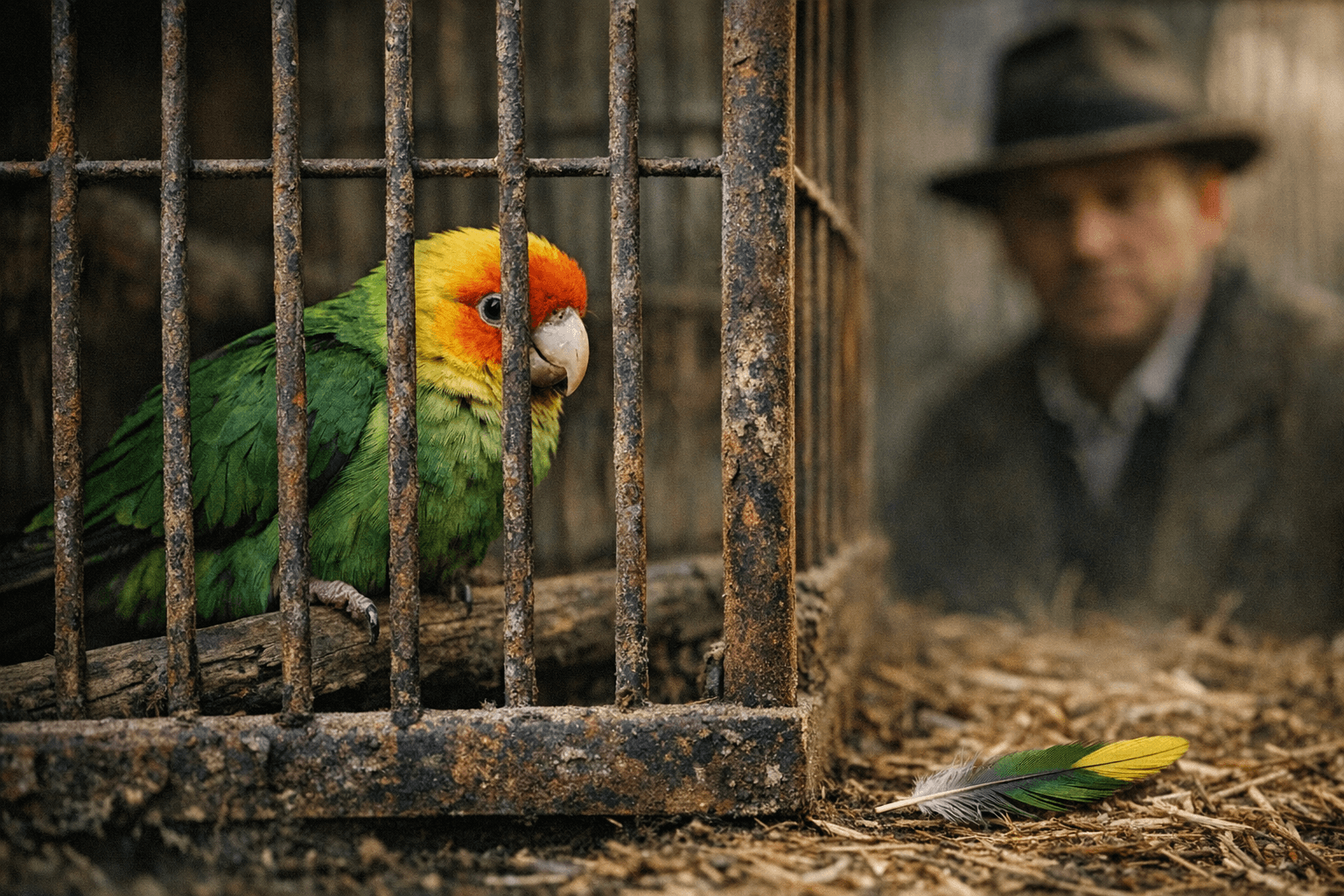
Incas spent his final years in an aviary at the Cincinnati Zoo, sharing an enclosure with Martha, the last passenger pigeon. When he died on February 21, 1918, the Carolina parakeet was gone: the only parrot species native to the continental United States, reduced from raucous flocks numbering in the hundreds to a single aging male in a cage. His mate, Lady Jane, had died the year before. The zoo had purchased Incas and fifteen other birds back in 1885 for just $40, hoping to pull the species back from the edge. It was already too late.
North America's Own Parrot
The Carolina parakeet (Conuropsis carolinensis) is a bird most parrot owners have never heard of, which is itself part of the problem. When most people picture a parrot, they picture a rainforest or a pet shop, not the forests along the Ohio River or the wetlands of Florida. Yet this bright-green bird with its vivid yellow head and reddish-orange face was once found across an enormous stretch of the United States. Its range ran from southern New England and Wisconsin south through Florida and Texas, and westward all the way to Colorado and Denver. Flocks of 100 to 1,000 birds moved through upland forests, wooded floodplains, and forest edges. The Seminole people called it puzzi la née, meaning "head of yellow." Sir Walter Raleigh mentioned it in the Carolinas as early as 1596. John James Audubon painted it.
It was, in short, a genuinely American parrot. And it disappeared within a human lifetime.
How a Common Parrot Vanished Fast
The standard explanation for the Carolina parakeet's extinction focuses on deforestation and the millinery trade, and both were real forces. As European settlers pushed westward through the 18th and 19th centuries, vast bottomland forests were cleared for agriculture, stripping away the old tree cavities the parakeets depended on for nesting. Meanwhile, the bird's brilliant plumage made it a direct target for the fashion industry: its green body feathers and yellow head were used to decorate ladies' hats, and hunters supplied a market that treated wild birds as raw material for accessories.
Farmers added another layer of pressure. As their native food sources thinned out, Carolina parakeets developed a taste for cultivated fruit and grain, and farmers responded by shooting them in large numbers. What made this especially lethal was the species' own social instinct: when one bird fell, the rest of the flock would wheel back and gather loudly around the downed bird. Hunters could eliminate hundreds in a single session. The same trait that made Carolina parakeets extraordinarily bonded to each other made them extraordinarily easy to kill. The pet trade played a role as well. The birds were easily kept in captivity and bred without much difficulty, but their capture drained already-shrinking wild populations, and the owners of captive birds made no organized effort to grow those numbers back.
The Fact Most People Get Wrong
Here is the part of the story that surprises most people, including those who know the broad outlines: by the 1890s, the surviving flocks in Florida were not obviously in crisis. Ornithologists noted vigorous groups with plenty of juveniles and reproducing pairs as late as 1896. There was no slow, visible fade. By 1904, the wild birds had essentially vanished, and genomic research later confirmed what that rapid collapse implies. The Carolina parakeet's genome showed no evidence of a prolonged demographic decline, no long runs of homozygosity associated with inbreeding, none of the genetic hallmarks of a species that had been struggling for generations. The extinction was abrupt, and the science points squarely at humans as the cause.
The most plausible explanation for that sudden final collapse is disease, likely transmitted from domestic poultry as the birds' range contracted and contact with human settlements intensified. A species that had survived centuries of hunting and habitat loss was apparently wiped out in its last redoubt by a pathogen it had no resistance to. Ornithologist Noel F. Snyder identified poultry disease as the most likely final cause, consistent with how rapidly those last Florida populations vanished.
This is the lesson most people miss: the Carolina parakeet probably did not die slowly, from axes and hat pins alone. It died fast, likely from a disease that tore through a small, socially bonded population with nowhere left to retreat. That is a very different kind of warning.
What This Means for Parrot Owners Today
The Carolina parakeet's extinction is not a relic framed behind glass. Each of its drivers maps directly onto pressures that wild parrot populations face right now, and each one connects to choices companion-bird owners make.
- Support habitat protection. Deforestation was the Carolina parakeet's first and most sustained killer. Wild parrots across Central and South America, Africa, and Australasia are losing nesting habitat at rates that would have been recognizable to an Ohio farmer in 1850. Supporting conservation organizations that protect and restore parrot forest habitat is the most direct action available to anyone in the parrot-care community.
- Refuse wild-caught demand. The pet trade removed birds from already-stressed wild populations in the 19th century, and illegal wild-caught birds still enter the market today despite CITES protections and national legislation. Buying only from reputable, captive-bred sources matters, and asking breeders direct questions about their practices matters just as much.
- Take biosecurity seriously. The Carolina parakeet's probable final cause, disease transmission in a stressed, shrinking population, is a warning about what happens when a socially bonded species meets a novel pathogen it cannot outrun. Annual veterinary check-ups, strict quarantine when introducing new birds, and active awareness of disease risks in the broader avian community are not optional extras. Diseases move fast through flocking species. The Carolina parakeet is the starkest possible proof of that.
- Breed with purpose. The Cincinnati Zoo's 1885 purchase of sixteen birds produced no lasting recovery because captive keeping was never organized into a real program. Responsible breeding through parrot societies, aviculture organizations, and species-specific recovery efforts exists precisely because well-meaning but ad hoc captive keeping does not substitute for structured conservation. Supporting those programs is part of what it means to take parrot ownership seriously.
A Species That Shouldn't Have Been Forgotten
The Carolina parakeet was not obscure. It was loud, colorful, and abundant across half a continent. The fact that it was gone before most people noticed it was going is precisely the lesson it still carries. Common does not mean safe. Abundant does not mean permanent. A species can be thriving in 1896 and extinct by 1918 if populations are small enough, habitat is fragmented enough, and a single novel pressure arrives at the wrong moment.
Incas died in a cage in Ohio more than a century ago. The pressures that put him there are still operating on wild parrots today, and the parrot-care community is one of the few audiences positioned to both understand that and act on it.
This article was produced by Prism’s automated news system from verified source data, official records, and press releases, then run through automated quality and moderation checks before publishing. The system is built and supervised by the people who set the standards it runs under. Read our full AI policy.
Did this article answer your question?