Essential Parrotlet Care Guide: Housing, Diet, Enrichment, and Health Tips
Pocket-sized but built for decades, parrotlets demand more than a pretty cage — here's what responsible ownership of these 25-gram New World parrots actually looks like.
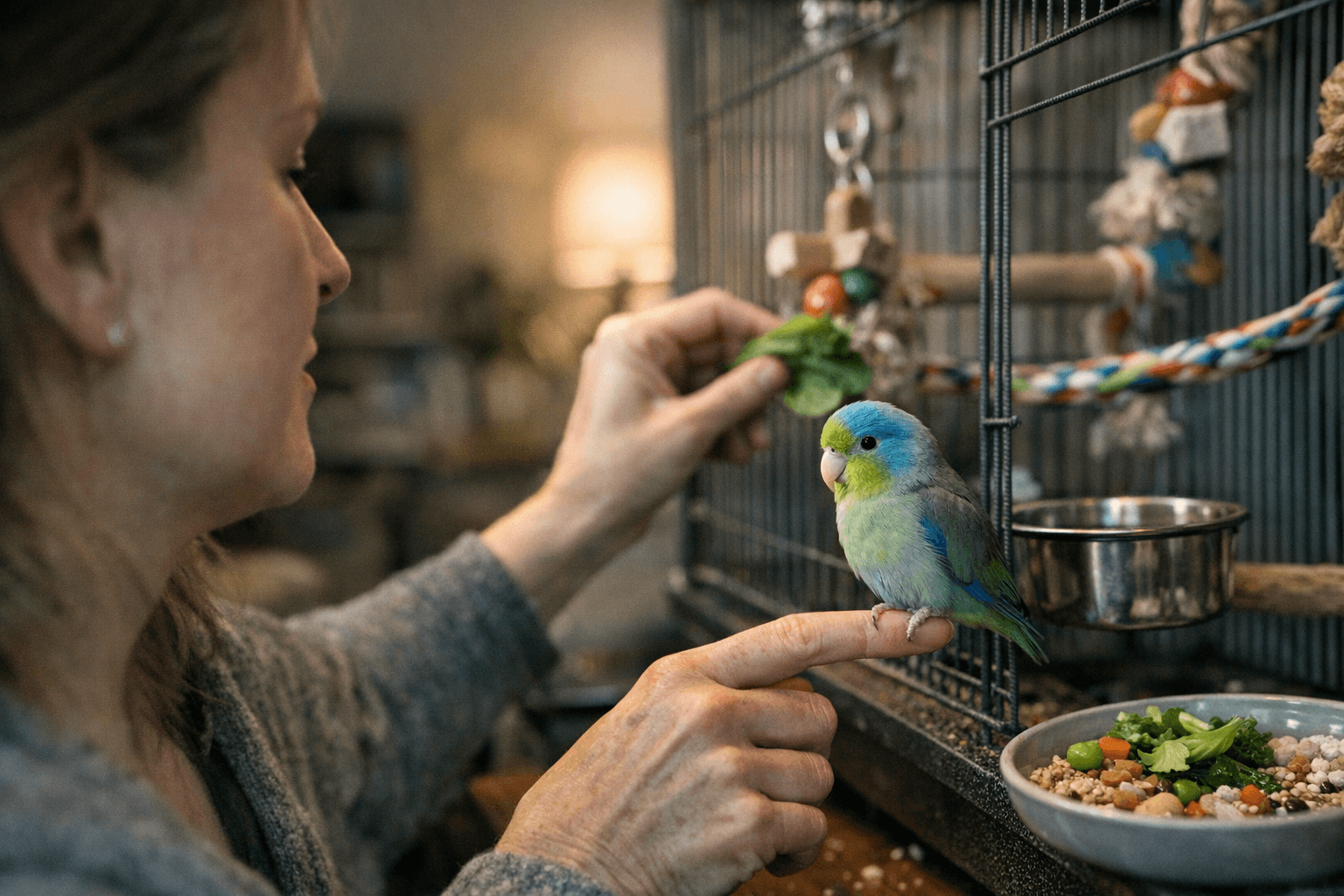
They fit in the palm of your hand, but commit to one and you're signing up for potentially 20 years of companionship. Parrotlets, genus Forpus, are the smallest New World parrots, measuring just 3.5 to 5 inches and tipping the scale at roughly 25 grams. Native to Central and South America, these birds are nicknamed "pocket parrots" for obvious reasons, and the species most commonly kept as pets include the Pacific and the Green Rump. Don't let the compact size fool you: these birds have the personality, intelligence, and longevity of a much larger parrot, and their care reflects that.
Who parrotlets are
Pronounced exactly as it reads, "parrot"-"let," parrotlets belong to genus Forpus and represent one of the most popular small-parrot choices among bird keepers today. A lifespan of 15 to 20 years means bringing one home is a long-term relationship, not a casual experiment. Their wild counterparts spend the better part of every day flying and foraging, chewing open fruit and nuts with powerful little beaks, which tells you something important about what they need from you once they're living in your home.
Setting up the right housing
"Parrotlets need a clean, warm, mentally stimulating environment" — that's the foundational standard, and every cage decision flows from it. The minimum recommended cage size is 18 inches by 18 inches by 18 inches, built from powder-coated or stainless steel that is completely free of rust and chips. Bar spacing matters enormously with such a small bird: nothing wider than 3/8 to 1/2 of an inch. A head or foot caught in wider bars can mean a serious injury, so this is a specification worth double-checking before you buy.
Cage placement and the broader household environment count just as much as the cage itself. A smoke-free household is strongly recommended for both the bird and the owner, since avian respiratory systems are highly sensitive. At night, covering the cage can help: the cover blocks out extraneous light and creates a more secure sleeping space, which supports the bird's natural rest cycle. The fabric you choose for that cover matters, though. Avoid anything your bird might catch its claws or beak in, or that it could pull strings from and swallow. A tightly woven, snag-free material is the right call.
Water hygiene: more demanding than you'd expect
One of the most underestimated aspects of parrotlet care is water bowl maintenance, and the reason is behavioral. Parrotlets will often bathe in their water dish or dunk food into it, which means a bowl that looked clean an hour ago may be a bacterial soup by mid-afternoon. Water must be checked and changed several times a day, not once. At every change, wipe the bowl clean with a paper towel to prevent the slimy film that bacteria form on the inside of the bowl. Once a day at minimum, wash the bowl thoroughly with a mild dishwashing detergent and water. That's not optional fastidiousness; it's basic disease prevention.
Enrichment: solving the foraging problem
Here's the central challenge of keeping a parrotlet: in the wild, these birds spend most of their day from morning until night flying and foraging. They use their beaks constantly to chew open fruit and nuts. Bring them home, and their food is sitting right in front of them with no effort required. As the source material notes, "For the domestic parrot, their food is right at their beaks and this provides limited physical and mental enrichment."
Toys are the primary solution, and variety is the operative word. At least three different types of toys should be available to your bird at any given time. Rotating toys in and out of the cage keeps the environment fresh and prevents boredom. Think about what a parrotlet's beak is built to do — chew, tear, explore, manipulate — and select toys that engage those instincts. Foraging toys that require the bird to work for a treat, shreddable materials, and items with different textures and shapes all serve different enrichment functions. A single bell hanging in the corner of the cage does not constitute an enrichment program.
Diet: what the research flags
The source material covers wild diet context clearly — fruit, nuts, foraging — but the specific domestic diet recommendations in the available research are limited. What's confirmed is that parrotlets interact heavily with their water bowl around food, dunking items as part of normal behavior. A board-certified avian veterinarian is the right resource for building out a complete feeding plan tailored to your bird, covering the balance between formulated pellets, fresh produce, and appropriate treats. Don't rely on a single information source for nutrition specifics; the guidance available here is explicitly described as "a basic overview and not a substitute for veterinary care."
Health monitoring and veterinary care
The care information compiled here was "written by an expert in the pet care industry and approved by a board-certified avian veterinarian," which gives the housing and hygiene recommendations solid standing. That said, the explicit disclaimer is worth repeating: this is a starting framework, not a clinical protocol. Parrotlets are prey animals with a strong instinct to hide illness, which means by the time symptoms are visible, a problem may already be advanced. Establishing a relationship with a qualified avian vet before you need one in an emergency is the kind of preparation that can make a genuine difference.
For locating a qualified avian veterinarian, the Association of Avian Veterinarians maintains a directory at AAV.org, which is the recommended starting point for new and prospective parrotlet owners.
The long view
A 25-gram bird that may share your life for two decades deserves housing that's correctly sized, an environment free of smoke and hazards, water that's changed multiple times a day, and enough enrichment to engage a brain shaped by millions of years of active foraging. The pocket parrot may be small, but the commitment is full-sized.
This article was produced by Prism’s automated news system from verified source data, official records, and press releases, then run through automated quality and moderation checks before publishing. The system is built and supervised by the people who set the standards it runs under. Read our full AI policy.
Did this article answer your question?