Girl Runs With Disabled Macaw Scooter, Giving Her the Joy of Flight
Scooter can't fly, but 12-year-old Kambre fixed that: she runs outdoors holding the disabled blue-and-yellow macaw while Scooter flaps joyfully, and the video hit millions of views in days.
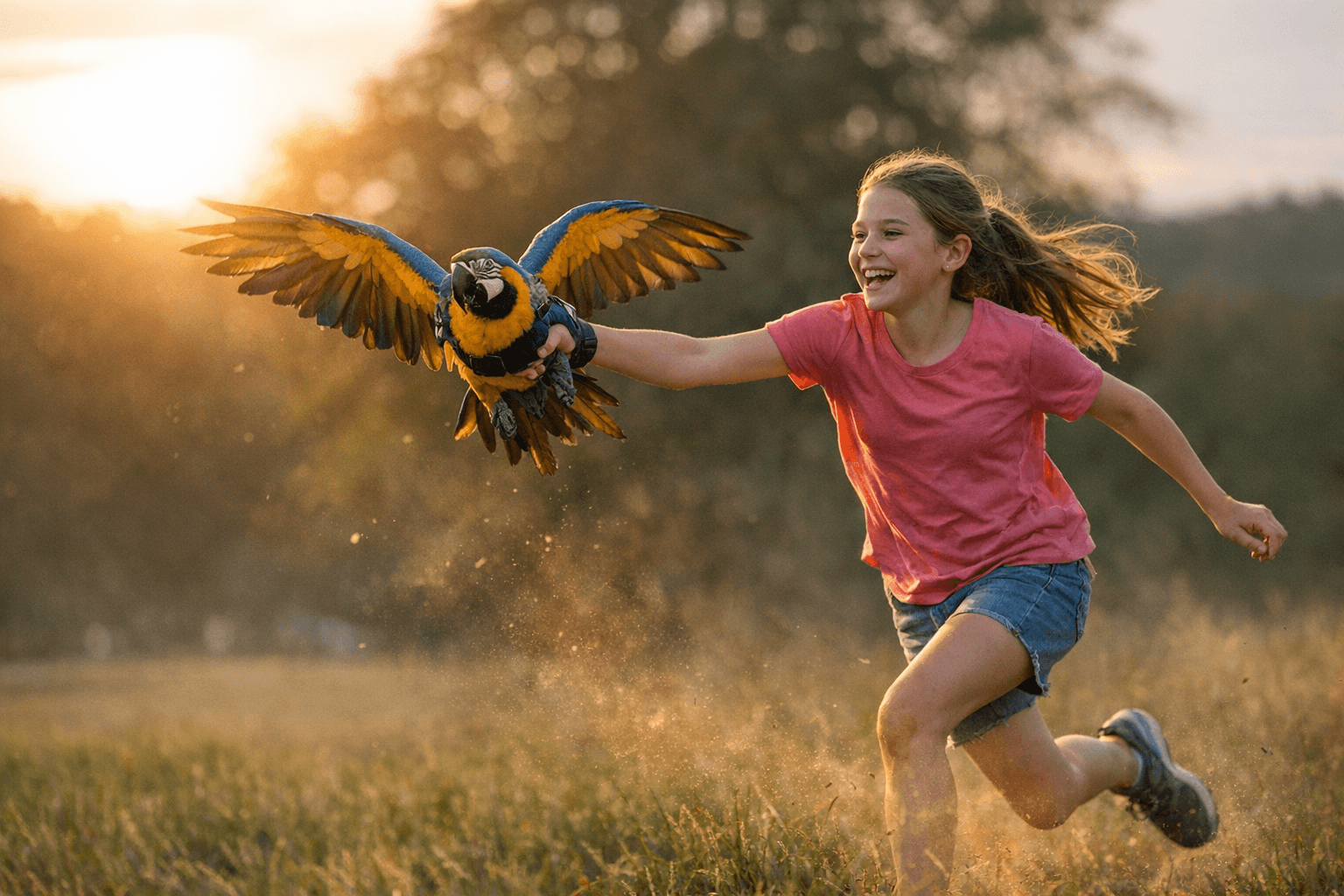
Scooter, a blue and yellow macaw who cannot fly, gets to feel the rush of wind beneath her wings anyway, thanks to 12-year-old Kambre: the girl runs through an open outdoor area holding the bird while Scooter stretches her wings wide and flaps with unmistakable enthusiasm. The short clip, posted to TikTok by Kambre's mother Alex, 33, under the handle @gaspers1115, pulled in millions of views within days of going live in late March 2026, drawing the kind of emotional response that rarely accompanies bird content.
Alex explained that the running routine is carefully supervised, with the family having spent time learning to read Scooter's comfort signals before taking the exercise outside. The bond at the center of it all is not ambiguous. Alex noted that Scooter's preference for Kambre is clear, with the macaw actively choosing her daughter's company above all others in the household.
Thousands of comments flooded in alongside the views. Many were expressions of pure admiration; others raised pointed questions about safety and welfare, a knowledge gap that parrot caretakers and rescue groups were quick to address in replies. Some viewers reached for a cultural reference point they knew well, comparing Kambre and Scooter to Linda and Blu, the human-bird duo at the heart of the animated film Rio.
The wider welfare context gives the video its real weight. Macaws in the wild live in small, social flocks and require consistent interaction in captivity to stay psychologically healthy. Without it, birds can develop serious behavioral problems: excessive vocalizations, aggression, and feather-plucking are among the most common signs of understimulation. For Scooter, whose disability prevents true flight, Kambre's daily runs serve as both physical exercise and emotional enrichment, simulating a species-typical behavior the bird would otherwise be permanently denied.
Rescue groups and experienced owners who responded to the viral clip were consistent on one point: consult an avian vet before attempting similar routines with a non-flying bird. Enrichment for grounded parrots does not have to involve running. Supervised exercise, target training, and physical therapy designed by vets or qualified rehabilitators are all viable paths, and the right approach depends entirely on the individual bird's condition and limits.
What the video makes plain, beyond the obvious warmth between a girl and her macaw, is that creative, attentive caregiving can give a disabled parrot genuine quality of life. Scooter cannot fly. But every time Kambre runs, she does.
This article was produced by Prism’s automated news system from verified source data, official records, and press releases, then run through automated quality and moderation checks before publishing. The system is built and supervised by the people who set the standards it runs under. Read our full AI policy.
Did this article answer your question?